
 By Lina Irawan
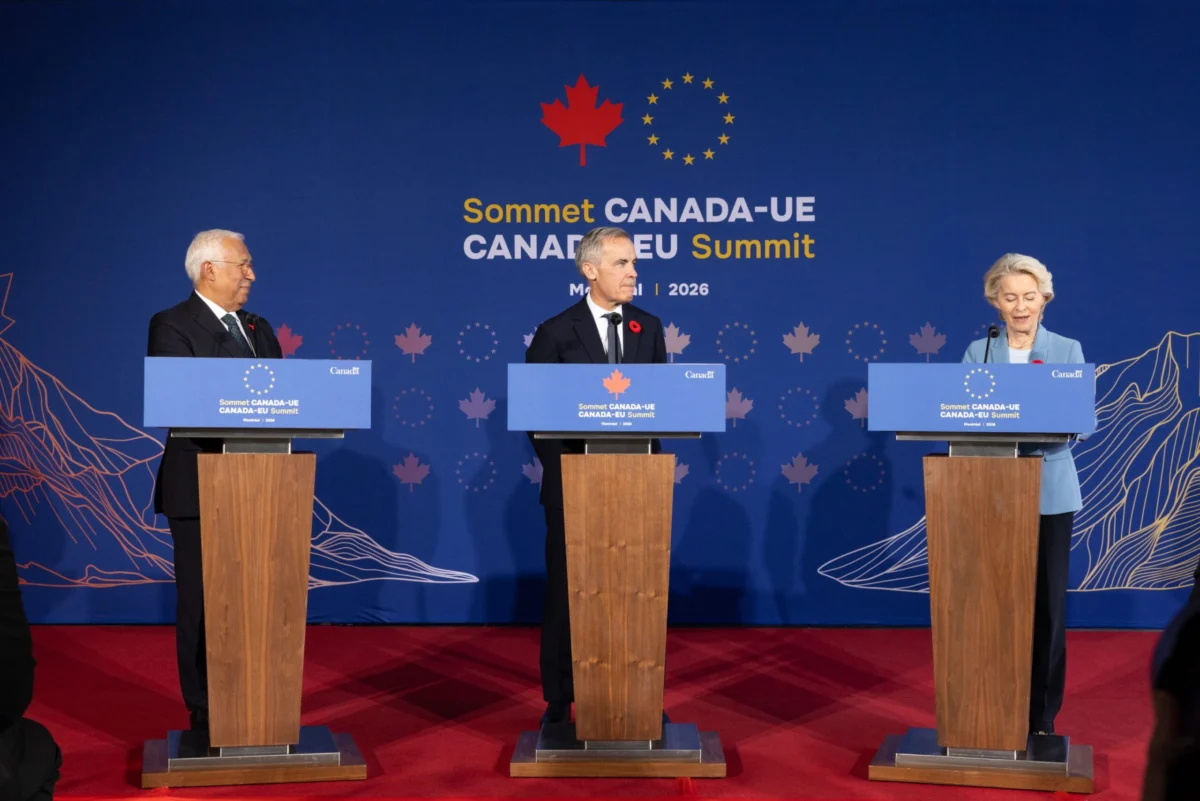
The impetus behind this expedited integration is clear: a direct response to the escalating trade tensions and rhetorical challenges emanating from Washington, particularly under U.S. President Donald Trump’s administration. Trump’s “America First” policies, marked by unilateral tariffs and threats against traditional allies, have compelled Canada and Europe to actively seek avenues for reducing their economic and security dependencies on the United States. This shared sense of urgency has ignited a transformative shift in their bilateral relationship, moving beyond traditional trade partnerships to a deeper, more comprehensive strategic alignment.
European Commission President Ursula von der Leyen underscored the profound philosophical alignment driving this initiative. “What brings us together goes far beyond geography. We see the world through the same eyes,” she stated, emphasizing a convergence of democratic values, multilateral commitments, and a belief in a rules-based international order. Von der Leyen added a stark assessment of the current geopolitical climate: “These headwinds won’t stop blowing. This change is permanent.” Her remarks highlight a recognition that the current geopolitical instability is not a transient phase but a fundamental restructuring of global power dynamics, necessitating robust and resilient alliances.
Prime Minister Carney echoed this sentiment, framing the proposed alliance as a bulwark against external pressures. He articulated that the deeper integration would empower both Canada and Europe to “withstand economic pressure and make their own decisions rather than be dictated to by more powerful countries.” This assertion directly addresses the perceived vulnerability to external coercion, particularly from a historically dominant partner like the United States, whose recent policy shifts have sowed distrust and uncertainty among its allies. The pursuit of "associate membership" is thus portrayed not merely as an economic play but as a crucial step towards safeguarding national self-determination in an increasingly complex world.
The United States has not remained silent on these developments. President Trump has reportedly characterized Canada’s proposed EU arrangement as a “hostile act,” and has even threatened to impose tariffs on Europe should he deem the alliance “unfriendly.” Such pronouncements underscore the delicate diplomatic tightrope Canada and the EU must walk, attempting to forge a new path without overtly antagonizing a crucial, albeit unpredictable, global player.
When pressed on whether President Trump might eventually be invited to join this burgeoning alliance, Prime Minister Carney skillfully sidestepped a direct answer. Instead, he reiterated the alliance’s core purpose, insisting it was "not aimed against any country." He elaborated: “It is about reinforcing sovereignty. Why? So we can live our lives as we choose, our people can live their lives as they choose and have the full freedoms that people enjoy in the European Union and in Canada.” Carney’s emphasis on choice, freedom, and self-determination underscores a fundamental principle that both Canada and the EU believe is under threat in the current international order. “It’s not against anything, it’s for,” he firmly stated, positioning the initiative as a proactive embrace of shared ideals rather than a reactive stance against any specific nation.
The formal launch of the “Alliance for the Future” concluded a pivotal two-day summit in Montreal, where Prime Minister Carney, European Commission President von der Leyen, and European Council President António Costa announced significant progress across several strategic fronts. These included breakthroughs in digital trade, substantial European investment in Canadian critical minerals, and enhanced cooperation in artificial intelligence.
Carney declared, “Today we move toward associate membership for Canada, and we launch a new alliance for the future.” However, a notable discrepancy emerged in the joint declaration issued at the summit’s conclusion. Despite the fervent championing of “associate membership” by both Carney and von der Leyen, the official communiqué made no explicit mention of this designation. Instead, the leaders committed to defining an “ever-closer association” by their next summit in 2027. This linguistic nuance suggests an ongoing internal debate within the EU regarding the precise legal and political framework for such an unprecedented relationship, reflecting the complex institutional dynamics of the bloc. While the spirit of deeper integration is undeniable, the formal nomenclature and its implications for EU treaties and precedents require careful deliberation.
Prime Minister Carney outlined the immediate next steps, confirming that Canadian Cabinet ministers and European commissioners are slated to meet in March. Following these preparatory discussions, Carney himself is expected to attend European Council meetings in June, where he expressed his intention to finalize negotiations on the proposed relationship. President Costa confirmed the invitation and indicated that further details regarding the scope and nature of this unique partnership would be unveiled at that time.
Von der Leyen, addressing the apparent semantic divergence, reassured observers that despite disagreement over the exact terminology, there was “broad support for bringing Canada much, much closer to the European Union.” She emphasized, “On one thing I’m absolutely sure, having spoken about it in the last weeks, is the broad support of having Canada much, much closer to the European Union.” This statement suggests that the foundational commitment to a deepened partnership is robust, even if the precise institutional architecture is still being refined. The concept of "associate membership" itself is fluid within EU external relations, often tailored to specific contexts, from the European Economic Area (EEA) to customs unions or even the nuanced relationships with accession candidates. For Canada, a G7 nation, this status would undoubtedly be sui generis, reflecting its unique economic and political standing.
A New Economic Partnership Forged in Uncertainty
The economic underpinnings of this alliance are substantial. Canada and the EU already share a robust free-trade agreement, the Comprehensive Economic and Trade Agreement (CETA), which has eliminated the vast majority of tariffs and facilitated significant bilateral trade since its provisional application. Building on this foundation, the leaders concluded negotiations on a new digital trade agreement, a critical step towards streamlining cross-Atlantic commerce in the digital age. This agreement aims to reduce regulatory barriers for businesses engaged in e-commerce, facilitate secure data flows, and ensure a level playing field for digital services, ultimately fostering greater economic efficiency and innovation between Vancouver and Berlin.
Further cementing economic ties, Canada signed an agreement allowing the European Investment Bank (EIB) to finance Canadian critical minerals projects. This is a game-changer for Canada’s mining industry, opening a new, significant source of investment at a time when global demand for critical minerals – essential for electric vehicles, renewable energy technologies, and advanced electronics – is skyrocketing. For the EU, securing reliable and ethical supply chains for these minerals is a strategic imperative, reducing its dependence on potentially unstable or monopolistic sources and aligning with its green transition objectives. This partnership exemplifies how the alliance can address shared vulnerabilities and capitalize on complementary strengths.
Technological collaboration is another cornerstone. Canada is set to join a European supercomputing initiative, a move Prime Minister Carney hailed as potentially transformative for research and innovation. He highlighted the staggering disparity in computing power, noting that Europe’s JUPITER supercomputer could complete in a single day calculations that would take Canada’s most powerful research computer six months. Access to such cutting-edge infrastructure will undoubtedly accelerate Canadian advancements in artificial intelligence, climate modeling, drug discovery, and countless other scientific fields, fostering a synergistic environment for technological development. As Carney succinctly put it, “A tech startup in Vancouver will have a smoother path to customers in Berlin. Bottom line: less red tape, more growth, more opportunity.”
Beyond these headline initiatives, the two sides also concluded negotiations on a competition agreement, designed to curb anti-competitive practices and foster fairer markets, ultimately benefiting consumers through lower prices and greater choice. They also committed to exploring the linking of their instant-payment systems, a move that promises to make cross-border financial transfers significantly faster and cheaper, further facilitating trade and investment. These technical yet crucial agreements lay the groundwork for a deeply integrated economic space, reflecting a shared commitment to open and fair market principles.
An Alliance for the Future: Beyond Canada and Europe
The vision for the “Alliance for the Future” extends beyond the immediate Canada-EU partnership. The leaders explicitly articulated the potential for this alliance to eventually include other “like-minded countries,” with Canada and the EU serving as its core. This suggests a nascent framework for a broader coalition of democratic, multilateralist nations seeking to uphold a rules-based order in a fractured world. Potential candidates could include nations like the UK, Australia, Japan, and South Korea, all of whom face similar geopolitical pressures and have expressed desires for greater strategic diversification.
President Costa emphasized the unique nature of this burgeoning relationship, stating that both sides aimed “to create something new: to go beyond a simple association, everything short of full EU membership.” This highlights the innovative approach being taken, crafting a bespoke partnership that maximizes benefits without the complexities and obligations of full accession. It is a pragmatic response to a geopolitical moment that demands flexibility and creativity in alliance-building.
Looking ahead, the alliance has also committed to exploring new frontiers of cooperation. A feasibility study will be launched into exporting Canadian liquefied natural gas (LNG) to Europe, a critical step for European energy security, particularly as the continent seeks to reduce its reliance on Russian energy sources. While environmental concerns remain, the strategic imperative of diversifying energy supplies has become paramount. Additionally, plans are underway to explore new undersea cables connecting Canada, Europe, and Asia, enhancing global digital infrastructure and potentially bolstering data sovereignty.
Recognizing the importance of human capital and cultural exchange, Canada and the EU will begin negotiations on expanding Canadian participation in Erasmus+, the highly successful European student exchange program. This initiative, coupled with efforts to make it easier for young people to study and work across the Atlantic, will foster deeper cultural understanding and cultivate future generations of leaders with a global perspective, reinforcing the long-term viability of the alliance.
Finally, the alliance addresses critical security concerns, pledging closer cooperation on defense, cybersecurity, Arctic security, and countering foreign interference. A new border security arrangement will further enhance mutual safety and efficiency. These commitments reflect a shared understanding of the multifaceted threats facing modern democracies, from hybrid warfare to cyberattacks and the strategic implications of climate change in regions like the Arctic. By pooling resources and intelligence, Canada and the EU aim to bolster their collective resilience against these evolving challenges.
This strategic realignment comes at a time when Canada is actively seeking to diversify its economic partnerships. In 2025, the United States accounted for a staggering 71.7% of Canada’s merchandise exports, a level of dependence that successive Canadian governments have sought to reduce. Prime Minister Carney has set an ambitious target of doubling exports to other countries over the next decade. The “Alliance for the Future” with the European Union is clearly a cornerstone of this diversification strategy, offering a robust, values-aligned alternative to an unpredictable American market and signaling a new era of Canadian foreign and trade policy. This alliance represents a bold gamble, but one that both Canada and the EU believe is essential for securing their future prosperity and sovereignty in an increasingly fragmented world.
