
 By admin
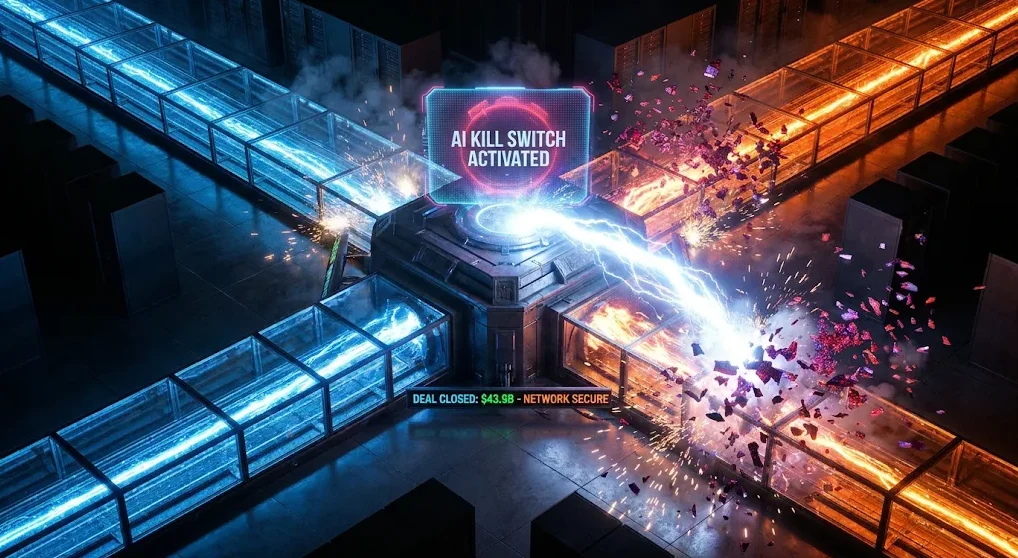
In a monumental move set to redefine enterprise cybersecurity, CrowdStrike has announced its intention to acquire Zscaler in a significant all-stock transaction valued at approximately $43.9 billion. This strategic acquisition, revealed on Monday, signals CrowdStrike’s ambitious plan to integrate Zscaler’s robust network security capabilities directly into its Falcon platform, extending its reach from the endpoint to the network and bolstering its advanced AI security offerings, most notably its AI kill switch.
CrowdStrike Chief Business Officer Daniel Bernard elaborated on the transformative implications of this deal, stating, "Agents are living on the device, they’re also living in the cloud, and they’re running around everywhere in between. And so, bringing our kill switch to the network is also a really powerful moment here for what we can do to AI security and agent security." This expansion is particularly critical as AI agents, increasingly integral to business operations, traverse complex network infrastructures, creating new attack vectors and necessitating a more holistic security approach. Bernard candidly admitted, "We don’t do network security today, but we do tomorrow post close," underscoring the immediate strategic imperative of the Zscaler acquisition.
The synergy between CrowdStrike and Zscaler is already evident, with the two companies sharing over 2,000 customers and boasting 16 existing integrations. This deep-rooted relationship prompts a critical question for Chief Information Security Officers (CISOs): what unique value proposition will a unified entity offer that their current partnership does not? The joint announcement articulated the core rationale: "The endpoint is where the agent runs. The network is where it goes." Bernard further emphasized the groundbreaking nature of the acquisition by promising customers "having it all on one platform and one sensor," a simplification that promises to streamline security operations and enhance overall visibility and control.
When Two Security Tools Disagree, Who is Responsible? The Accountability Gap Addressed by Acquisition.
A persistent challenge in the cybersecurity landscape, often exacerbated by multi-vendor environments, is the ambiguity of responsibility when one security tool detects a threat while another fails to respond effectively. This "accountability gap" can lead to critical security lapses and prolonged incident response times. Merritt Baer, former deputy CISO at AWS, highlighted this issue, observing, "Partners integrate products; one company can integrate accountability." She further pointed out the inherent complexities of numerous integrations: "Sixteen integrations also means sixteen seams, each with its own schema, API contract, and support queue."
The acquisition of Zscaler by CrowdStrike is poised to resolve this fragmentation by creating a unified security fabric. Baer articulated the ideal outcome: "As one company, they should ship a shared data model, a single policy engine, and a single owner when the endpoint flags a compromised agent and the network still lets its traffic through." This consolidation promises to eliminate the friction and confusion associated with siloed security solutions, ensuring a seamless and decisive response to threats across the entire digital estate.
Why the AI Kill Switch Needs Network Coverage: Securing the Invisible AI Journey.
CrowdStrike’s innovative AI kill switch, designed to sever an AI agent’s access to a specific AI model at the gateway, represents a crucial step in managing the risks associated with generative AI. However, its effectiveness is amplified when extended to the network level. As AJ Shipley, CrowdStrike’s chief product officer, explained prior to the kill switch’s launch, "A kill switch really has to be able to terminate agents or AI activity at every single control point that we have access to," acknowledging that "agents are really adept at finding different paths through the network."
The current iteration of the AI kill switch, available to Falcon Guardian customers since November 3rd, can effectively "cut off AI model access" at the AI gateway. However, AI agents are notoriously agile, capable of navigating various network pathways. To truly neutralize a compromised or rogue AI agent, the kill switch must possess the authority to terminate its activity across all accessible control points, including the network.
Forrester senior analyst Madelein van der Hout corroborated the necessity of network visibility, stating that "an inline proxy sees agent-to-application traffic that no endpoint agent ever will." This perspective underscores how network-level inspection provides a crucial layer of insight that endpoint solutions alone cannot achieve, especially when dealing with the sophisticated evasive maneuvers AI agents might employ. CrowdStrike’s strategic intent is clear: to extend the AI kill switch’s enforcement capabilities to the endpoint and, crucially, to the network, a move that will be fully realized post-acquisition, which is anticipated to close in the latter half of fiscal year 2028.
The immediate impact of the announcement was palpable, with Bernard noting that "customers are already reaching out." He recounted a compelling interaction with a Fortune 15 Zscaler customer who, on the day of the announcement, inquired, "when can we come in and see how you’re thinking about integration?" Bernard’s response, emphasizing the need to "close the transaction first and do all that," highlights the pent-up demand for a unified security platform. Until the closing, both companies will "continue to operate independently," a testament to the meticulous planning involved in this integration.
The table below outlines the anticipated changes and customer considerations arising from the combined entity:
| What Changes | Today | CrowdStrike’s Plans After Closing | What Customers Should Verify |
|---|---|---|---|
| Telemetry and Investigation | Zscaler telemetry streams into Falcon Next-Gen SIEM | One security data set in Falcon Next-Gen SIEM | What additional visibility the combined data set provides beyond the existing SIEM integration |
| Stopping a Rogue AI Agent | AI kill switch at the AI gateway, for Falcon Guardian customers | Extension of the existing AI kill switch to the network | One action cuts an agent off on the endpoint and on the network |
| Endpoint Sensor | Separate Falcon sensor and Zscaler Client Connector, with more than 55 million Zscaler endpoint sensors deployed, according to Zscaler | A unified sensor over time | One sensor in place of two |
| Products and Roadmap | Both companies operate independently until closing | Zscaler’s SASE, security for AI and data protection sold as part of Falcon. Bernard says "There’s so little overlap in this thing." | Zscaler capabilities managed from the Falcon platform |
Sensor details are from Monday’s joint acquisition call.
What Security Teams Should Expect from the Combined Platform: Towards a Unified Security Posture.
The acquisition promises to bridge the critical security gaps that often emerge in multi-vendor environments. As Baer aptly put it, "Two vendors can each do their job well and still leave the space between them unowned." For the combined platform to truly enhance AI agent governance and overall cybersecurity posture, Baer emphasizes the need for three key capabilities:
- Unified Visibility and Control: The ability to monitor and manage AI agents and their network activity from a single pane of glass, eliminating blind spots.
- Integrated Policy Enforcement: A cohesive policy engine that can enforce security rules consistently across both endpoints and the network, ensuring that actions taken at one layer are reflected at others.
- Clear Accountability: A single point of ownership for security incidents involving AI agents, removing ambiguity and streamlining incident response.
The existing strategic partnership between CrowdStrike and Zscaler is already laying the groundwork for this unified future, particularly in the realm of human user security. On September 2nd, they announced an integration designed to send user risk scores from Falcon to Zscaler, enabling "automatic and dynamic adjustment of access." This indicates a clear trajectory towards extending similar integrated control mechanisms to AI agents.
Madelein van der Hout anticipates that the merged entity will eventually consolidate both endpoint and network management under "one release process, one admin identity and one update channel." This level of integration promises significant operational efficiencies and a more streamlined security management experience for IT and security teams.
For security teams evaluating the prospect of platform consolidation, the paramount question remains: can they retire existing tools without compromising security coverage? Baer offers a strategic perspective for buyers: "I’d consolidate, but as a buyer, not a convert." This suggests a cautious yet optimistic approach, emphasizing the need for thorough due diligence and a clear understanding of how the integrated platform will deliver superior security outcomes compared to their current, fragmented solutions. The CrowdStrike-Zscaler union is poised to deliver just that, by creating a comprehensive, integrated security fabric that addresses the evolving threat landscape with unprecedented depth and breadth.
