
 By admin
The biological clock is a metaphor that has haunted reproductive medicine for decades, but modern science is finally beginning to untangle the molecular gears that cause it to wind down. Across the globe, a seismic shift in demographics is underway as individuals and couples increasingly delay parenthood into their 30s and 40s. Driven by a complex interplay of career aspirations, economic instability, and the evolution of social structures, this trend has brought the inherent limitations of human biology into sharp relief. As the average age of first-time mothers rises, so too does the prevalence of age-related infertility, a condition primarily driven by a phenomenon known as aneuploidy. This chromosomal instability, which leads to eggs having the wrong number of chromosomes, is the single greatest hurdle in modern reproductive health, serving as the leading cause of failed in-vitro fertilization (IVF) cycles, miscarriages, and developmental disorders.
New research published in the journal Science by a team at the Max Planck Institute for Multidisciplinary Sciences in Göttingen, Germany, offers a glimmer of hope that this "irreversible" biological decline may one day be treatable. The study introduces a pioneering protein system designed to physically reinforce the structural integrity of aging eggs, potentially extending the reproductive window for millions of women. By engineering a synthetic "molecular glue," researchers have demonstrated a proof-of-concept that can restore normal chromosome connections in aging mouse eggs, bringing their chromosomal health back to levels seen in much younger specimens.
To understand the magnitude of this breakthrough, one must first understand the unique and grueling life cycle of a human egg cell, or oocyte. Unlike most cells in the human body, which are constantly replenished, a female is born with all the oocytes she will ever have—roughly one to two million at birth. These cells are frozen in a state of suspended animation, a partial division process that begins before the female is even born. They remain in this state for decades, waiting for the hormonal signal to mature and undergo meiosis—the specialized cell division that reduces the chromosome count by half so the egg can eventually fuse with a sperm cell.
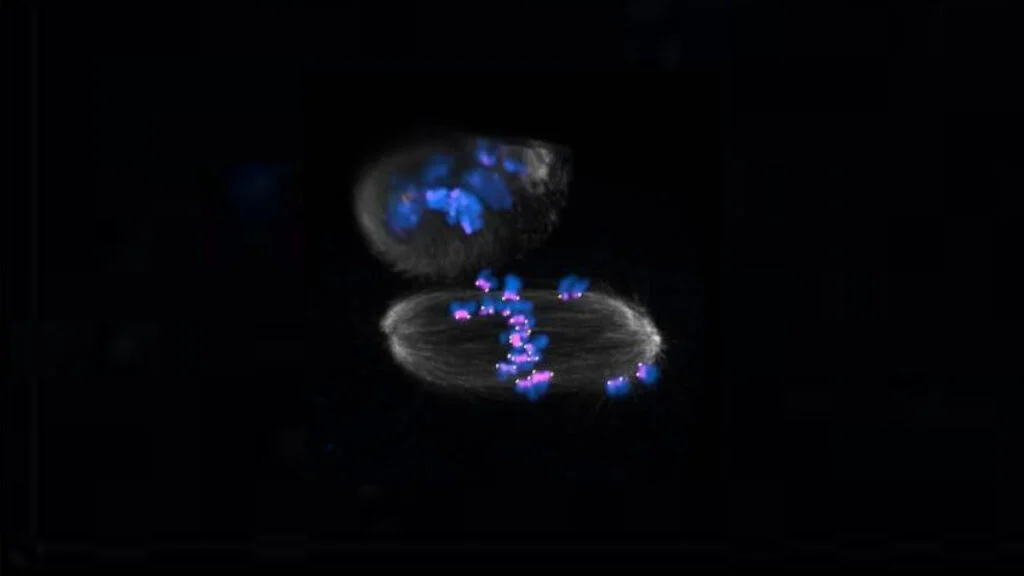
At the heart of this process is a protein complex called cohesin. Cohesin acts as a ring-shaped tether, holding together sister chromatids—the identical copies of a chromosome. This "glue" is essential because it ensures that when the cell finally divides, the chromosomes are pulled apart evenly. In most cells, cohesin only needs to hold for a few hours. However, in an oocyte, cohesin must maintain its grip for twenty, thirty, or even forty years. Emerging evidence suggests that cohesin is never "reloaded" or replaced throughout a woman’s life. As the decades pass, the cohesin rings begin to fray and disintegrate, leaving the chromosomes loosely organized and prone to drifting apart prematurely. When the egg finally attempts to complete its division during ovulation or fertilization, the lack of structural support leads to a chaotic distribution of genetic material.
The statistics are sobering. Studies indicate that between 50% and 80% of embryos created by women in their 40s carry chromosomal abnormalities. By the time a woman reaches 40, the risk of aneuploidy increases dramatically, leading to a precipitous drop in IVF success rates. While women under 35 often see a one-in-three success rate per IVF cycle, that probability plummets to roughly one-in-ten for those over 40. The result is a cycle of expensive, emotionally draining, and often futile medical interventions.
Melina Schuh, a director at the Max Planck Institute and the lead author of the new study, has spent two decades investigating the mechanics of meiosis. In 2015, her laboratory provided the first visual evidence of how chromosome-holding structures deteriorate in human eggs as they age. This realization sparked a radical idea: if the natural glue was disappearing, could science provide a synthetic replacement? Over the last eight years, Schuh’s team experimented with various protein designs, eventually developing a system they call "TALhesins."
TALhesins are engineered proteins programmed to recognize and bind to specific DNA sequences near the centromere—the central junction of a chromosome. Once attached, these proteins act as a bridge, physically tethering the sister chromatids together in the absence of natural cohesin. Crucially, the researchers incorporated a biological "kill switch" into the system. Because chromosomes must eventually separate to allow for successful fertilization and embryo development, the TALhesins were designed with cleavage sites that respond to the cell’s natural enzymes. This ensures the synthetic glue holds firm during the critical waiting period but dissolves the moment fertilization is triggered, allowing meiosis to conclude naturally.
The results in animal models were striking. When TALhesins were introduced into the eggs of older mice, the rate of premature chromosome separation dropped significantly. The proportion of eggs with correctly connected and organized chromatids rose from a baseline of 47% to 74%—a figure that mirrors the chromosomal health of young, fertile mice. Rajiv McCoy, a biologist at Johns Hopkins University who specializes in pregnancy loss, called the proof of concept "highly successful." McCoy noted that because roughly half of all human conceptions are lost before birth—often due to aneuploidy—technologies that can stabilize chromosomes could have "far-reaching consequences for the IVF industry and for society at large."
However, translating mouse successes into human treatments is a path fraught with technical and ethical hurdles. Schuh’s team has already begun the transition, adapting the TALhesin system to bind to human chromosomes. Early tests show a positive effect on cohesion, but the team has yet to prove that this stabilization actually translates into a reduction of genetic errors in human oocytes. Eva Hoffman, a molecular geneticist at the University of Copenhagen, emphasizes that safety is the paramount concern. Researchers must ensure that adding synthetic proteins to an egg doesn’t interfere with subsequent embryonic development or introduce unforeseen epigenetic changes. "The clinical potential depends upon regulatory aspects including safety studies," Hoffman noted, while praising the study for challenging the long-held dogma that age-related egg decline is an irreversible "one-way street."
The urgency for such a solution is underscored by the current state of the fertility industry. Desperate to overcome the "aneuploidy wall," many patients turn to expensive "add-ons"—experimental treatments that often lack robust scientific backing. Even more controversial is the rise of "fertility tourism" for Mitochondrial Replacement Therapy (MRT). Originally designed to prevent the transmission of rare mitochondrial diseases, MRT is now being marketed by clinics in countries like Ukraine and Albania as a "rejuvenation" technique for older eggs. Despite high costs and scant evidence that replacing mitochondria can fix the chromosomal issues caused by cohesin loss, hundreds of women have sought out these "three-parent IVF" procedures. TALhesins, by contrast, target the actual root cause of age-related infertility: the chromosomes themselves.
The commercialization of this technology is already underway. Schuh has co-founded Ovo Labs, a startup based in Munich and London, to bring TALhesin to the clinical market. The primary logistical challenge lies in the timing of the treatment. Most eggs retrieved during standard IVF have already completed their first meiotic division, meaning the damage from cohesin loss may already be done. To be effective, TALhesins likely need to be introduced to "immature" eggs, which are then matured in a lab—a process known as In Vitro Maturation (IVM). While IVM is not yet a standard practice in most clinics and faces its own set of efficiency challenges, it provides the necessary window for synthetic proteins to stabilize the chromosomes before they are ever pulled apart.
Ovo Labs is not alone in this race. A competing U.K. startup, U-Ploid, co-founded by study co-author Alexandre Webster, is developing a different candidate called Lyvanta. Rather than using synthetic DNA-binding proteins, Lyvanta is designed to preserve and bolster the cell’s existing natural structures. At the 2026 meeting of the American Society for Reproductive Medicine (ASRM), U-Ploid reported that 65.5% of immature human eggs treated with Lyvanta matured without detectable chromosomal errors, compared to just 35.7% in a control group.
As these technologies move toward clinical trials, they represent more than just a medical advancement; they represent a potential shift in the lifecycle of the modern human. By addressing the fundamental biological degradation of the oocyte, science may finally provide a way to align our ancient reproductive biology with the realities of 21st-century life. While the road to a widely available "anti-aging pill" for eggs is long, the transition from viewing aneuploidy as an inevitable fate to a treatable condition marks a historic turning point in reproductive medicine. The stakes, as Rajiv McCoy noted, remain incredibly high, but for the first time, the "molecular glue" of life is within our reach to repair.
