
 By Lina Irawan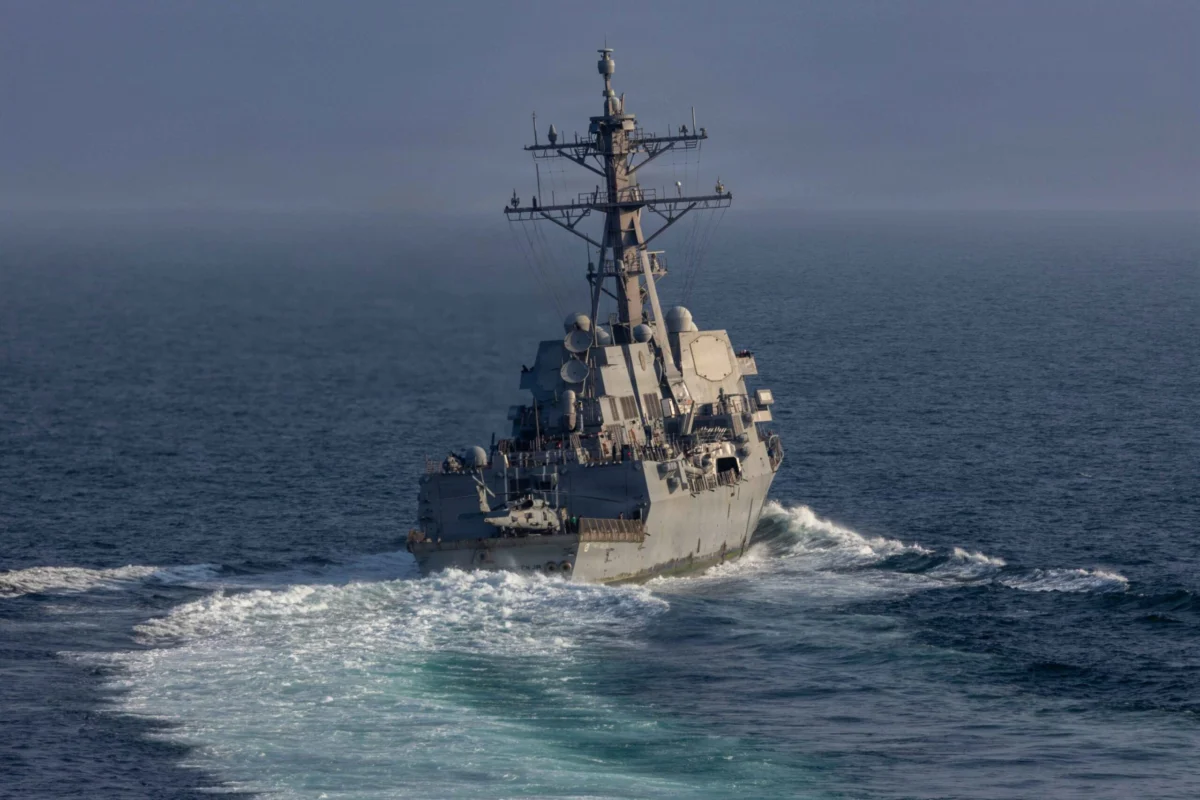
President Donald Trump, known for his direct and often confrontational foreign policy approach, wasted no time in announcing a significant escalation: a naval blockade on the Strait of Hormuz. This strategic choke point, a narrow waterway connecting the Persian Gulf to the open ocean, is arguably the world’s most critical oil transit route, accounting for approximately 20-30% of global petroleum consumption. The decision marks a dramatic shift in the U.S. strategy, moving from an initial phase dominated by aerial bombardments and missile barrages to a direct naval confrontation aimed at crippling Iran’s economic lifeline and challenging its perceived control over vital international waters.
The declared blockade specifically targets Iranian oil shipments, which, despite existing international sanctions, have continued to flow, albeit at reduced capacities, through various clandestine routes and often with the complicity of some international actors. Tehran, for its part, has historically leveraged its geographical advantage, selectively closing the strait with drone and missile attacks to impede oil supplies from rival nations, effectively weaponizing the waterway to exert pressure and demonstrate its regional might. This tit-for-tat struggle for control and influence over the Strait of Hormuz has been a recurring flashpoint in the long-standing animosity between the two nations.
The immediate fallout of this announcement was palpable across financial markets worldwide. Futures tied to the Dow Jones Industrial Average plummeted by 531 points, reflecting a 1.10% decline. S&P 500 futures mirrored this pessimism, falling 1.15%, while Nasdaq futures, often more sensitive to global instability due to its tech-heavy composition, lost 1.32%. The broad market downturn underscored investor anxiety over the prospect of a prolonged and intensified conflict, which could disrupt global trade, fuel inflation, and potentially tip an already fragile global economy into recession.
The energy sector, predictably, reacted with extreme volatility. U.S. oil futures surged by an alarming 8.63%, reaching $104.90 a barrel. Brent crude, the international benchmark, climbed 8.04% to $102.85. These significant price jumps reflect the immediate market fear of supply disruptions from the Strait of Hormuz, a conduit through which roughly 21 million barrels of oil pass daily. Analysts noted that while the initial month and a half of the conflict had already introduced a risk premium into oil prices, a direct naval blockade escalates this premium dramatically, pushing prices towards levels not seen since major supply shocks. Consumers worldwide are now bracing for the inevitable increase in gasoline prices, further exacerbating inflationary pressures.
In a seemingly counterintuitive move, gold, traditionally a safe-haven asset during times of geopolitical turmoil, saw a dip of 2.28% to $4,678 per ounce. This could be attributed to several factors: strong dollar appreciation drawing investment away from commodities, profit-taking after previous surges in anticipation of conflict, or perhaps a complex market signal suggesting that a decisive, albeit aggressive, U.S. military posture might prevent a protracted, indeterminate conflict, though this interpretation remains contentious among analysts. Meanwhile, the U.S. dollar strengthened against major currencies, rising 0.49% against the euro and 0.32% against the yen, as global investors sought the perceived stability of the dollar amid escalating international tensions. The yield on the benchmark 10-year Treasury bond, typically a barometer of economic sentiment, remained flat at 4.317%, suggesting a balancing act between a flight to safety (which drives bond prices up and yields down) and potential inflationary concerns from rising oil prices (which could push yields higher).
The strategic shift to naval forces represents a critical new phase in the U.S. campaign. The two-part strategy aims to deliver a decisive blow to Iran’s economy while simultaneously undermining its tactical control over the Strait. Preventing Iran from generating oil revenue would not only accelerate the collapse of its already distressed economy but would also directly deny crucial financial resources to the Islamic Revolutionary Guard Corps (IRGC), the powerful paramilitary organization that underpins the regime’s domestic control and regional proxy operations. Iran’s economy has been teetering on the brink, grappling with hyperinflation, rampant unemployment, and severe currency devaluation, all exacerbated by years of stringent international sanctions. Cutting off oil exports, its primary source of foreign currency, is designed to be a crippling blow.
U.S. Central Command (CENTCOM) confirmed that the Hormuz blockade is slated to commence on Monday at 10 am ET. Crucially, CENTCOM’s statement clarified that the blockade, despite President Trump’s earlier rhetoric of the strait being "open to everyone or no one at all," would be selective. "The blockade will be enforced impartially against vessels of all nations entering or departing Iranian ports and coastal areas, including all Iranian ports on the Arabian Gulf and Gulf of Oman," CENTCOM explained in a press release. However, it added a vital caveat: "CENTCOM forces will not impede freedom of navigation for vessels transiting the Strait of Hormuz to and from non-Iranian ports." This distinction is critical. By targeting only vessels related to Iranian commerce, the U.S. aims to minimize disruptions to global shipping and avoid direct confrontation with other nations’ commercial interests, potentially mitigating international condemnation while maximizing pressure on Tehran. Legal experts note that while any blockade is generally considered an act of war under international law, the U.S. may frame this as a counter-measure to Iran’s previous hostile acts and an enforcement of existing sanctions, thus attempting to justify its legality.
In preparation for this dramatic escalation, the U.S. Navy dispatched two destroyers through the Strait of Hormuz on Saturday. These Arleigh Burke-class guided-missile destroyers, known for their advanced air defense and anti-ship capabilities, were deployed to prepare for mine-clearing operations. CENTCOM further stated its intention to "establish a new passage" for the maritime industry, signaling a concerted effort to create a secure, protected corridor for the free flow of commerce that bypasses Iranian threats. This move is a direct challenge to Iran’s long-held assertion of effective control over the Strait and its ability to dictate terms of passage.
The IRGC swiftly reacted to the presence of U.S. warships, issuing stern warnings and demanding their immediate departure. A drone, reportedly launched towards the U.S. vessels, was subsequently destroyed by the Navy. On Sunday, the IRGC escalated its rhetoric further, threatening a "strong and forceful response" to any warships that approach the Strait of Hormuz. Iran’s capabilities in the Strait are diverse and formidable, encompassing fast-attack boats, anti-ship missiles, sophisticated drones, sea mines, and even mini-submarines, all designed to exploit the narrow waterway’s geography to its advantage.
Until this weekend’s audacious transit, U.S. Navy ships had largely avoided direct passage through the Strait of Hormuz for weeks, a deliberate decision based on previous assessments by Navy officials who had notoriously described it as an "Iranian ‘kill box’." This designation reflected the multitude of threats posed by Iran’s layered defenses, which make transiting the strait an extremely high-risk endeavor. The failure to reopen the strait fully and reliably has indeed sent oil prices skyrocketing, and Tehran’s demonstrated ability to intimidate and deter tanker traffic had emerged as its most potent source of leverage over the U.S. and the international community.
However, the U.S. Navy’s current strategy aims to nullify this leverage. If it can successfully establish and maintain an alternate, secure path through the strait, effectively mitigating the risks from Iranian attacks, then the regime loses its most potent geopolitical and economic weapon. This would allow global oil flows to resume with greater confidence, reducing the risk premium that has inflated energy prices and simultaneously stripping Iran of its primary means of exerting pressure.
Salvatore Mercogliano, a professor at Campbell University specializing in military and maritime history, underscored the significance of the U.S. Navy’s recent actions on his podcast. "One of the things that commercial ships were waiting to see was whether or not this strait was clear, and sailing two destroyers in is a big one," Mercogliano remarked. His analysis highlights the psychological and practical impact of a visible U.S. naval presence, which serves as both a deterrent to Iran and a reassurance to the international shipping industry.
The situation in the Strait of Hormuz now stands at a critical juncture, poised for an unprecedented naval standoff. The U.S. gambit is high-stakes: success could cripple Iran’s economy and reassert freedom of navigation, but failure or a miscalculation could ignite a wider regional conflict with devastating global consequences. The world watches with bated breath as the U.S. and Iran enter this dangerous new phase of confrontation, where the fate of global energy supplies and regional peace hangs precariously in the balance. The coming days will determine whether this naval blockade achieves its objectives or triggers an even more volatile escalation in the already simmering conflict.
