
 By Titik Puspa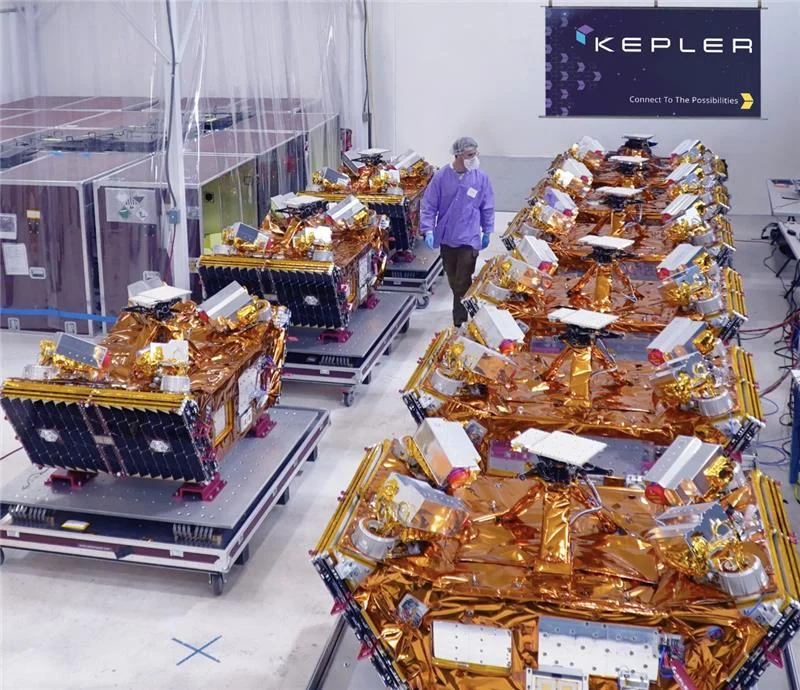
The ambitious vision of massive data centers in orbit, once confined to the realm of science fiction and the long-term roadmaps of industry titans like SpaceX and Blue Origin, is beginning to materialize in a more practical, near-term capacity. While the grand spectacle of colossal orbital server farms remains a decade or more away, the nascent business of orbital compute is rapidly evolving, driven by companies like Kepler Communications, which is actively deploying and utilizing distributed processing power in space. This shift marks a pivotal moment, moving beyond mere data collection to the crucial task of data processing where it is generated, promising to revolutionize space-based applications and unlock new frontiers in technological advancement.
Kepler Communications, a Canadian company at the forefront of this burgeoning sector, has established what is currently the largest compute cluster in orbit. Launched in January, this impressive network comprises 10 operational satellites, each equipped with approximately 40 Nvidia Orin edge processors. These powerful processors are interconnected through advanced laser communication links, enabling them to function as a cohesive, distributed computing system. This innovative approach represents a significant leap forward in harnessing computational power beyond Earth’s atmosphere, laying the groundwork for more sophisticated space-based operations.
The utility of Kepler’s orbital infrastructure is rapidly gaining traction, evidenced by its growing roster of 18 customers. The company recently announced a significant new partnership with Sophia Space, a promising startup developing unique orbital computing solutions. Sophia Space will leverage Kepler’s constellation to test and validate the software for its novel space computer. This collaboration is particularly noteworthy as it aims to demonstrate the feasibility of deploying and managing complex software across multiple spacecraft and GPUs in the harsh environment of space – a feat that, while commonplace on Earth, represents a critical milestone in orbital computing.
Industry experts anticipate that the widespread deployment of large-scale data centers in space, akin to terrestrial hyperscale facilities, will likely not become a reality until the 2030s. The immediate focus, therefore, is on incremental advancements that can deliver tangible benefits in the near term. The primary objective of these initial orbital compute efforts is to process data directly at its source, enhancing the capabilities of space-based sensors. This localized processing is essential for a variety of applications, including Earth observation, environmental monitoring, and scientific research, benefiting both private companies and government agencies that rely on timely and accurate spatial data.
Kepler Communications, under the leadership of CEO Mina Mitry, strategically positions itself not as a traditional data center provider, but as an enabler of space-based applications. Mitry emphasizes Kepler’s role as an infrastructure layer, providing essential network services for other satellites in orbit, as well as for drones and aircraft operating in the airspace below. This broader vision underscores the interconnected nature of future space and aerial systems, where robust communication and processing capabilities are paramount.
Sophia Space’s contribution to this evolving ecosystem is particularly significant, as they are developing passively cooled space computers. This technological innovation directly addresses one of the most formidable challenges facing the development of large-scale orbital data centers: thermal management. Powerful processors generate substantial heat, and without efficient cooling systems, they risk overheating and malfunctioning. Traditional active cooling systems, while effective on Earth, are often heavy, complex, and energy-intensive, making them impractical for space deployment. Sophia’s passively cooled solutions offer a potential breakthrough, enabling the sustained operation of high-performance computing hardware in space without the need for bulky and expensive active cooling mechanisms.
The partnership between Sophia Space and Kepler Communications involves a critical demonstration of Sophia’s proprietary operating system. This software will be uploaded to one of Kepler’s satellites and then deployed and configured across six GPUs housed on two separate spacecraft. This intricate process of remote software deployment and management across a distributed network of hardware in orbit is a groundbreaking endeavor. Successfully executing this task will be a vital de-risking exercise for Sophia Space, paving the way for their own planned satellite launch in late 2027. The ability to reliably manage software and computational resources across multiple orbital assets is a fundamental prerequisite for any advanced space-based computing initiative.
For Kepler, this collaboration serves as a crucial validation of its network’s capabilities and utility. Currently, Kepler’s satellites are primarily engaged in carrying and processing data that is either uploaded from ground stations or collected by hosted payloads integrated onto their own spacecraft. However, as the space sector matures, Kepler anticipates a significant expansion of its services, moving towards linking with third-party satellites to offer comprehensive networking and processing solutions. This evolution will transform Kepler into a crucial hub within a burgeoning orbital internet, facilitating seamless data exchange and computational resource sharing.
Mitry highlights that satellite companies are increasingly incorporating this model into their future asset planning. The benefits of offloading computationally intensive processing tasks, particularly for advanced sensors like synthetic aperture radar (SAR), are becoming undeniable. SAR systems, capable of generating high-resolution imagery regardless of weather conditions or time of day, generate vast amounts of data that can significantly benefit from on-orbit processing. The U.S. military, a key customer for such capabilities, is actively developing a new missile defense system that relies heavily on satellites for the detection and tracking of threats. Kepler has already demonstrated the potential of its technology with a successful space-to-air laser link demonstration for the U.S. government, showcasing its ability to facilitate rapid data transfer and communication in critical defense applications.
This concept of "edge processing" – performing data analysis and computation closer to where the data is collected – is where orbital data centers are poised to demonstrate their initial value proposition. This distributed, edge-centric approach differentiates Kepler and Sophia from larger, more established players like SpaceX and Blue Origin, as well as well-funded startups such as Starcloud and Aetherflux. These entities are primarily focused on building massive, centralized orbital data centers that utilize data center-style processors, envisioning a future where vast quantities of data are processed in vast orbital facilities.
Mitry articulates Kepler’s strategic focus on distributed inference capabilities, stating, "Because we have the belief it’s more inference than training, we want more distributed GPUs that do inference, rather than one superpower GPU that has the training workload capacity." This philosophy is rooted in the practicalities of space-based operations. "If this thing consumes kilowatts of power and you’re only running at 10% of the time, then that’s not super helpful. In our case, our GPUs are running 100% of the time," Mitry explains, emphasizing the efficiency and continuous operation of their distributed edge processing model. This approach maximizes the utilization of limited orbital resources, ensuring that computational power is consistently applied to critical tasks.
The implications of successfully proving these orbital computing technologies extend far beyond the immediate applications. The growing trend of data center limitations on Earth, exemplified by recent bans on new construction in regions like Wisconsin and increasing legislative scrutiny in Congress, is inadvertently bolstering the appeal of space-based alternatives. Sophia CEO Rob DeMillo astutely observes this trend, musing, "There’s no more data centers in this country. It’s gonna get weird from here." This sentiment highlights the potential for orbital computing to become not just a supplementary solution, but a critical necessity as terrestrial constraints on data center development become more pronounced.
The convergence of advanced satellite technology, distributed computing, and the growing demand for on-orbit data processing is creating a fertile ground for innovation. Kepler Communications and Sophia Space, by focusing on practical, near-term applications and overcoming key technical hurdles like thermal management, are at the vanguard of this transformation. Their partnership represents a significant step towards realizing the promise of orbital compute, moving beyond the hype to establish a tangible and valuable business in the final frontier. As the technological landscape continues to evolve and terrestrial limitations persist, the allure and necessity of computing in space will only intensify, ushering in an era of unprecedented possibilities. The potential for orbital computing to address global challenges, from climate change monitoring to advanced defense capabilities, is immense, and the groundwork being laid today by companies like Kepler and Sophia is paving the way for a future where the vastness of space is also a vast computational resource.
