
 By admin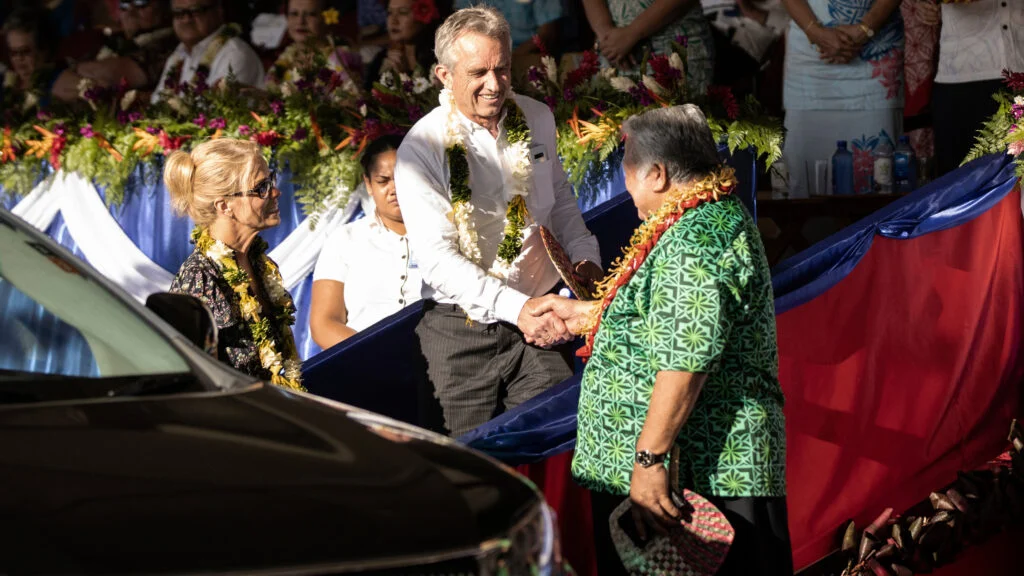
The confirmation of Robert F. Kennedy Jr. as the United States Secretary of Health and Human Services was one of the most contentious political appointments in recent memory, marked by intense scrutiny over his decades of anti-vaccine activism. Central to the skepticism he faced from lawmakers was a 2019 trip to the Pacific island nation of Samoa—a visit that preceded a catastrophic measles outbreak that claimed the lives of dozens of children. During his grueling confirmation process last year, Kennedy repeatedly and emphatically assured members of the Senate that his visit to the island had "nothing to do with vaccines." However, newly unearthed documents obtained through a joint investigation by The Associated Press and The Guardian provide a starkly different narrative, suggesting that the nation’s top health official may have provided misleading testimony to the very legislators who held the power to confirm him.
The documents, released following a lawsuit against the State Department, include a pivotal letter written by Kennedy on January 20, 2019, months before his arrival in Samoa. At the time, Kennedy was serving as the chairman and chief legal counsel for Children’s Health Defense (CHD), a nonprofit organization that has become a global powerhouse for vaccine skepticism. Writing on CHD letterhead to then-Samoan Prime Minister Tuilaepa Sailele Malielegaoi, Kennedy’s correspondence was laser-focused on the country’s immunization program. In a letter that utilized the terms "vaccine" or "vaccination" eight times, Kennedy explicitly requested permission to study the nation’s use of the measles, mumps, and rubella (MMR) vaccine. This request followed the tragic deaths of two infants in 2018 who had died shortly after receiving their shots—deaths that were later proven to be the result of human error by nurses rather than a defect in the vaccine itself.
The discrepancy between this letter and Kennedy’s testimony before Congress has ignited a firestorm of criticism from Democratic lawmakers and public health experts. During his confirmation hearings, Kennedy sought to distance his public image from his activist past, attempting to reassure skeptical Republicans and hostile Democrats that he would uphold the integrity of the nation’s public health infrastructure. When questioned by Senator Ron Wyden of Oregon, the top Democrat on the Senate Finance Committee, regarding the intent of his Samoa trip, Kennedy was unequivocal. "I went there, nothing to do with vaccines," Kennedy told the committee. "I went there to introduce a medical informatics system that would digitalize records in Samoa and make health delivery much more efficient." He repeated similar claims under questioning from Senator Edward Markey of Massachusetts, insisting his purpose was entirely unrelated to the island’s vaccination policies.
The newly surfaced 2019 letter suggests a much more specific and vaccine-oriented agenda. In the correspondence, Kennedy speculated that the infant deaths in Samoa might have been caused by manufacturing issues or specific "vaccine lots." He proposed that his team conduct a "detailed health informatics assessment" specifically to investigate "what happened with your MMR vaccines." He further argued in the letter that most global health systems were not designed to quickly identify links between "diagnoses and specific vaccination events," implying that his organization could provide an independent oversight that the established medical community could not.
The political stakes of these revelations are significant. While Kennedy was not under oath during his confirmation hearings—a point noted by the Department of Health and Human Services (HHS) in their defense of the Secretary—knowingly providing false or material misrepresentations to Congress is a federal crime under 18 U.S. Code § 1001. While such prosecutions are rare in the context of political hearings, the moral and political weight of the accusation threatens to undermine Kennedy’s authority as he oversees agencies like the Centers for Disease Control and Prevention (CDC) and the Food and Drug Administration (FDA).
To understand the gravity of Kennedy’s 2019 visit, one must look at the tragic sequence of events in Samoa. In July 2018, two infants died after being injected with the MMR vaccine. The Samoan government immediately suspended the national vaccination program for ten months while an investigation was conducted. It was eventually discovered that two nurses had accidentally mixed the vaccine powder with an expired muscle relaxant instead of the proper water-based diluent. The nurses pleaded guilty to manslaughter and were sentenced to prison. However, during the ten-month suspension of the program, vaccination rates in Samoa plummeted from roughly 60–70% to below 30% in some regions, leaving the population dangerously vulnerable.
It was during this period of heightened fear and plummeting immunity that Kennedy and his team arrived. While Kennedy maintained to Congress that he was there for administrative and technological reasons, public health officials on the ground at the time reported a surge in anti-vaccine sentiment fueled by the presence of high-profile American activists. When the measles virus eventually hit the islands in late 2019, the results were devastating: over 5,700 cases were reported in a population of just 200,000, and 83 people died. The vast majority of the victims were children under the age of five.
The Department of Health and Human Services has moved aggressively to shield Kennedy from the fallout of the leaked documents. In a statement, the department dismissed the allegations of dishonesty as "not only false but outright defamatory." They maintained that the visit was "unrelated to vaccines" and that the Secretary’s testimony remained accurate. However, the department declined to make Kennedy available for an interview to clarify the contents of his 2019 letter, and the White House has remained silent on the matter.
The fallout is particularly acute for Republican Senator Bill Cassidy of Louisiana, a physician who provided a crucial "yes" vote for Kennedy’s confirmation. Cassidy had expressed deep reservations about Kennedy’s history but ultimately supported him after receiving personal assurances that Kennedy would not dismantle existing vaccine policy frameworks. Specifically, Cassidy noted that Kennedy promised to maintain the CDC’s Advisory Committee on Immunization Practices (ACIP) without radical changes. Yet, shortly after taking office, Kennedy ousted all 17 members of the committee and replaced them with his own hand-picked advisers, many of whom share his skeptical views on traditional immunization schedules.
"The commitments that were made to me have been violated," Cassidy recently stated on CBS’s "Face the Nation." The revelation that Kennedy’s testimony regarding Samoa may have also been misleading further erodes the trust of the few moderates who supported his ascent to the Cabinet. Senator Wyden has signaled that he intends to press his Republican colleagues to refer the matter to the Justice Department for a formal investigation into whether Kennedy obstructed the congressional inquiry. "There are consequences for lying to Congress," Wyden said, promising to hold the Secretary accountable should the balance of power in the Senate shift in future elections.
Legal experts and historians note that the situation reflects a broader tension within the current administration, where traditional norms of transparency and factual consistency are frequently challenged. Kennedy’s role as HHS Secretary places him in charge of a $1.7 trillion budget and the health security of over 330 million Americans. His ability to lead effectively depends heavily on the credibility of his office. Critics argue that if the Secretary cannot be trusted to be truthful about his past activities in a foreign nation during a health crisis, his guidance on future domestic health emergencies will be viewed through a lens of profound suspicion.
The 2019 Samoa measles outbreak remains a textbook case for epidemiologists on how the breakdown of public trust and the interruption of vaccination services can lead to preventable mass mortality. For Kennedy, the ghost of the Samoa trip continues to haunt his political career. While his supporters view him as a courageous whistleblower challenging "Big Pharma," his detractors see a man whose rhetoric has real-world consequences—consequences that the newly released letters suggest he was more directly involved in cultivating than he was willing to admit to the United States Senate. As the Republican-led Congress appears unlikely to pursue an impeachment inquiry or formal hearings in the immediate future, the battle over Kennedy’s truthfulness will likely play out in the court of public opinion and through the continued release of internal documents that pull back the curtain on his long career as an activist.
