
 By Lina Irawan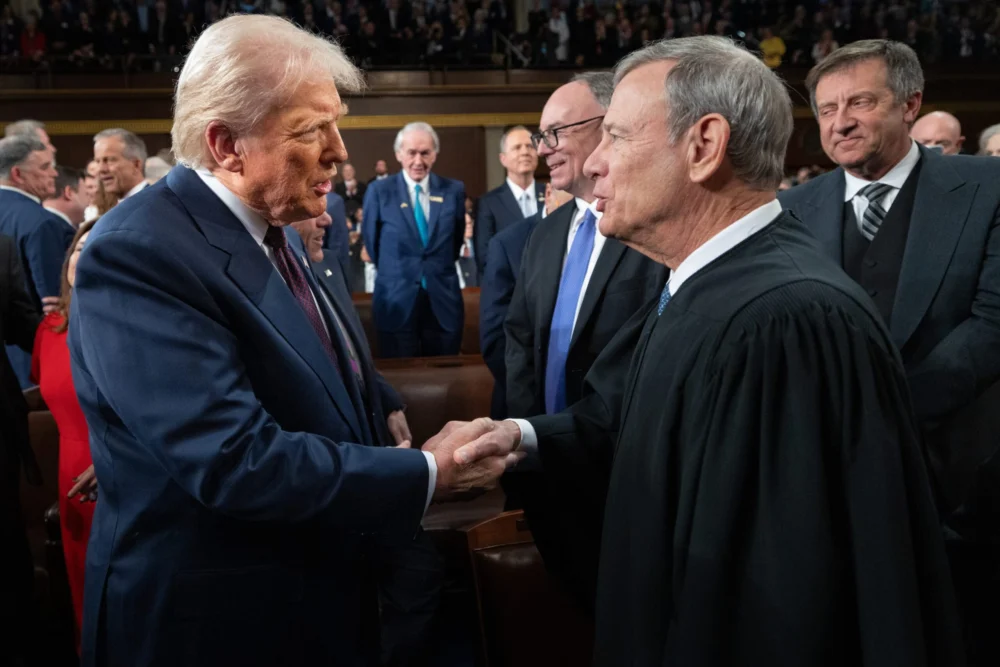
The Supreme Court’s majority opinion asserted that the President had overstepped the bounds of the IEEPA, a statute traditionally reserved for genuine national security emergencies like sanctions against hostile states, rather than broad economic policy instruments. Legal scholars widely praised the court for reining in what many viewed as an executive overreach that circumvented Congress’s constitutional authority over trade. However, President Trump’s reaction was swift and vitriolic. In a press briefing following the decision, he launched a severe tongue-lashing against the six justices in the majority, branding them a "disgrace to our nation" and "fools and lapdogs for the RINOs and the radical left Democrats." This rhetoric underscored his defiance and signaled an unwillingness to cede ground on his signature trade policies.
Indeed, the President combined his insults with a defiant bravado, asserting his ability to enact a fresh set of tariffs under separate laws. He quickly made good on this threat, imposing a new 10% global duty, which he then hiked to 15% just a day later. While the specific legal frameworks for these new tariffs were not immediately detailed, observers speculated they would likely invoke Section 232 of the Trade Expansion Act of 1962, which permits tariffs on imports deemed a threat to national security, or Section 301 of the Trade Act of 1974, which targets unfair trade practices by other countries. However, the legal and economic implications of these new tariffs remain subject to intense scrutiny, with many questioning their long-term viability and potential for further legal challenges.
A Crushing Blow to Perceived Invincibility
Despite the President’s immediate counter-move, the Supreme Court’s judgment is widely seen as a significant crack in his previously unassailable image. Kurt Campbell, a seasoned diplomat and national security official who chairs the Asia Group, articulated this sentiment clearly: "Still, the importance of this judgment is another step in piercing President Trump’s seeming invincibility." Campbell highlighted a series of domestic actions that, when combined, paint a picture of an administration increasingly facing resistance from various corners.
"We have seen a series of domestic actions, including the withdrawal of Immigrations and Customs Enforcement from Minneapolis, various Republicans separating from the White House on domestic legislation and now the Supreme Court basically hollowing out the most important plank on President Trump’s economic vision," Campbell wrote in an analytical note. The "hollowing out" refers to the core tenet of Trump’s economic strategy, which heavily relied on tariffs as a primary tool to reshape global trade, protect domestic industries, and pressure trading partners. The IEEPA-based tariffs were particularly broad and aggressive, and their invalidation forces a recalibration of his trade agenda, potentially limiting its scope and impact.
Campbell also pointed out that congressional resistance to Trump’s tariff agenda had been building even before the Supreme Court ruling. Earlier this month, a largely symbolic but nonetheless significant vote in the House of Representatives saw several Republicans join Democrats to revoke Trump’s import taxes on Canada. While the vote lacked the force of law, it demonstrated a bipartisan discomfort with the President’s unilateral trade actions and hinted at a willingness within Congress to assert its own constitutional prerogatives. Campbell predicted that lawmakers on Capitol Hill, from both parties, would now leverage the Supreme Court decision, solidifying its implications and making it exceedingly difficult for the Trump administration to pass any legislation designed to reinforce or expand his tariff authority. "This is significant at a time that the president seeks to head into midterm elections with a head full of steam," he concluded, underscoring the political ramifications for an administration eager to project strength and resolve ahead of crucial electoral contests.
Biggest Ruling Since the New Deal
The timing of this legal setback is particularly awkward for President Trump, as his administration grapples with an escalating affordability crisis that has become a potent political weapon for the opposition. This crisis, characterized by rising consumer prices and stagnant wages, contributed significantly to Democratic victories in the 2025 off-year elections and now threatens to deliver control of at least one chamber of Congress to Democrats in the 2026 midterms. Trump’s rush to establish alternate tariffs, which inevitably contribute to higher import costs and ripple effects throughout the economy, appears to clash directly with his stated efforts to address the very crisis that is eroding his political support.
Should Democrats succeed in taking over Congress, President Trump’s maneuvering room would be severely curtailed. A Democrat-controlled legislative branch would undoubtedly seek to rein in his administration’s spending and policies, especially in contentious areas like immigration, environmental regulations, and, critically, trade. The Supreme Court’s tariff decision could, therefore, be a harbinger of a broader trend, signaling that the judicial branch is increasingly willing to join the legislative branch in drawing clear lines against what it perceives as executive overreach.
Harvard law professor and Bloomberg columnist Noah Feldman characterized the ruling as a "turning point," drawing a compelling historical parallel to the Supreme Court’s monumental decisions in 1935 that struck down key components of President Franklin D. Roosevelt’s first New Deal. These earlier rulings, particularly Schechter Poultry Corp. v. United States and United States v. Butler, famously limited federal power and challenged the executive’s authority during a period of national crisis. Feldman wrote, "It took almost a decade, but Chief Justice John Roberts and the Supreme Court finally found a way to stand up to President Donald Trump’s executive power overreach, striking down the tariffs that are the signature initiative of his presidency." This comparison highlights the magnitude of the present ruling, suggesting it could reshape the balance of power between the branches of government for years to come. Chief Justice Roberts, known for his incremental approach and desire to protect the Court’s institutional integrity, likely played a pivotal role in crafting a majority opinion that, while legally sound, also sent a clear message about the limits of presidential power.
Epstein Files, Jerome Powell, and the Greenland Gambit: A Cascade of Resistance
The Supreme Court’s ruling did not emerge in a vacuum but rather as the culmination of several months during which "cracks have been forming in Trump’s support," both within and outside his traditional power base. The narrative of an increasingly besieged presidency began to solidify last November, following significant Democratic election victories. Buoyed by their success, Congress, with broad bipartisan support, including crucial Republican approval, ordered the release of the Epstein files – a trove of documents related to the disgraced financier Jeffrey Epstein. This near-unanimous vote underscored a rare consensus on transparency, which was subsequently strained in December by heavy redactions and the Justice Department’s failure to disclose all records by the mandated deadline, fueling public suspicion and congressional frustration.
As the new year dawned, President Trump initially appeared to be riding high. The U.S. military pulled off a stunning raid that captured Venezuelan dictator Nicolás Maduro, a dramatic foreign policy success that, for a moment, overshadowed simmering "America First" grumblings about another foreign intervention. However, this aura of invincibility quickly began to unravel through a rapid succession of events.
Just a week after the Maduro raid, Federal Reserve Chair Jerome Powell issued a defiant video statement, revealing he was facing a Justice Department criminal investigation related to a renovation project at the central bank’s headquarters. This unprecedented move by the DOJ against the head of the independent Federal Reserve sent shockwaves through financial markets and political circles. It immediately rallied bipartisan support for Powell on Capitol Hill, including from key Republicans who vociferously defended the central bank’s independence from political interference, viewing it as essential for economic stability. The investigation was widely perceived as a politically motivated attack aimed at undermining Powell, who had previously clashed with the administration over monetary policy.
A week later, Trump escalated international tensions by announcing tariffs against several NATO countries unless they supported his audacious bid to seize control of Greenland. This extraordinary demand was met with firm resistance from Canada and Europe, who stood united in protecting the semi-autonomous Danish territory. In a rare display of international unity against his demands, Trump was forced to back down, a significant diplomatic retreat that highlighted the limits of his "America First" unilateralism.
The following week brought a more tragic domestic crisis. Federal agents, as part of Trump’s controversial deportation campaign in Minnesota, shot to death a second U.S. citizen in the state. The incident ignited a firestorm of public outrage. Silicon Valley workers expressed their anger, and Minnesota-based CEOs from Fortune 500 companies publicly pleaded for de-escalation, warning of the economic and social fallout. Democrats in Congress seized on the tragedy, stiffening their opposition to an appropriations bill for the Department of Homeland Security, leading to a partial government shutdown. Concurrently, more Republicans began to voice "uneasiness" with the federal agents’ tactics, signaling a growing discomfort within his own party with the administration’s aggressive immigration enforcement. Eventually, the immense pressure forced Trump to dispatch his border czar, who ultimately ousted the controversial Border Patrol chief Greg Bovino and announced an end to the Minnesota surge.
This relentless swirl of events, each chipping away at the administration’s perceived power and unity, added up to a definitive tipping point for President Trump. As political scientist Lee Drutman, a senior fellow at the New America think tank, succinctly posted on X last month, "Starting to feel like we are in the midst of a historic hinge moment here." The Supreme Court’s tariff ruling, therefore, is not an isolated event but a powerful confirmation of this emerging reality, solidifying the growing wall of resistance that now challenges President Trump’s authority from multiple directions.
