
 By Rifan Muazin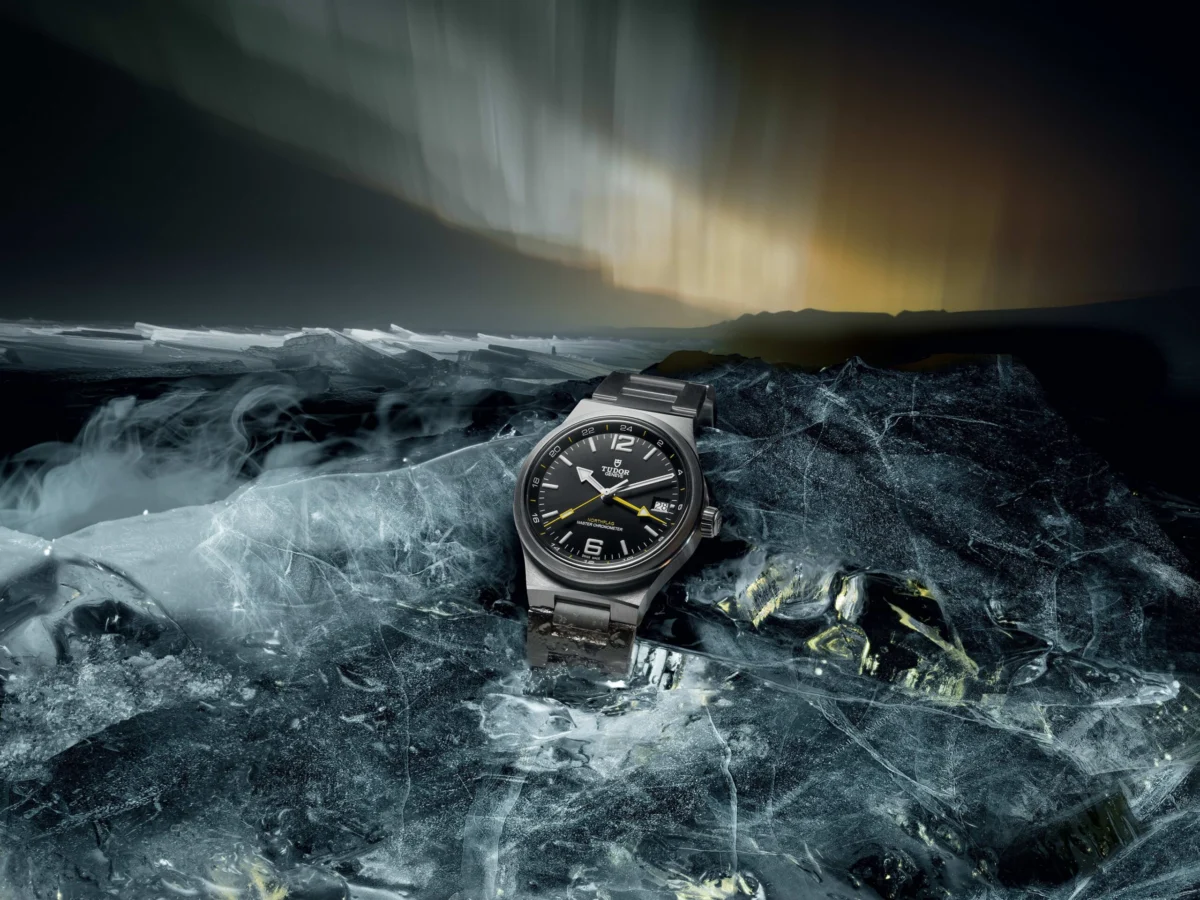
Back in 2015, fresh off the success of its relaunch, Tudor debuted the North Flag. At the time, the watch industry was in the midst of a massive shift. Tudor, long considered the "younger sibling" to Rolex, had spent decades living in the shadow of the Crown. However, the early 2010s saw the brand find its own voice, largely through the Heritage Black Bay and Pelagos lines. The North Flag was supposed to be the next step in that evolution—a bold, idiosyncratic statement of independence. It was a watch that looked like it could represent Tudor’s future: not only did the bright, quirky design seem to depart from the vintage-inspired models the brand often looked to, but it was also the first model powered by an in-house movement, the Calibre MT5621. While the watch didn’t catch on with collectors during its first run and was eventually discontinued in 2021, Tudor believes enthusiasts are finally ready to love its funkiest watch.
The resurgence of interest in integrated-bracelet sports watches and the booming popularity of travel complications have created the perfect storm for a comeback. Meet the new Northflag, now equipped with a GMT complication in place of the original’s power reserve display. This subtle but significant shift in utility transforms the watch from a niche "explorer’s tool" into a versatile global traveler. Whereas the original—which was based loosely on the Ranger II from 1973—might’ve been a bit ahead of the luxury-sport-watch craze back in 2015, the new version is right on target. Today, everyone and their mother—or sister, in the case of Rolex with its Land-Dweller—is releasing a watch with an integrated bracelet. In a market saturated with "Genta-esque" designs, the Northflag offers a brutalist, scientific alternative that feels uniquely Tudor.

To understand the Northflag, one must first understand the deep-seated history that Tudor has with the frozen frontiers of the world. Why "Northflag," you might ask? The name is a direct tribute to the British North Greenland Expedition (BNGE) of 1952. This was a scientific mission that lasted for two years, during which 25 members of the expedition were equipped with Tudor Oyster Prince watches. This was a pivotal moment for the brand; it was Hans Wilsdorf’s way of proving that a Tudor could survive the same punishing conditions as a Rolex. The watches performed beautifully despite the adverse conditions, and the mission serves as a foundational event in Tudor lore. While the visual inspiration for the Northflag is the Ranger II from 1973, the spiritual inspiration is the Oyster Prince ref. 7909, the very watch that accompanied those scientists across the ice.
The 2026 Northflag retains the soul of its predecessor but refines the execution for a modern audience. It features a 40mm satin-brushed and polished stainless steel case that strikes a balance between ruggedness and elegance. The fixed smooth bezel is sharp and purposeful, while the signed crown—now featuring the iconic Tudor rose in relief—omits crown guards to maintain a clean, architectural silhouette. Protected by a flat sapphire crystal, the dial is a masterclass in functional legibility. The black dial is now more symmetrical than that of the original North Flag, thanks to the removal of the nine-o’clock power reserve indicator. In its place, an outer 24-hour rehaut track in white flanks applied rectangular and Arabic indices. These indices are generously filled with Grade A Super-LumiNova, ensuring visibility in the darkest conditions, whether you’re in a cockpit or a tent in the Arctic.
The most striking visual element remains the use of color. A date window at 3 o’clock provides daily utility, while the luminous "Northflag" hands are joined by a vibrant yellow GMT hand and a matching yellow central-seconds hand. This "pop" of yellow has become a signature of the model, separating it from the more traditional red or blue accents found on other GMT watches. The watch is paired directly to a matching two-link integrated bracelet, a design choice that echoes the steel-on-steel aesthetics of the 1970s. However, unlike the stiff bracelets of the past, this modern iteration features the brand’s fan-favorite "T-fit" rapid-adjustment clasp. This allows the wearer to adjust the bracelet length on the fly without tools, a feature that is indispensable for travelers whose wrists might swell during long-haul flights or in varying climates.

Under the hood, the Northflag has received a massive technological upgrade. It is now powered by Tudor’s COSC and METAS-certified Manufacture Calibre MT5652-U. This automatic movement is a marvel of modern horology, featuring a non-magnetic silicon balance spring and a 65-hour power reserve. The METAS certification is particularly noteworthy; it means the entire watch—not just the movement—has been tested for precision, waterproofness, power reserve, and, perhaps most importantly, resistance to magnetic fields up to 15,000 gauss. In an age where we are constantly surrounded by electronic devices, this level of magnetic resistance is a genuine "real-world" luxury.
The GMT system itself is a "flyer" style, also known as a "true" GMT. This is the gold standard for travelers. Unlike "office" GMTs, where the 24-hour hand is adjusted independently, a flyer GMT allows the local hour hand to be jumped in one-hour increments without stopping the movement. This means that upon landing in a new time zone, the wearer can quickly sync their watch to local time without losing a second of accuracy. This sophisticated movement is visible via a sapphire caseback, allowing the owner to admire the industrial-chic finish of the caliber—a rarity for a brand that usually favors closed casebacks.
Beyond the specs, the Northflag represents a strategic pivot for Tudor. For the last decade, the brand has been heavily reliant on the "heritage" trend, looking back to the 1950s and 60s for inspiration. While this has been incredibly successful, it also risked pigeonholing the brand as a "vintage-reissue" specialist. The Northflag, with its blocky typography and integrated lugs, feels like a bridge to a different era—the 1970s—while remaining firmly planted in the 21st century. It is a formidable tool watch, boasting 100m of water resistance and a build quality that feels essentially bulletproof.

At $5,225, the Northflag is competitively priced. It sits in a unique position within the market: it is more affordable than its cousins at Rolex, yet it offers technical specifications—like the METAS certification—that many watches twice its price cannot match. Its closest competitors, such as the Longines Spirit Zulu Time or the Omega Seamaster Aqua Terra GMT, offer different flavors of the travel watch, but neither has the same "instrument-dial" aesthetic that makes the Northflag so distinctive. It is a watch for the person who finds the Black Bay too common and the Pelagos too technical—a middle ground for the individualist.
The reception of the new Northflag suggests that the market has finally caught up to Tudor’s vision. In 2015, the "integrated bracelet" was still a niche preference, and the watch world was obsessed with 38mm vintage divers. In 2026, the landscape is different. Collectors are looking for watches that tell a story, offer genuine technical innovation, and possess a design language that doesn’t feel like a copy of something else. Slightly more straightforward and slightly less quirky than the 2015 North Flag, the 2026 Northflag is handsome, genuinely useful, and priced considering its provenance and credentials.
Though its integrated bracelet and blocky typography were inspired by a 1970s model, it still feels like one of the brand’s more forward-looking designs. Tudor has always done splendidly by re-thinking its back catalog for modern wearers, but the idea of something that splits the difference between past and present is a welcome addition to the catalog. It proves that a brand can be respectful of its history without being a prisoner to it. The Northflag is a reminder that Tudor was always meant to be the experimental arm of the Wilsdorf empire—the place where new ideas and bold colors could live. In fact, provided we’re all still around in 2076, we wouldn’t be surprised to find the Northflag is still being produced to much acclaim, having transitioned from an "outsider" to a cornerstone of the Tudor identity.
