
 By admin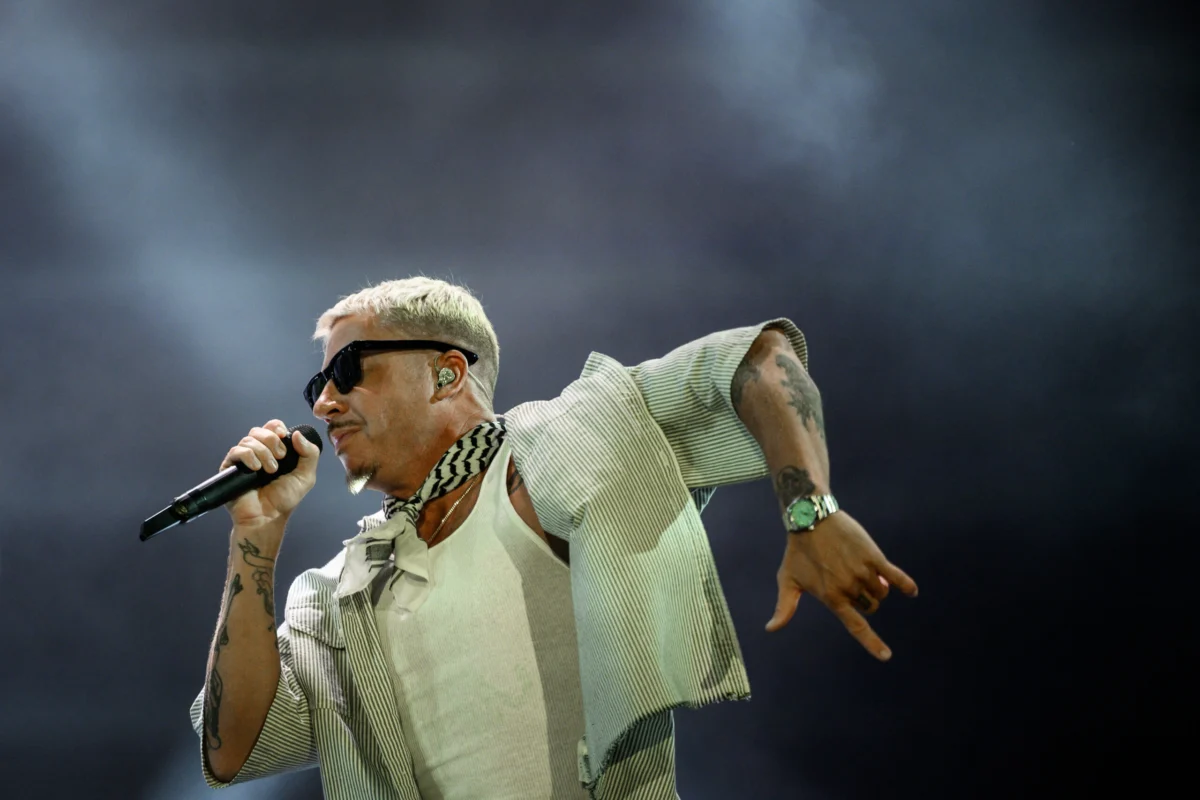
Macklemore, the Grammy-winning artist known for his socially conscious lyrics, ignited a firestorm of controversy and debate when he publicly declared "Free Palestine" during his opening set for Ed Sheeran at MetLife Stadium in New Jersey on Friday night. The rapper’s bold statement, delivered before launching into a passionate speech, was aimed at ensuring those in Gaza and the occupied West Bank felt acknowledged and not forgotten. He articulated his stance by asserting, "I believe that every human being walking on this earth deserves exactly the same freedom," a sentiment he reiterated during his Saturday night performance at the same venue. This politically charged declaration has not only resonated with some concertgoers but has also drawn sharp criticism, culminating in a petition launched by the Israeli American Council demanding Macklemore’s removal from the remaining dates of Ed Sheeran’s "Mathematics Tour," also known as the "Loop tour."
The Israeli American Council’s petition, the current signature count of which is not publicly disclosed, vehemently argues that the event was intended as a music concert, not a platform for political activism. "This was an Ed Sheeran concert – not a political rally, not a protest, and not an activist event," the petition states. It further questions the appropriateness of an opening act utilizing a global concert platform to promote what it describes as a "one-sided political agenda," while acknowledging Macklemore’s right to hold personal political views. The core of their objection lies in the perceived crossing of a boundary, transforming a musical performance into a vehicle for partisan political messaging.
Macklemore’s engagement with political issues extends beyond this recent declaration. He has been an outspoken critic of U.S. Immigration and Customs Enforcement (ICE), a stance he also alluded to during his remarks at the stadium. His 2024 release, "Hind’s Hall," serves as a direct critique of Israel’s actions in Gaza. The song’s proceeds have been pledged to humanitarian efforts facilitated by the United Nations Relief and Works Agency for Palestine Refugees in the Near East (UNRWA), an organization that provides essential services to Palestinian refugees. The decision to direct funds to UNRWA is particularly significant, as the agency plays a critical role in the humanitarian crisis in Gaza, providing food, shelter, and medical assistance to millions. However, UNRWA has also faced scrutiny and accusations, particularly from Israel and some of its allies, regarding alleged ties to Hamas and the use of its resources by militant groups.
The reactions to Macklemore’s statements on social media have been starkly divided, mirroring the broader societal polarization surrounding the Israeli-Palestinian conflict. Some concert attendees expressed their disappointment and anger, stating that they had not anticipated a "political rally" and accusing Macklemore of antisemitism. These individuals often voiced feelings of betrayal, having purchased tickets for a musical experience rather than a political statement. The accusation of antisemitism is a serious charge, and its invocation in this context highlights the deeply sensitive and often contentious nature of discussions surrounding the conflict, where criticism of Israeli government policy can be perceived by some as an attack on Jewish people.
Conversely, a significant number of social media users applauded Macklemore’s courage and conviction, viewing his actions as a powerful example of music’s potential as a tool for social justice advocacy. These supporters emphasized that music has historically served as a vital platform for raising awareness and advocating for human rights, rather than merely offering an "escapist experience." This perspective aligns with a long tradition of artists using their platforms to address pressing social and political issues, from Bob Dylan’s protest songs to Beyoncé’s politically charged performances. For these individuals, Macklemore’s intervention was a brave act of solidarity with a marginalized population and a call for universal human rights.
The controversy surrounding Macklemore’s remarks at the Ed Sheeran concert is situated within a larger global context of escalating tensions and increasing public discourse on the Israeli-Palestinian conflict. The conflict, which has a history spanning over seven decades, involves complex issues of land, self-determination, security, and human rights. Recent escalations, particularly following the October 7th attacks by Hamas and Israel’s subsequent military operations in Gaza, have led to widespread international attention and a surge in activism and advocacy on both sides of the issue.
The choice of venue – a massive stadium concert with a global superstar like Ed Sheeran – amplified the reach and impact of Macklemore’s message. Such large-scale events offer unparalleled visibility, allowing artists to connect with millions of fans simultaneously. This power, however, also carries significant responsibility, as demonstrated by the varied reactions. For Ed Sheeran himself, the situation presents a delicate balancing act. While he has not publicly commented on Macklemore’s specific statements, his involvement as the headliner means he is indirectly associated with the messages delivered during his shows. Artists often face pressure to engage with or distance themselves from controversial statements made by their opening acts, especially when those statements touch upon highly sensitive political matters.
The petition’s focus on the "line" between artistic expression and political agenda is a recurring theme in discussions about celebrity activism. Critics often argue that artists, particularly those with a broad appeal, should refrain from using their platform to promote partisan political views, fearing it alienates segments of their audience or misrepresents the artist’s primary role. Proponents, on the other hand, contend that artists, as citizens, have a right to express their views and that their influence can be a powerful force for positive social change. They argue that remaining silent on critical issues is itself a political stance.
The specific mention of "Hind’s Hall" and its connection to UNRWA is also noteworthy. The song’s title itself is a reference to Columbia University’s Hamilton Hall, which was renamed "Hind’s Hall" by pro-Palestinian protesters during a campus demonstration. This naming convention reflects a broader trend of using symbolic gestures to express solidarity and protest. The channeling of proceeds to UNRWA, while seemingly straightforward humanitarian aid, has become entangled in the broader geopolitical debate surrounding the agency’s operations and the overall international response to the humanitarian crisis.
The differing interpretations of Macklemore’s words – ranging from accusations of antisemitism to praise for human rights advocacy – underscore the profound difficulty in navigating discussions about the Israeli-Palestinian conflict in the current global climate. Each side often perceives the other’s narrative as biased or misinformed, leading to entrenched positions and an inability to find common ground. The role of social media in this dynamic is undeniable, as it allows for the rapid dissemination of information, opinion, and counter-opinion, often amplifying the most extreme voices and contributing to echo chambers.
The incident at MetLife Stadium is not an isolated event but rather a microcosm of a larger, ongoing cultural and political conversation. As artists continue to grapple with their roles in society and the power of their platforms, the tension between artistic expression, personal conviction, and audience expectations will likely remain a prominent feature of the music landscape. The debate sparked by Macklemore’s "Free Palestine" declaration serves as a potent reminder of the complex intersection of art, politics, and humanitarian concerns in the 21st century, highlighting the challenges and responsibilities that come with using a global stage to address deeply divisive issues. The long-term implications of such public pronouncements can range from increased awareness and support for a cause to intensified backlash and calls for censorship, illustrating the potent, and often unpredictable, power of artistic voice in the public sphere.
