
 By admin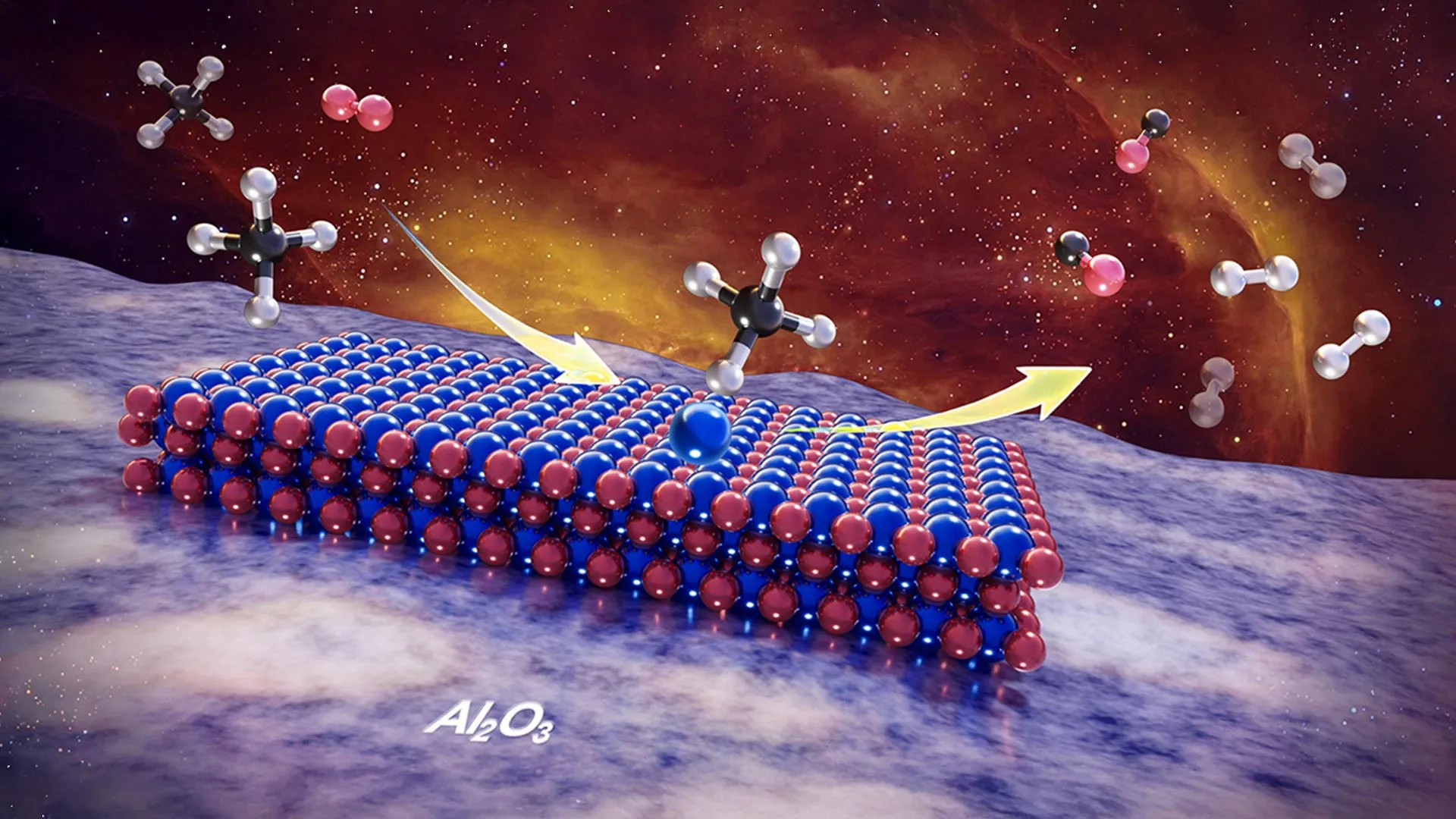
Partial oxidation of methane (POM) is considered a promising industrial method for producing syngas, a crucial mixture of carbon monoxide (CO) and hydrogen (H₂). This versatile feedstock is indispensable in the chemical industry, serving as a fundamental building block for synthesizing a vast array of products, including methanol, ammonia, and a variety of liquid fuels via Fischer-Tropsch synthesis. For years, scientists and engineers have operated under the assumption that metallic nickel (Ni) nanoparticles serve as the primary active centers driving this vital reaction. This long-standing hypothesis has guided catalyst design and development efforts across the globe. However, despite its widespread acceptance, there has been an important and persistent unresolved question that has cast a shadow of doubt over this fundamental understanding: the metallic Ni observed after a reaction may simply form when nickel oxide is reduced by syngas at high temperatures, rather than truly representing the species that actually performs the catalysis. This ambiguity underscores a critical challenge in catalysis: distinguishing between the active species present during a reaction and those observed in post-mortem analysis.
The complexity of the POM reaction environment further compounds this challenge. Nickel, a transition metal, is known for its ability to change both its oxidation state and its atomic arrangement under the high-temperature redox conditions inherent in POM. These dynamic transformations occur rapidly and at the atomic scale, making them exceptionally difficult to track in detail using conventional characterization techniques. The inability to observe the catalyst in situ—meaning while it is actively participating in the reaction—has historically made it extremely challenging to determine the true structure responsible for the observed catalytic activity. This knowledge gap has limited the rational design of more efficient and durable catalysts, often leading to trial-and-error approaches rather than mechanism-driven innovation.
A Hidden Active Structure Forms Dynamically During the Reaction
A groundbreaking study, recently published in the prestigious journal Nature Catalysis, has finally shed light on this enduring mystery. Researchers have definitively found that highly active structures can form in situ when the surface of nickel oxide (NiO) undergoes a dynamic reconstruction during the partial oxidation of methane. This remarkable discovery fundamentally alters our understanding of nickel-based catalysts for POM. The results not only reveal the atomic-scale source of the catalytic activity but also powerfully illustrate why it is absolutely critical to observe catalysts while they are operating under realistic reaction conditions, moving beyond static post-reaction analyses. This paradigm shift emphasizes the importance of operando spectroscopy and microscopy in modern catalysis research.
The pioneering research was a collaborative effort, spearheaded by a distinguished team of scientists. The core leadership included Professors Tao Zhang, Aiqin Wang, and Xiaoyan Liu from the Dalian Institute of Chemical Physics (DICP) of the Chinese Academy of Sciences (CAS). They were joined by Professor Wei Liu, also from DICP, Professor Tao Yang from Xi’an Jiaotong University, and Professor Graham J. Hutchings from Cardiff University, bringing together a wealth of expertise in catalysis, materials science, and theoretical chemistry. Their interdisciplinary approach was key to unraveling such a complex phenomenon.
To meticulously investigate this intricate process, the team meticulously created a novel Ni/Al₂O₃ catalyst containing an exceptionally low nickel content of only 0.8 weight percent (wt%). This low-loading catalyst was synthesized using a sophisticated microemulsion method, a technique known for producing highly dispersed, uniformly sized nanoparticles. Despite its relatively modest nickel content, a stark contrast to many industrial catalysts that often utilize much higher metal loadings, this specially prepared catalyst demonstrated remarkably strong performance during POM. Under typical operating conditions, it achieved an impressive 92% conversion of methane, a key metric for industrial efficiency. Furthermore, the selectivities towards desired products, carbon monoxide and hydrogen, reached an excellent 87.0%. Critically, the H₂/CO molar ratio remained stable at approximately 2.0, which is the ideal stoichiometric ratio for many downstream applications, such as methanol synthesis. This performance indicated a highly efficient and selective catalytic process.
High Performance Achieved With Significantly Less Nickel
One of the most striking and counter-intuitive findings from the study was the almost complete absence of detectable metallic Ni in the catalyst after the reaction had taken place. This observation directly challenged the long-held belief that metallic nickel was the primary active species. Even in the absence of significant metallic nickel, the catalyst’s overall performance was comparable to that of an 8.0 wt% Ni/Al₂O₃ catalyst produced through the more conventional impregnation method, a stark testament to its efficiency. This is particularly significant given that the microemulsion-derived catalyst contained only one-tenth as much nickel. The implications of this finding are profound, suggesting a pathway to developing catalysts with dramatically reduced precious metal content, which translates into significant economic savings and reduced environmental impact associated with metal extraction and processing.
The superiority of the low-loading microemulsion catalyst was further underscored by comparative studies. The researchers also tested another 0.8 wt% Ni/Al₂O₃ material, but this one was prepared using the more common impregnation method. Under identical reaction conditions, this impregnation-derived catalyst did not effectively carry out the partial oxidation of methane. Instead, it predominantly exhibited only methane combustion activity, producing CO₂ and H₂O rather than the desired syngas. This critical distinction highlighted that not only the nickel content but also the specific preparation method and the resulting morphology and dispersion of the nickel species play a pivotal role in determining the catalytic pathway. The microemulsion method, in this case, proved crucial for enabling the formation of the truly active structure.
Further detailed investigation into the dynamic behavior of the catalyst revealed that any metallic Ni nanoparticles present at the beginning of the reaction were quickly oxidized into the NiO phase under the harsh, high-temperature, and oxidative conditions of POM. This initial oxidation process itself was not surprising, given the reaction environment. However, the researchers then demonstrated that NiO alone was not sufficient to catalyze the POM reaction. A pre-formed, pure-phase NiO catalyst, when tested under the same conditions, showed absolutely no POM activity. Instead, it exclusively catalyzed the complete oxidation of methane, again producing undesirable CO₂ and H₂O. This finding solidified the notion that neither static metallic nickel nor bulk nickel oxide, as traditionally conceived, were the sole or even primary active sites for the desired syngas production.
Atomic Reconstruction Reveals the True Active Site
A closer and more sophisticated examination, utilizing advanced in situ characterization techniques likely including environmental transmission electron microscopy (ETEM) and various spectroscopies (such as X-ray absorption spectroscopy or diffuse reflectance infrared Fourier transform spectroscopy), revealed the true atomic-scale events unfolding on the catalyst surface. During the course of the reaction, the researchers successfully captured the in situ formation of a dynamically reconstructed [Ni₁O₄Ni₄] structural unit on the NiO(100) surface. This specific, highly ordered motif was not present before the reaction and formed only under the active POM conditions, underscoring its transient and dynamic nature.
To validate their experimental observations and gain deeper mechanistic insights, the team employed Density Functional Theory (DFT) calculations, a powerful computational tool for understanding chemical reactions at the atomic level. The DFT calculations indicated that this newly formed [Ni₁O₄Ni₄] motif significantly lowers the energy barrier for breaking the C-H bonds in methane, which is one of the most challenging and rate-limiting steps in activating the highly stable methane molecule. The calculated activation barrier for this crucial step on the reconstructed surface was remarkably low, determined to be only 12.5 kcal·mol⁻¹.
This calculated barrier stood in stark contrast to the values obtained for other potential active sites. For the intact NiO(100) surface, the calculated activation barrier for C-H bond cleavage was significantly higher at 38.5 kcal·mol⁻¹, explaining why pure NiO exhibited no POM activity and favored complete combustion. Even more compelling, the activation barrier calculated for the metallic Ni(111) surface, previously thought to be the active site, was 15.7 kcal·mol⁻¹. While lower than that of intact NiO, it was still notably higher than the barrier for the dynamically reconstructed [Ni₁O₄Ni₄] unit. This substantial kinetic advantage strongly supports the conclusion that the in situ formed, reconstructed structure is indeed the true active center primarily responsible for efficiently driving the partial oxidation of methane. It explains the high activity observed despite low metal loading and the absence of metallic nickel post-reaction.
Together, these meticulously executed experimental observations and rigorous theoretical calculations paint a clear and consistent picture: the exceptional catalytic activity for methane partial oxidation does not originate simply from static metallic nickel nanoparticles or from ordinary, bulk nickel oxide. Instead, it emerges from a specific, dynamically formed atomic structure that self-assembles on the catalyst surface precisely while the reaction is taking place. This dynamic restructuring represents a sophisticated adaptive behavior of the catalyst, allowing it to optimize its surface for the specific reaction conditions.
Broader Implications and Future Outlook
The profound implications of this study extend far beyond the realm of methane partial oxidation. As Professor Liu aptly summarized, "Our study highlights the critical role of in situ characterization in identifying dynamic active structures under reaction conditions." This statement underscores a paradigm shift in catalysis research, moving away from static models to embrace the dynamic and adaptive nature of catalytic materials. He further elaborated on the practical benefits: "Dynamic reconstruction enables low-loading catalysts to achieve high performance, offering new opportunities for the rational design of efficient catalysts while reducing reliance on high metal loadings."
This breakthrough provides a robust scientific foundation for the rational design of next-generation catalysts. By understanding how active sites dynamically form and evolve, researchers can develop strategies to engineer materials that are not only highly efficient but also more sustainable and cost-effective. The ability to achieve high performance with significantly less active metal, as demonstrated by the 0.8 wt% Ni catalyst, has immense economic advantages, reducing the demand for expensive and often scarce noble metals or even less abundant base metals. Environmentally, this translates to a smaller footprint associated with mining, processing, and waste generation.
Furthermore, this research opens up exciting avenues for exploring similar dynamic reconstruction phenomena in other catalytic systems. Many industrial reactions occur under extreme conditions where catalyst surfaces are inherently unstable and undergo continuous transformation. The insights gained from this study could inspire similar in situ and operando investigations into a wide range of catalytic processes, potentially uncovering hidden active sites and unlocking new levels of performance across various chemical transformations. The collaborative nature of this work, combining advanced experimental techniques with sophisticated theoretical modeling, serves as a model for future interdisciplinary efforts aimed at deciphering the complex mechanisms of catalysis. Ultimately, this discovery marks a significant step forward in both fundamental catalysis science and the practical development of more efficient and sustainable industrial processes for syngas production and beyond.
