
 By Titik Puspa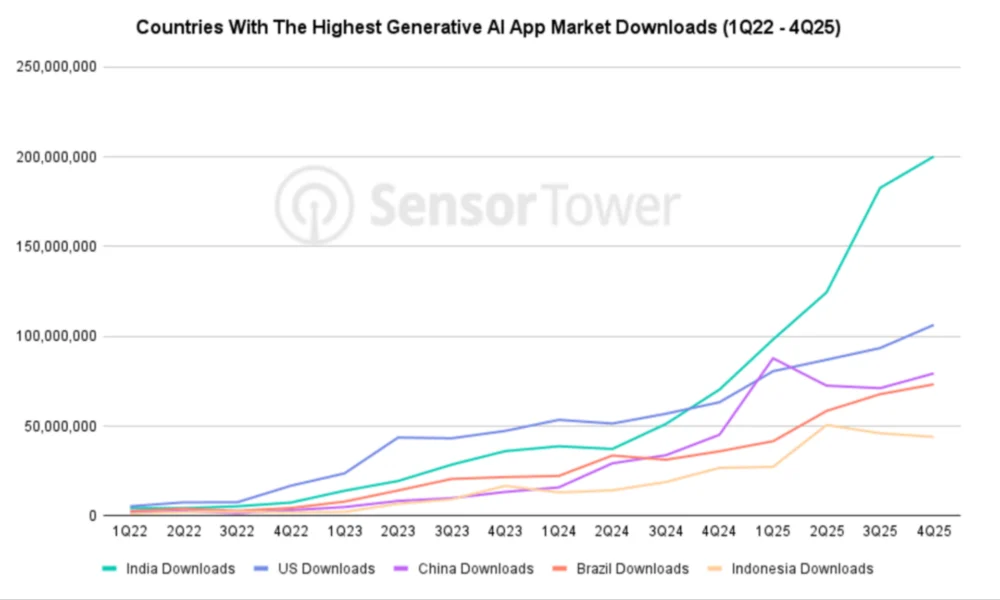
India, the world’s fourth-largest economy, stands at a critical juncture in its artificial intelligence journey as major tech players begin to transition from extensive free promotions to strategies aimed at cultivating a substantial base of paid subscribers. This strategic pivot follows a remarkable surge in generative AI app downloads, which propelled India to become the leading global market in 2025, significantly widening its lead over the United States. According to data from market intelligence firm Sensor Tower, India witnessed an astonishing 207% year-over-year increase in generative AI app installations.
The aggressive expansion of AI adoption in India was significantly fueled by the deliberate efforts of industry heavyweights such as OpenAI, Google, and Perplexity. These companies, acutely aware of India’s price-sensitive market, strategically rolled out extended free premium access to their AI applications. This approach was designed not only to accelerate user acquisition but also to embed their services within the daily digital routines of millions of Indian consumers. Furthermore, leading AI firms have demonstrated a strong commitment to India’s burgeoning AI ecosystem. This was vividly underscored by the recent major AI summit held in New Delhi, which attracted prominent figures from the global AI landscape, including OpenAI’s CEO Sam Altman, Anthropic’s CEO Dario Amodei, and Alphabet CEO Sundar Pichai. Their presence at the summit served as a powerful testament to India’s escalating influence and strategic importance in the global race for AI dominance.
However, the era of widespread complimentary AI access is gradually drawing to a close. Perplexity, for instance, concluded its bundled Pro offer with Indian telecommunications giant Airtel in January, signaling a move away from extended free access. Similarly, OpenAI’s complimentary ChatGPT Go service, which was a key driver of user growth, is no longer available in India. These shifts mark a crucial turning point, paving the way for a more definitive assessment of how many of the newly acquired users will successfully transition into paying subscribers, thereby validating the long-term monetization potential of the Indian market.
Despite the phenomenal growth in app downloads, India currently contributes a disproportionately small fraction to the overall revenue generated by AI applications. Sensor Tower data, shared exclusively with TechCrunch, reveals that India accounts for approximately 1% of in-app purchases within the generative AI app sector, even as it represents a substantial 20% of global downloads. This stark disparity highlights the significant monetization challenge that AI companies face in one of the industry’s most rapidly expanding markets. The journey from widespread adoption to sustainable revenue generation is proving to be a complex and multifaceted endeavor.
The acceleration of generative AI app adoption in India throughout 2025 was particularly pronounced, with download figures peaking in September and October. During these months, year-over-year growth rates reached impressive levels of approximately 320% and 260%, respectively. Yet, this surge in user engagement did not immediately translate into commensurate revenue gains. Data indicates that in November and December of 2025, in-app purchase revenue for AI applications in India experienced a month-over-month decline of 22% and 18%, respectively. The impact was even more pronounced for ChatGPT, where revenue dropped by 33% and 32% during the same period. This decline followed the November launch of the sub-$5 ChatGPT Go access, underscoring the immediate, albeit temporary, impact of aggressive promotional pricing on revenue metrics.
The dominance of ChatGPT in the Indian AI app market is undeniable, as it continues to command over 60% of the generative AI in-app revenue. Consequently, any adjustments to its pricing strategy or promotional offers can have a significant ripple effect on the overall performance of the Indian AI market. This underscores the critical importance of understanding user behavior and price sensitivity when formulating monetization strategies in this dynamic market.
The rapid expansion of generative AI app downloads in India during the past year can be attributed to a confluence of factors. Sensor Tower points to the launch of several new platforms, including DeepSeek, Grok, and Meta AI, which captured user interest and contributed to the overall growth. Concurrently, significant upgrades to established AI chatbots such as ChatGPT, Gemini, Claude, and Perplexity also played a crucial role in driving adoption. Beyond new product introductions, the viral appeal of AI-generated content has been a significant catalyst. Tools for content creation and editing emerged as highly popular, with seven of the top 20 most downloaded generative AI apps in India in 2025 falling into this category. This trend indicates a growing consumer interest in leveraging AI for creative expression and productivity.

The surge in user adoption has been equally remarkable on a global scale. In 2025, India accounted for approximately 19% of the global user base for leading AI assistant applications, surpassing the United States, which represented 10%. ChatGPT has maintained its leadership position in the Indian market in terms of monthly active users. However, its competitors, including Google’s Gemini and Perplexity, have also experienced substantial growth, particularly following their respective promotional offers. Earlier Sensor Tower data had already identified ChatGPT as the most downloaded generative AI app in India and globally in 2025. More recently, OpenAI’s CEO revealed that the chatbot now boasts over 100 million weekly active users in India, a staggering figure that highlights the immense scale of engagement within the country.
The widespread promotional campaigns in India are indicative of a broader strategic approach adopted by AI firms to mitigate pricing barriers in a market where value for money is a paramount consideration. The underlying bet is that early user adoption and sustained engagement will eventually translate into stronger long-term customer retention once the periods of free access conclude. Sneha Pandey, an insights analyst at Sensor Tower, explained that this strategy aims to build a loyal user base that will be more inclined to pay for premium features once they have experienced the benefits of AI firsthand.
India’s inherent appeal as a market for AI services lies in its vast digital infrastructure and burgeoning internet user base. With over a billion internet users and approximately 700 million smartphone owners, India represents one of the largest potential markets for AI services globally. This vast user pool makes it a critical battleground for tech companies vying for user growth and market share. The sheer scale of the addressable market presents an unparalleled opportunity for AI adoption and monetization.
Despite the impressive user growth, engagement levels in India still lag behind those in more mature markets. In 2025, users of leading AI chatbot applications in the United States spent approximately 21% more time per week interacting with these apps compared to their Indian counterparts. Furthermore, U.S. users logged an average of 17% more sessions, according to Sensor Tower data. This suggests that while Indians are readily adopting AI tools, deeper integration and sustained, high-frequency usage are still developing.
Pandey anticipates that AI in-app revenues in India will likely witness "meaningful but gradual improvement as users become more deeply integrated into these platforms, making sustained engagement paramount." This indicates a long-term perspective on revenue growth, emphasizing the importance of user stickiness and value realization over immediate monetization gains. The focus will likely shift towards enhancing user experience and demonstrating tangible benefits that justify subscription costs.
Moreover, Pandey highlighted that pricing pressure in India is expected to remain elevated due to the country’s young and value-conscious demographic. Consequently, AI companies will need to explore a range of pricing models to cater to this segment. This includes the introduction of lower-cost subscription tiers, the development of lucrative telecom bundles that integrate AI services, and the implementation of micro-transaction models for specific features or content. These strategies are crucial for achieving long-term retention and building a sustainable revenue stream in the Indian market.
As of January 2026, ChatGPT maintained its clear market leadership in India, boasting an impressive 180 million monthly active users. It was followed by Google’s Gemini, which garnered 118 million users, Perplexity with 19 million, and Meta AI with 12 million. These figures underscore both the immense AI opportunity that India presents and the escalating challenge for companies to effectively convert rapid user adoption into consistent and substantial revenue. The competitive landscape is intense, with established players and emerging platforms vying for user attention and loyalty.
While OpenAI, Google, and Perplexity did not immediately respond to requests for comment regarding their strategies for the Indian market, their actions and the data from Sensor Tower paint a clear picture of a sector undergoing a significant evolution. The transition from a free-access model to a paid-subscription framework represents a critical test for the AI industry in India, one that will likely shape the future of AI monetization not only in this rapidly growing economy but also in other emerging markets worldwide. The success of these strategies will depend on their ability to deliver compelling value propositions that resonate with a diverse and discerning user base, ultimately transforming India’s massive AI adoption into a robust and sustainable revenue engine. The coming months will be crucial in determining whether the initial enthusiasm for AI can be successfully translated into a thriving paid subscriber ecosystem.
