
 By admin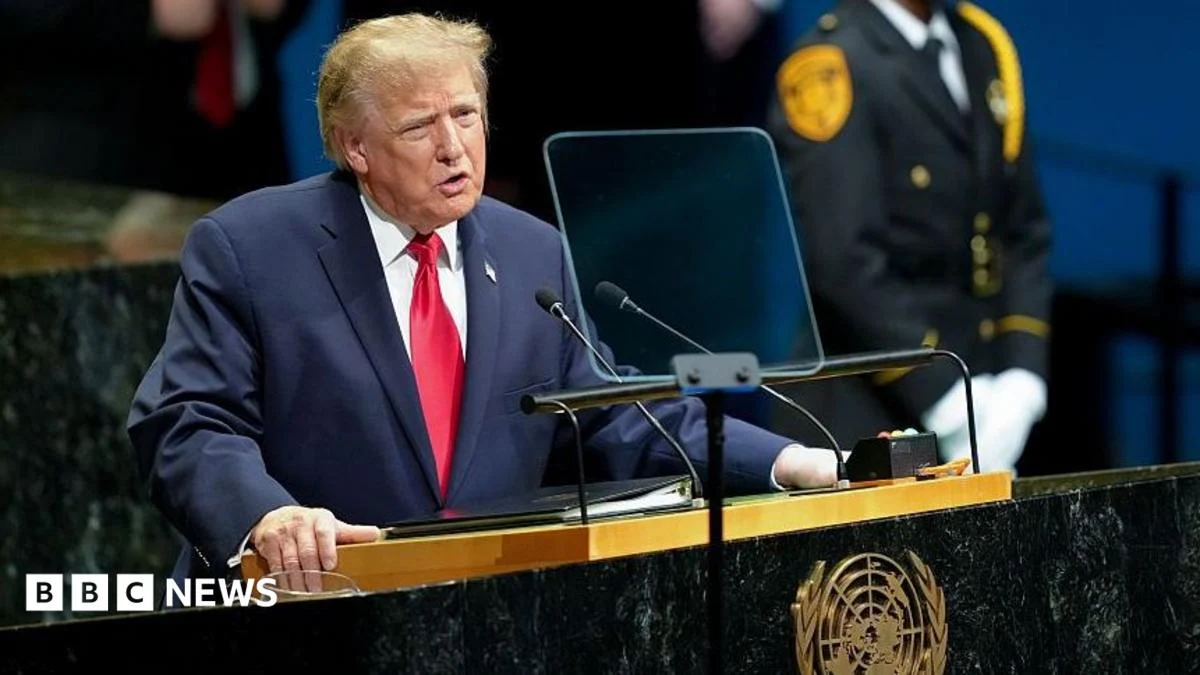
In a striking display of his signature "peace through strength" foreign policy, United States President Donald Trump, speaking at the United Nations General Assembly, articulated a vision for global stability rooted in ultimatums and overwhelming military might, rather than traditional diplomatic engagement. His remarks, delivered with characteristic boldness, suggested that the recent conflict with Iran had effectively deterred Tehran from pursuing nuclear weapons, thus validating his confrontational approach. "Will a deal be made with Iran that lets them rebuild and create a far greater country than it ever was before?" he posed rhetorically, immediately following with a stark dichotomy: "Or do I annihilate the Islamic Republic and do it quickly, never giving them a chance to kill and destroy people and countries again? Do I drive them into hell?" This stark framing underscored his belief that forceful deterrence, rather than negotiation or compromise, was the most effective path to preventing aggression.
Trump expressed confidence that an agreement with Iran, a diplomatic outcome that has thus far remained elusive, would materialize shortly after the upcoming November elections. This assertion aligns with his broader foreign policy strategy, often described as coercive diplomacy. This approach is characterized by the simultaneous deployment of overt threats of overwhelming force alongside the maintenance of open channels for negotiation. This dual-pronged strategy, while controversial, aims to pressure adversaries into concessions by demonstrating a credible willingness to use military power while leaving the door ajar for a negotiated settlement.
Adding a layer of tangible progress to his assertive rhetoric, Trump later informed reporters that American officials had engaged in a "very productive" three-hour meeting with the Iranian delegation on the sidelines of the General Assembly. This development was corroborated by Iran’s state television, which confirmed that Foreign Minister Abbas Araghchi had met with US Special Envoy to the Middle East Steve Witkoff. While no official comment was forthcoming from Tehran, the very fact of the meeting, facilitated by intermediaries, suggested a glimmer of diplomatic activity amidst the heightened tensions. When questioned by the BBC as he departed the UN building, Witkoff offered a succinct "thumbs up," a gesture that, while brief, conveyed a sense of positive engagement. He later elaborated in a post on X, formerly Twitter, stating that the talks had been held "through the mediators, who shuttled between the two sides throughout the day." He expressed hope that the discussions would prove "constructive and promising," adding that "the mediators will continue their work." This indirect communication, a hallmark of sensitive diplomatic overtures, indicated a carefully managed process aimed at de-escalating tensions without compromising national positions.
Beyond the Middle East, President Trump reiterated his conviction that his diplomatic initiatives would swiftly bring an end to Russia’s protracted war in Ukraine. Despite the ongoing tit-for-tat missile and drone strikes deep into each other’s territories, indicating a persistent stalemate, Trump remained optimistic. "We’re working very closely with the leaders of Russia and Ukraine, and we will get that one done," he declared. "It’s going to happen, I think, more quickly than people understand." This assertion comes at a time when diplomatic efforts to resolve the conflict have yielded limited breakthroughs, and the human cost continues to mount. The US Secretary of State, Marco Rubio, is slated to meet with Russian Foreign Minister Sergei Lavrov in New York, a meeting that, while not directly orchestrated by Trump, aligns with his stated commitment to brokering peace. The State Department confirmed this engagement, highlighting a continued, albeit potentially challenging, diplomatic track.
In a separate address, President Trump sought to assuage concerns surrounding the rapid advancement of artificial intelligence (AI), framing it as a domain where American leadership would not be ceded to China. He dismissed fears of AI’s potential downsides as alarmism and a "globalist scheme" to control the technology. Instead, Trump proposed renaming AI as "super intelligence," arguing that the term "artificial" inaccurately implies fakery. "The use of the word artificial makes it sound fake," he stated. "It’s not fake, it’s actually amazing. But we have to be careful." This reframing suggests an intent to embrace and harness AI’s capabilities while acknowledging the need for responsible development and deployment. This stance positions the US as a proactive player in the AI race, emphasizing innovation and national advantage.
Adding a concrete strategic move to his foreign policy agenda, Trump signed an agreement with the leaders of Denmark and Greenland on the sidelines of the General Assembly. This accord aims to bolster the US military presence on the North Atlantic island. The deal, while reaffirming Greenland’s sovereignty as an autonomous territory of Denmark, grants the United States broad access to its airspace and territory. This move signals a strategic reorientation, potentially aimed at enhancing American influence in the Arctic region and strengthening its defense posture against emerging geopolitical challenges.
Throughout his engagement at the UN, President Trump was engaged in a series of high-level bilateral meetings. He met with Ukrainian President Volodymyr Zelensky, British Prime Minister Andy Burnham, and leaders from Saudi Arabia, the United Arab Emirates (UAE), Qatar, Kuwait, Bahrain, and Oman. A particularly significant gathering involved leaders from several Arab and Islamic nations, where discussions focused on "current regional developments and the situation in the Middle East, as well as ways to consolidate security and stability," as stated by the UAE’s foreign minister. These meetings underscore Trump’s active engagement in addressing complex regional dynamics and fostering alliances.
Contrastingly, UN Secretary-General António Guterres, in his farewell address, offered a more somber assessment of the global landscape. He urged unnamed superpowers to recognize the limitations of their influence, stating, "The fault lines in our world are widening." Guterres cited escalating geopolitical rivalries, ongoing wars, the existential threat of climate change, and the transformative potential of artificial intelligence as key drivers of global instability. His remarks served as a poignant counterpoint to Trump’s more nationalistic and unilateralist pronouncements.
President Trump, in direct opposition to Guterres’s multilateralist sentiment, launched a scathing critique of international institutions, including the UN, which he accused of harboring a "far-left agenda of globalist bureaucrats who nobody ever elected." He instead championed the principles of national sovereignty and what he described as "unmatched" American military power. "There is no global government," he declared, emphasizing a vision of international relations based on the primacy of individual nation-states. This sentiment reflects a broader trend of rising nationalism and skepticism towards supranational organizations.
Further reinforcing his commitment to national interests, Trump issued a stern warning regarding threats in the Western Hemisphere. "If necessary, we will use our unmatched military might to secure the vital national interests of the United States," he proclaimed, signaling an assertive stance on regional security. This declaration comes amidst ongoing geopolitical shifts and potential challenges to American dominance in its traditional sphere of influence.
In a particularly contentious moment, President Trump accused Cuba’s communist government of cultivating ties with left-wing groups within the United States, specifically naming the Communist Party USA, Antifa, and the Democratic Socialists of America. As Trump’s remarks shifted to Cuba, the Cuban delegation reportedly walked out of the assembly chamber, a symbolic act of protest against his characterization of the island nation as a "failed state." This exchange highlighted the enduring ideological divides and historical animosities that continue to shape international relations. The incident underscored Trump’s willingness to confront adversaries directly and utilize the UN platform to voice his criticisms, even if it leads to diplomatic friction. The departure of the Cuban delegation, while not halting the proceedings, served as a visible manifestation of the deep divisions Trump’s rhetoric often engendered. This incident, coupled with his broader critique of international institutions, paints a picture of a leader who prioritizes a transactional and often adversarial approach to foreign policy, seeking to reshape the global order according to his own "America First" philosophy. The meetings and speeches at the UN, therefore, served not only as diplomatic engagements but also as a stage for Trump to articulate and advance his distinct vision of global governance, one characterized by assertive unilateralism, a belief in military supremacy, and a deep skepticism of multilateral cooperation.
