
 By Titik Puspa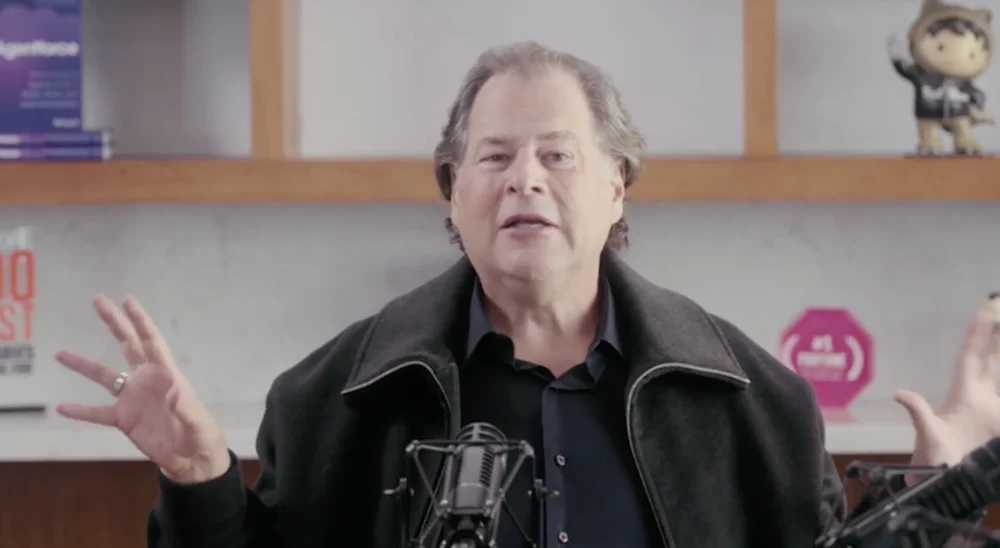
Boston, MA | June 9, 2026 – Salesforce, the undisputed titan of customer relationship management (CRM) and a bellwether for the broader software-as-a-service (SaaS) industry, found itself on the defensive this past Wednesday, not against a competitor, but against the existential anxieties rippling through the market concerning the transformative power of artificial intelligence. In a meticulously orchestrated presentation coinciding with its fourth-quarter earnings announcement, the company deployed an arsenal of financial prowess, strategic initiatives, and a compelling narrative to assuage investor fears that the burgeoning AI revolution might signal the twilight of its reign.
The numbers themselves painted a picture of robust health. Salesforce reported a stellar fourth quarter, raking in $10.7 billion in revenue, a significant 13% increase year-over-year. This impressive quarterly performance contributed to a formidable annual revenue of $41.5 billion, marking a healthy 10% ascent over the previous fiscal year. A substantial portion of this growth, analysts noted, can be attributed to the strategic $8 billion acquisition of data management powerhouse Informatica, a move completed last May. This acquisition, in particular, is seen as a crucial step in fortifying Salesforce’s data infrastructure, a critical component for any AI-driven enterprise.
Beyond top-line revenue, Salesforce demonstrated solid profitability, with net income landing at an impressive $7.46 billion. Looking ahead, the company offered optimistic guidance for the upcoming fiscal year, projecting revenues to reach between $45.8 billion and $46.2 billion, a solid 10% to 11% increase. Furthermore, its "remaining performance obligation" (RPO), a key indicator of future revenue under contract but not yet recognized, surged past the $72 billion mark. This substantial RPO figure signifies a deeply entrenched customer base and a strong pipeline of future revenue streams, providing a considerable cushion against market volatility.
However, the strength of these financial figures, while undeniable, could only partially counteract the prevailing market sentiment. Software-as-a-service stocks, with Salesforce often serving as their de facto standard-bearer, have been under considerable pressure. The specter of AI agents, capable of automating tasks traditionally performed by human employees, has ignited widespread investor apprehension, threatening to render the per-employee-seat subscription models that underpin the SaaS industry obsolete. This looming disruption has been grimly dubbed the "SaaSpocalypse."
The pervasive concern surrounding the "SaaSpocalypse" was palpable during the earnings call, so much so that CEO Marc Benioff himself referenced the term no less than six times. "You’ve heard about the SaaSpocalypse? And it isn’t our first. We’ve had a few of them," Benioff remarked, injecting a note of historical perspective into the discussion. He further elaborated, "If there is a SaaSpocalypse, it may be eaten by the Sasquatch because there are a lot of companies using a lot of SaaS because it just got better with agents." This colorful analogy aimed to reframe the AI revolution not as a destructive force, but as an evolutionary catalyst that enhances, rather than replaces, the value proposition of SaaS.
In a concerted effort to project an image of unwavering resilience and forward momentum, Salesforce unleashed a barrage of shareholder-friendly initiatives. The company announced a nearly 6% increase in its quarterly dividend, raising it to $0.44 per share. More significantly, it unveiled a massive $50 billion share buyback program. Such programs are perennial favorites among investors, as they serve a dual purpose: creating a consistent demand for the company’s stock in the open market and reducing the number of outstanding shares, a move that can artificially inflate the stock price and earnings per share.
The earnings call itself was a departure from the conventional format, masterfully blending elements of a podcast, an infomercial, and a traditional Q&A session with a smattering of Wall Street analysts. Eschewing a dry recitation of financial data, Benioff opted for a more engaging and persuasive approach. He conducted on-camera interviews with three prominent Salesforce customers, each of whom delivered glowing testimonials regarding their positive experiences with the company’s nascent agentic AI offerings. The featured executives included the CEOs of SharkNinja, a major home appliance company, and Wyndham Hotels and Resorts, a global hospitality giant. To underscore the industry-wide adoption and endorsement, SaaStr CEO, a prominent figure in the software industry conference and media space, was also present, reinforcing the widespread embrace of Salesforce’s AI advancements. The overarching message from these testimonials was unequivocally positive: these industry leaders are enthusiastically leveraging Salesforce’s AI agent products to drive tangible business outcomes.
To further quantify the value and impact of its AI agents, Salesforce introduced a novel performance metric: "agentic work units" (AWU). This new metric aims to move beyond the industry standard of counting "tokens," which represents the fundamental unit of AI processing volume. Instead, AWU is designed to measure more meaningful progress – specifically, whether an AI agent has successfully completed a verifiable task, such as writing data to a record, rather than merely generating text. As Salesforce president and CMO Patrick Stokes articulated during the call, "You can ask it a question and it can write you a poem, but that’s not really all that valuable in the enterprise world." AWU, therefore, seeks to capture the true utility of AI agents in an enterprise context by focusing on demonstrable task completion and verifiable actions. While Salesforce reported processing 19 trillion tokens last quarter, a staggering number in isolation, Stokes emphasized that in the rapidly expanding AI landscape, this volume is not as substantial as it might appear, highlighting the need for more sophisticated metrics like AWU.
Adding another layer to its strategic defense, Salesforce presented its own architectural vision for the future of AI-powered enterprise software. This vision positions SaaS platforms like Salesforce itself at the apex of the technology stack, effectively "owning most of the tech stack." In this model, AI model makers are relegated to the foundational layers, depicted as unseen, interchangeable, and commoditized "work engines." This counter-narrative directly challenges a prevailing fear that fueled a significant sell-off in SaaS stocks earlier this month. Following OpenAI’s launch of its enterprise agent platform, Frontier, a different architectural vision emerged, one that places OpenAI at the top of the stack, with systems-of-record SaaS providers – the foundational databases and business software platforms where companies store their critical data – serving as the "unseen engines" at the bottom. Salesforce’s proposed architecture, by contrast, asserts its own centrality and control within the evolving AI ecosystem.
As a final, perhaps symbolic, flourish to underscore its commitment to leading the AI charge, Benioff appeared on camera sporting a black leather jacket, an unmistakable sartorial echo of Nvidia CEO Jensen Huang, a figure synonymous with the current AI boom and his company’s dominant position in the field. This deliberate choice of attire was a clear signal to investors: Salesforce is not just adapting to the AI revolution; it intends to lead it, channeling the same disruptive energy and technological prowess that has propelled Nvidia to unprecedented heights. By presenting a united front of strong financial performance, strategic acquisitions, robust shareholder returns, innovative new metrics, and a compelling vision for the future, Salesforce made a powerful case for its continued relevance and dominance in the age of artificial intelligence, attempting to transform the narrative from one of impending obsolescence to one of AI-enhanced evolution.
