
 By admin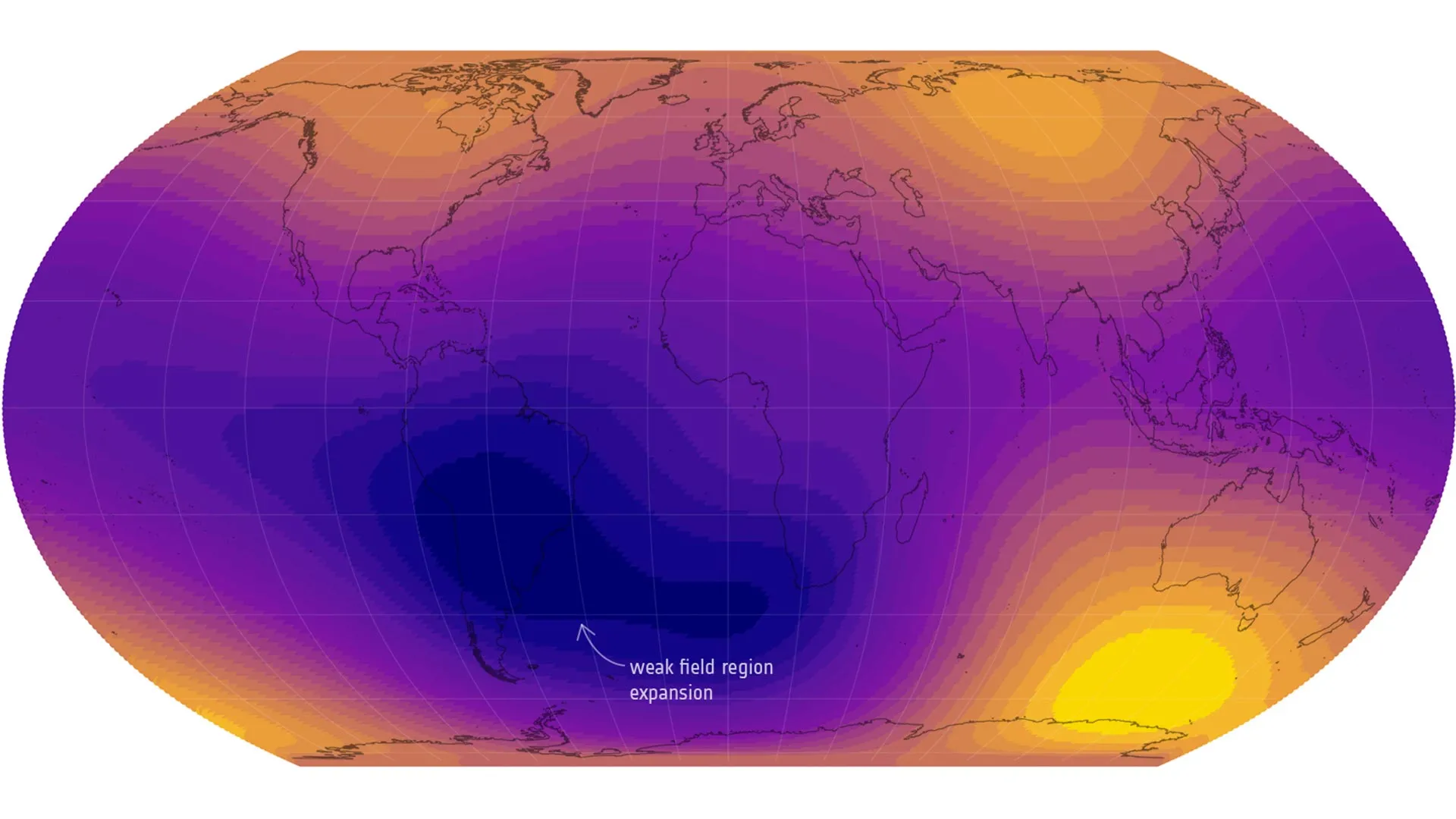
The South Atlantic Anomaly represents a vast region where Earth’s magnetic field strength is considerably lower than average. This weakness allows charged particles from the Sun, normally deflected by the stronger magnetic field at higher latitudes, to dip closer to the Earth’s surface. Satellites and spacecraft traversing the SAA are thus exposed to elevated levels of radiation, increasing the risk of technical malfunctions, hardware damage, and temporary outages. For instance, spacecraft electronics can experience "single-event upsets" – brief, high-energy particle strikes that can flip bits in computer memory, leading to errors or even system reboots. Over time, prolonged exposure can degrade sensitive components, shortening mission lifespans. Astronauts on the International Space Station, which orbits within the SAA’s influence, also receive slightly higher radiation doses when passing through this zone, necessitating careful monitoring and shielding.
Earth’s magnetic field plays a critical role in making the planet livable. It acts as an indispensable protective barrier, shielding us from harmful cosmic radiation and a continuous stream of charged particles known as the solar wind, which emanate from the Sun. Without this magnetosphere, the solar wind would gradually strip away our atmosphere, rendering Earth barren and uninhabitable, much like Mars is believed to have become. This magnetic field is not a static entity; it is a complex, ever-changing phenomenon driven by processes deep within our planet.
How Earth Generates Its Magnetic Field
The magnetic field is produced deep inside the planet, originating from what scientists call the geodynamo. Roughly 3,000 kilometers below the surface lies Earth’s outer core, a vast ocean of superheated, molten liquid iron and nickel. This metallic fluid, under immense pressure and temperature, is in constant, turbulent motion. Convection currents, driven by heat escaping from the even hotter solid inner core, cause the electrically conductive material to churn and flow. As this molten metal moves, it generates electric currents through a process akin to a self-exciting dynamo. These electric currents, in turn, create the ever-changing electromagnetic field that envelops Earth. While it can be loosely compared to the motion of a spinning conductor in a bicycle dynamo, the true processes driving the field are far more intricate, involving complex interactions between fluid dynamics, electromagnetism, and the Coriolis effect caused by Earth’s rotation. The field is not a simple bar magnet; it has a dominant dipolar component but also significant non-dipolar components that cause its strength and orientation to vary across the globe and over time.
To meticulously study this dynamic field, the European Space Agency (ESA) developed the Swarm mission under its Earth Observation FutureEO program. Launched in November 2013, Swarm consists of three identical satellites orbiting in formation. Each satellite is equipped with highly sensitive magnetometers and advanced positioning systems that enable them to measure magnetic signals originating from multiple sources: Earth’s core (the primary source), the mantle, the crust (remnant magnetism from past geological activity), and even the oceans (tidal movements of seawater generating faint magnetic signals). Furthermore, Swarm captures contributions from the ionosphere and magnetosphere, which are layers of Earth’s upper atmosphere and the space region directly influenced by the planet’s magnetic field, respectively.
These detailed and precise observations are crucial for scientists. They allow researchers to separate the different sources of magnetism, disentangling the deep internal processes from external influences. This unprecedented clarity is vital for better understanding why the magnetic field is weakening in some regions, like the South Atlantic, while simultaneously strengthening in others. The long-term, high-resolution data provided by Swarm is indispensable for building accurate global magnetic field models, which are essential for a wide range of applications.
Why the South Atlantic Anomaly Matters
The South Atlantic Anomaly was first identified in the 19th century, then situated largely southeast of South America. Its historical presence highlights that the anomaly is not a new phenomenon, but its recent rapid expansion and intensification are causes for significant scientific and operational concern. Today, it is one of the most closely monitored regions on Earth due to its critical implications for space safety and infrastructure.
New findings, published in the esteemed journal Physics of the Earth and Planetary Interiors, provide a comprehensive analysis of the anomaly’s evolution. The research reveals that the SAA expanded steadily between 2014 and 2025. However, since 2020, a specific area of the Atlantic southwest of Africa has experienced an even more rapid and pronounced magnetic weakening. This localized acceleration suggests complex underlying processes.
"The South Atlantic Anomaly is not just a single block of weakening," explains lead author Chris Finlay, a distinguished Professor of Geomagnetism at the Technical University of Denmark (DTU Space). "It’s changing differently towards Africa than it is near South America. There’s something special happening in this region that is causing the field to weaken in a more intense way, suggesting heterogeneous dynamics within the core." This differentiation underscores the highly localized nature of core processes and their surface manifestations.
Reverse Flux Patches and Core Dynamics
Scientists link this unusual and accelerating behavior to specific patterns observed in the magnetic field at the boundary between Earth’s liquid outer core and its solid mantle – a critical interface known as the core-mantle boundary (CMB). These features are known as "reverse flux patches." They represent areas where the magnetic field behaves in an unexpected way, deviating significantly from the dominant dipolar field that normally emerges from the core.
Professor Finlay elaborates on this phenomenon: "Normally we’d expect to see magnetic field lines coming out of the core in the southern hemisphere, following the general pattern of a south magnetic pole. But beneath the South Atlantic Anomaly, we observe anomalous areas where the magnetic field, instead of coming out of the core, appears to go back into the core, or at least is oriented in the opposite direction. Thanks to the high-fidelity Swarm data, we can now clearly see one of these reverse flux patches moving westward over Africa, and this movement directly contributes to the intensified weakening of the South Atlantic Anomaly in this particular region."
These reverse flux patches are thought to be manifestations of complex, non-dipolar magnetic fields generated by turbulent fluid flow within the outer core. The interaction between the flowing molten iron and the irregular topography or thermal variations of the solid mantle at the CMB can create localized eddies and vortices, leading to these anomalous field orientations. The westward drift of these patches is consistent with the general westward drift observed in Earth’s non-dipolar magnetic field components, a phenomenon that has puzzled geophysicists for decades and is linked to the relative rotation of the liquid outer core with respect to the solid mantle. Understanding the precise mechanisms behind these patches is crucial for predicting the future evolution of the SAA and the overall magnetic field.
Swarm Sets a New Magnetic Record
The latest magnetic field model, incorporating the most recent Swarm data, marks an important milestone for the mission. Swarm now holds the longest continuous space-based record of Earth’s magnetic field. This unbroken decade-plus stream of data is invaluable for tracking subtle, long-term changes in the geodynamo, providing an unprecedented window into the planet’s deep interior.
Launched on November 22, 2013, as the fourth Earth Explorer mission, the Swarm satellites were initially designed to test advanced Earth observation technologies and provide data for a planned four-year operational life. However, thanks to their robust design and dedicated mission control, they have far exceeded their planned lifetime. Their continued operation has made them essential for maintaining long-term magnetic field records, supporting a multitude of operational services, and guiding the design and calibration of future satellite missions that rely on accurate geomagnetic models.
Swarm measurements form the foundational basis of global magnetic models, such as the World Magnetic Model (WMM) and the International Geomagnetic Reference Field (IGRF). These models are indispensable for navigation systems (from smartphones to aircraft), tracking space weather hazards (which can impact power grids and communications), and studying Earth’s system from its deep interior processes to the intricate dynamics of the upper atmosphere and magnetosphere. The continuity of this data ensures that these vital models remain accurate and up-to-date, reflecting the constantly changing magnetic landscape.
Magnetic Field Strength Grows Over Siberia
The new results from Swarm also vividly highlight how incredibly dynamic and geographically varied Earth’s magnetism truly is. While the South Atlantic Anomaly represents a region of significant weakening, other areas of the globe are experiencing strengthening. In the southern hemisphere, beyond the SAA, there is one particularly strong magnetic region. In the northern hemisphere, there are two such areas: one near Canada and another over Siberia.
"When you’re trying to understand Earth’s magnetic field, it’s important to remember that it’s not just a simple dipole, like a bar magnet, with perfectly aligned north and south poles," emphasizes Professor Finlay. "It’s a far more intricate, multi-polar structure that is constantly in flux. It’s only by having sophisticated satellite constellations like Swarm that we can fully map this complex structure and observe its dynamic changes in unprecedented detail."
Since Swarm began operating, the magnetic field over Siberia has demonstrably intensified, while, conversely, the field over Canada has weakened. The strong magnetic region over Canada has shrunk by approximately 0.65% of Earth’s surface area, which is roughly comparable to the landmass of India. In stark contrast, the Siberian strong field region has expanded by about 0.42% of Earth’s surface area, an area comparable to the size of Greenland.
These shifts are not isolated events; they are profound manifestations of the complex and turbulent activity within Earth’s liquid outer core. These regional changes are intrinsically connected to the gradual movement of the northern magnetic pole, which has been steadily migrating toward Siberia in recent years, accelerating its pace. This ongoing geographical shift affects a wide array of navigation systems, particularly those that rely on magnetic compasses or models of Earth’s magnetic field. Constant updates to magnetic models are required to account for this pole shift and the dynamic balance between these strong and weak magnetic regions, ensuring reliable navigation and reducing errors.
ESA’s Swarm Mission Manager, Anja Stromme, expresses enthusiasm for the mission’s achievements and future potential: "It’s truly wonderful to see the big picture of our dynamic Earth thanks to Swarm’s extended timeseries. The satellites are all healthy and providing excellent data, so we can hopefully extend that record beyond 2030. Reaching this milestone would be particularly valuable as it would encompass a significant portion of the upcoming solar minimum, a period when the Sun’s activity is reduced, allowing for even clearer, more unprecedented insights into our planet’s intrinsic magnetic field dynamics without significant interference from external solar influences." The continued operation of Swarm represents a critical investment in understanding the fundamental processes that make Earth a habitable planet, safeguarding our technological infrastructure, and pushing the boundaries of geophysical science.