
 By admin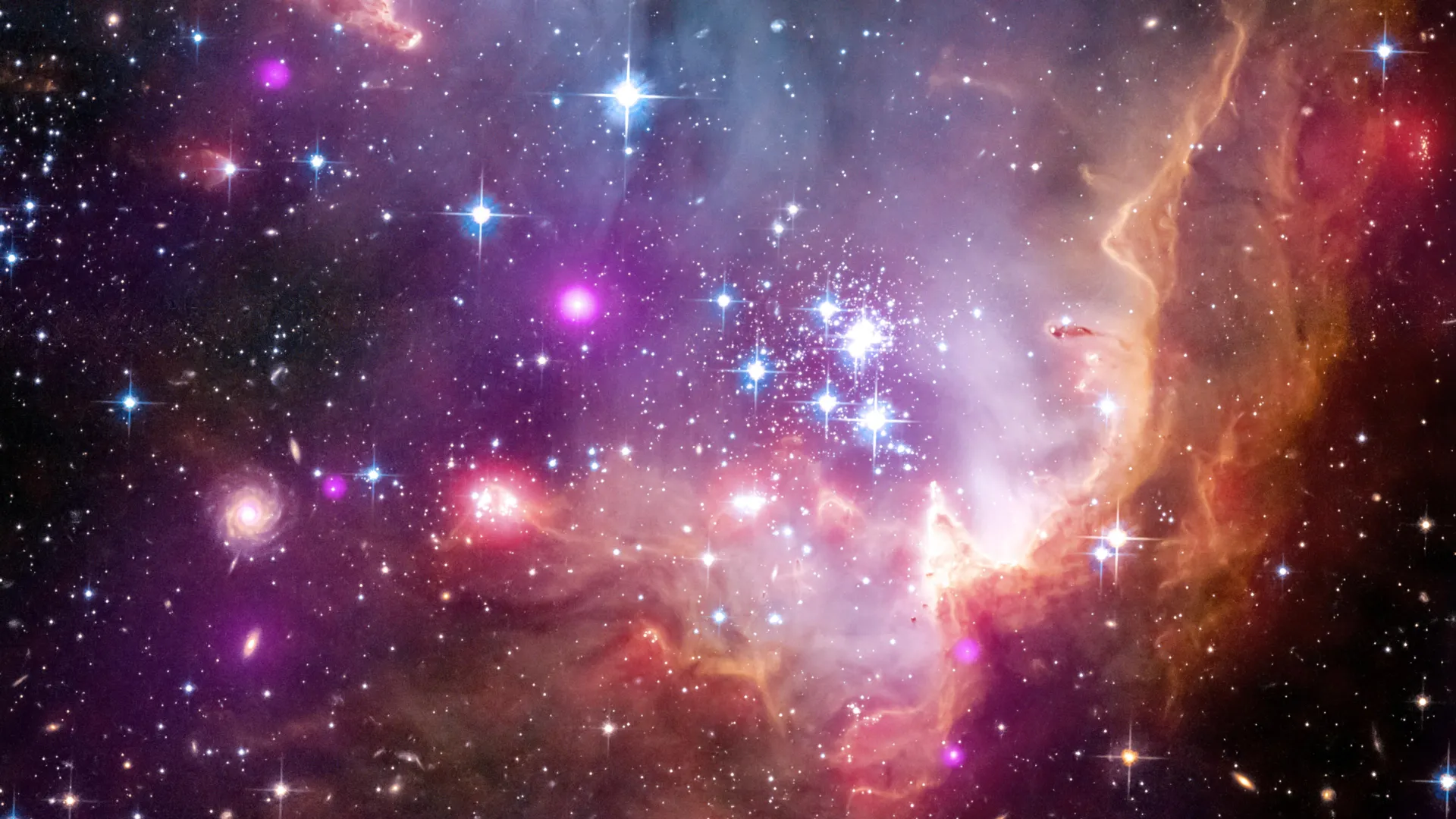
Yet, despite this intensive scrutiny and the wealth of observational data accumulated over generations, a profound and fundamental puzzle had stubbornly remained unresolved. Unlike the vast majority of galaxies observed across the cosmos, where stars typically trace predictable, orderly orbits around a central gravitational hub, the stars within the Small Magellanic Cloud exhibited a perplexing lack of coherent rotation. This anomaly defied conventional astrophysical models and left scientists searching for a compelling explanation for the SMC’s unusually chaotic internal dynamics. The discrepancy was not merely an academic curiosity; it represented a significant challenge to our understanding of how galaxies coalesce, organize, and evolve over cosmic timescales, particularly for dwarf galaxies that are thought to be more representative of the building blocks of the early universe.
Collision Explains Missing Stellar Rotation and Redefines Galactic Archetype
New groundbreaking research, recently published in the esteemed pages of The Astrophysical Journal, has now pointed to a dramatic and revelatory answer to this long-standing enigma. A dedicated team of astrophysicists from the University of Arizona, leveraging sophisticated computational simulations and novel analytical techniques, has concluded that the Small Magellanic Cloud’s peculiar and disordered stellar behavior is not an intrinsic property, but rather the direct and enduring consequence of a violent, head-on collision with its larger sibling, the Large Magellanic Cloud. This seminal finding not only provides a definitive explanation for the SMC’s missing stellar rotation but also casts a profound shadow of doubt over its long-held status as a pristine, standard example for understanding the fundamental processes of how galaxies formed and evolved throughout the universe’s expansive history. The implications are far-reaching, potentially necessitating a re-evaluation of numerous studies that have previously relied on the SMC as a benchmark for comparison.
"We are, in essence, seeing a galaxy transforming in live action," articulated Himansh Rathore, a brilliant graduate student at the University of Arizona’s Steward Observatory and the lead author of this pivotal paper. His words underscore the extraordinary nature of this observation. In the realm of astronomy, where timescales often stretch into billions of years, witnessing such a profound gravitational interaction and its immediate aftermath is akin to watching a cosmic experiment unfold before our very eyes. "The SMC," Rathore continued, "gives us a unique, front-row view of something very transformative – a process that is critical to how galaxies evolve and restructure themselves in response to external forces." This perspective highlights the unparalleled opportunity the SMC now presents: not as a static example of evolution, but as a dynamic laboratory for studying the violent gravitational choreography that shapes galactic destinies.
Gas, Gravity, and Disrupted Motion: Unpacking the Catastrophic Event
To fully appreciate the significance of this discovery, it is crucial to understand the normal developmental trajectory of galaxies. The Small Magellanic Cloud is particularly rich in gas, containing more mass in diffuse interstellar gas than it does in stars. Under typical astrophysical conditions, gas within a galaxy gradually cools and, under the relentless pull of gravity, settles into a rotating disk-like structure. This fundamental process is precisely what shaped our own solar system, forming a flat, spinning plane of planets and debris from a primordial gas cloud. Similarly, in larger spiral galaxies like the Milky Way, the vast majority of stars and gas reside within a relatively thin, rotating disk, their collective motion maintaining a stable, ordered structure. However, earlier, highly precise measurements conducted using the venerable Hubble Space Telescope and the European Space Agency’s Gaia satellite – the latter renowned for its unparalleled ability to map the positions and motions of billions of stars – had unequivocally demonstrated that the SMC’s stars were conspicuously failing to follow this expected, orderly pattern. Their movements were jumbled, incoherent, and lacked the systematic rotational signature that defines most disk galaxies.
According to Rathore and his team, the most probable cause for this dramatic deviation from galactic norms is a catastrophic collision that occurred approximately a few hundred million years ago – a relatively recent event in cosmic terms. During this tumultuous encounter, the Small Magellanic Cloud is believed to have plunged directly through the disk of its larger companion, the Large Magellanic Cloud. This wasn’t a glancing blow, but a deep penetration, a direct passage that unleashed immense gravitational and hydrodynamic forces.
The gravitational forces at play during such an event would have been immense. As the SMC traversed the LMC’s disk, the powerful tidal forces exerted by the LMC would have dramatically disrupted the SMC’s delicate gravitational equilibrium. These forces would have acted like a cosmic wrench, twisting and pulling at the SMC’s structure, effectively scattering its stars into disorganized, non-orbital motions. Imagine a swarm of bees suddenly flying through a strong crosswind – their individual paths become erratic and chaotic, losing their collective direction. Similarly, the stars of the SMC, once potentially part of a more ordered system, were gravitationally jolted into a state of disarray.
Simultaneously, a second, equally destructive process would have been at work: ram pressure stripping. The Large Magellanic Cloud, being a larger galaxy, possesses a denser and more extensive halo of interstellar gas. As the SMC, with its own considerable gas content, "punched through" this dense environment, it would have experienced a profound drag force. "Imagine sprinkling water droplets on your hand and moving it through the air – as the air rushes past, the droplets get blown off because of the pressure it exerts," Rathore explained, using a vivid analogy to illustrate this complex phenomenon. "Something very similar happened to the SMC’s gas as it punched through the LMC." This ram pressure would have effectively stripped away the SMC’s gas, not just physically removing some of it, but crucially, also stripping away any pre-existing rotational motion within the remaining gas. The combination of gravitational disruption and ram pressure stripping provides a comprehensive explanation for both the scattered stellar motions and the loss of gas rotation.
Solving a Decades-Old Illusion: The Gas Rotation Paradox
The study also brilliantly resolves another perplexing and long-standing contradiction regarding the SMC’s gas dynamics. For many years, observations of the gas within the Small Magellanic Cloud had consistently suggested that it was rotating. This presented a significant paradox: if the gas, the very material from which stars are born, was rotating, then stars, which typically inherit the motion of their progenitor gas clouds, should also exhibit some degree of rotation. Yet, as established by Hubble and Gaia, the stars stubbornly refused to conform to this expectation, leaving astronomers with a glaring inconsistency in their models.
The new analysis, informed by the collision hypothesis, reveals that this apparent gas rotation was, in fact, a misleading illusion – a trick of perspective born from the violent interaction. The collision not only disrupted the SMC’s internal structure but also physically stretched the dwarf galaxy into an elongated shape. When viewed from Earth, gas moving towards us along one end of this stretched structure and gas moving away from us along the other end could easily be misinterpreted as a coherent rotational pattern. This phenomenon, known as line-of-sight velocity gradients, can mimic rotation even in systems that are merely expanding, contracting, or, in this case, stretched and undergoing complex internal motions due to a recent impact. The researchers’ detailed simulations demonstrated how such a stretched configuration, with its inherent internal velocity dispersion, would produce the observed spectroscopic signatures that were previously attributed to actual rotation, finally reconciling the seemingly contradictory observations of gas and stellar kinematics.
Rethinking a Cosmic Benchmark: The SMC’s Altered Identity
For many decades, the Small Magellanic Cloud has held a uniquely important position in astrophysics, serving as a critical reference point – a cosmic benchmark – for studying how galaxies form stars, process heavy elements, and evolve over cosmic time. Its relatively small size, remarkably high gas content, and, crucially, its low abundance of heavy elements (what astronomers call ‘metallicity’) made it an almost ideal analogue for the dwarf galaxies that were prevalent in the early universe, billions of years ago. By studying the SMC, astronomers hoped to gain insights into the conditions and processes that governed the formation and evolution of the very first galaxies. These new findings, however, fundamentally challenge that long-held role.
"The SMC went through a catastrophic crash that injected a lot of energy into the system. It is not a ‘normal’ galaxy by any means," affirmed Dr. Gurtina Besla, a co-author on the paper and a leading expert in Magellanic Cloud dynamics. Her statement underscores the profound shift in understanding. A ‘normal’ galaxy, in this context, would be one whose evolution is primarily driven by internal processes like gas cooling, star formation, and its own gravitational potential, largely undisturbed by major external influences. The SMC, having undergone such a violent and recent collision, is clearly far from ‘normal.’ Its internal dynamics, gas distribution, and star formation history have been dramatically altered by this external impact, making it an unreliable model for galaxies evolving in isolation or under gentler conditions. This realization necessitates a careful re-evaluation of previous studies that used the SMC as a pristine model for early universe galaxies, potentially leading to revised conclusions about star formation efficiencies and chemical enrichment in the cosmos’s infancy.
To reach these definitive conclusions, the research team employed a rigorous methodology centered on detailed computer simulations. These sophisticated models meticulously matched all the known properties of both the Small and Large Magellanic Clouds, including their precise gas content, estimated stellar masses, and their observed positions and velocities relative to the Milky Way. These cosmological simulations, running on powerful supercomputers, allowed the researchers to wind back the clock and recreate the gravitational dance and subsequent collision with unprecedented accuracy. They combined these robust models with intricate theoretical calculations to understand precisely how the SMC’s gas behaved as it moved through the LMC’s denser environment, particularly focusing on the effects of ram pressure stripping. Furthermore, the team developed innovative new techniques specifically designed to interpret the complex, scrambled motions of stars within a galaxy that has recently experienced such a profound and violent collision, allowing them to disentangle the chaotic signals and identify the underlying cause.
The significance of this reclassification cannot be overstated. Because the SMC’s small size, high gas content, and low abundance of heavy elements made it a key comparison for galaxies observed in the early universe through distant telescopes, its altered status has wide-ranging implications. If it is still actively recovering from a major collision, with its internal dynamics fundamentally perturbed, it may no longer serve as a reliable, pristine model for understanding the initial conditions and evolutionary pathways of the universe’s earliest galactic structures. This shift will likely prompt astronomers to seek out other, less perturbed dwarf galaxies as analogues or to develop more sophisticated models that account for the prevalent role of interactions in shaping galactic evolution.
Clues About Dark Matter From a Galactic Impact
Intriguingly, the reverberations of this cosmic collision extend beyond merely explaining the SMC’s internal chaos, potentially offering new insight into one of the universe’s most elusive components: dark matter. In a separate, highly anticipated study slated for publication in 2025, the same University of Arizona team has found compelling evidence that the impact left a distinct and visible mark on the Large Magellanic Cloud itself. Its prominent central bar-shaped structure, a common feature in many spiral galaxies, is observed to be tilted significantly out of the galaxy’s main plane – a pronounced warp directly linked to the gravitational disturbance caused by the SMC’s passage.
Rathore elaborated on this fascinating connection, explaining that the precise degree of this tilt, the extent to which the LMC’s bar is warped, is directly dependent on how much dark matter the Small Magellanic Cloud actually contains. Dark matter, a mysterious substance that makes up roughly 27% of the universe’s mass, cannot be observed directly as it does not emit, absorb, or reflect light. Its presence is only inferred through its powerful gravitational influence on visible matter. This newly identified relationship between the LMC’s bar tilt and the SMC’s dark matter content offers a novel and indirect way to estimate the amount and distribution of dark matter within dwarf galaxies – a crucial piece of the puzzle for understanding galactic formation and the fundamental properties of dark matter itself. It represents a truly innovative approach to probing the invisible scaffolding of the cosmos.
"We are used to thinking of astronomy as a snapshot in time, a static image of the universe," Rathore reflected, encapsulating the profound shift in perspective this research demands. "But these two galaxies have come very close together, gone right through one another, and transformed into something fundamentally different from what they once were." This powerful statement serves as a reminder that the universe is not a frozen tableau but a dynamic, ever-evolving arena of gravitational interactions, collisions, and transformations. The Small Magellanic Cloud, once a quiet enigma, has now become a vibrant testament to the violent, beautiful, and endlessly surprising processes that sculpt the galaxies around us. This research not only solves a decades-old puzzle but opens new avenues for understanding galactic dynamics, the evolution of cosmic benchmarks, and the elusive nature of dark matter, promising a richer and more nuanced picture of our galactic neighborhood.