
 By Isnaini Azizah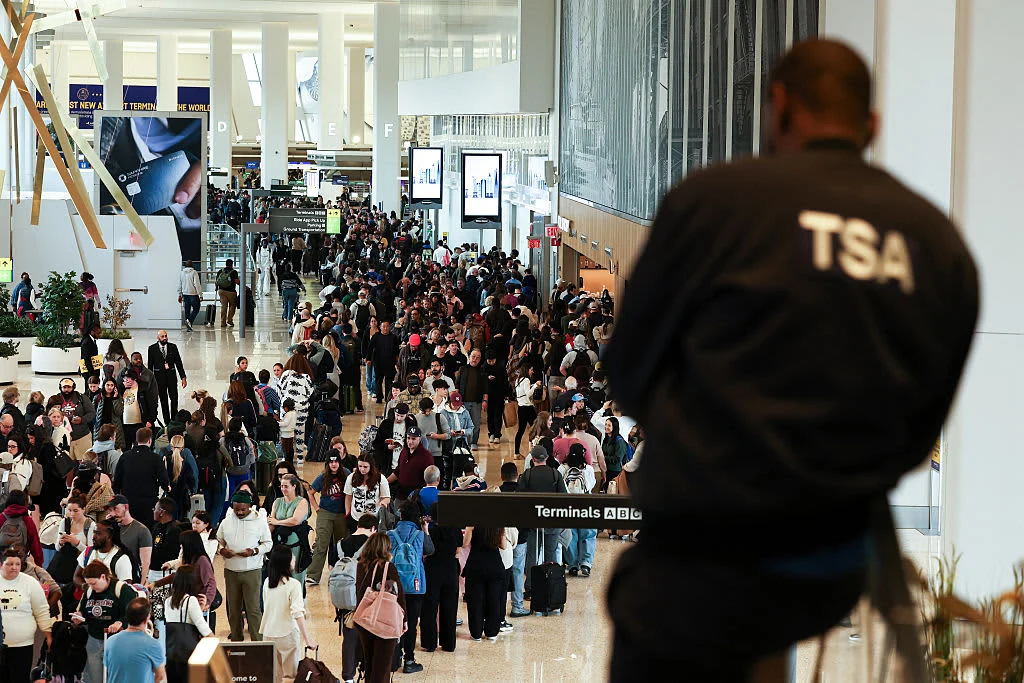
The early morning hours at John F. Kennedy International Airport on Monday, March 23, 2026, were defined not by the efficient hum of global commerce, but by a sprawling, stagnant sea of frustrated travelers. Among them was Andrew Leonard, a 34-year-old performing arts teacher from New York, who arrived at Terminal 8 at 4:45 a.m., more than two hours ahead of his 7:00 a.m. departure to Seattle. Despite his early arrival and familiarity with the terminal’s layout, Leonard found himself ensnared in a security queue that stretched deep into the departures hall, threatening his connection to a long-awaited family vacation in Hawaii.
"I fly out of this terminal all the time and this is insane," Leonard remarked as he finally approached his gate, making it just as the final boarding call echoed through the PA system. His experience is no longer an outlier but a representative snapshot of a burgeoning national crisis. Across the United States, major aviation hubs including Atlanta’s Hartsfield-Jackson, Houston’s George Bush Intercontinental, and New York’s primary gateways are grappling with unprecedented security wait times. The catalyst for this systemic failure is a critical shortage of Transportation Security Administration (TSA) officers, driven by a partial government shutdown that has entered a grueling second month.
The current impasse stems from a high-stakes political battle in Washington D.C. over the funding of the Department of Homeland Security (DHS). As of this week, more than 50,000 TSA officers are facing their second consecutive missed full paycheck. The shutdown, which began in mid-February 2026, was triggered by a legislative deadlock in the Senate. Democratic lawmakers have refused to release DHS funding until significant reforms are made to federal immigration enforcement protocols. This demand followed a controversial incident in Minneapolis where two U.S. citizens were shot and killed during a confrontation with federal officers, an event that has ignited a national debate over the scope of DHS authority and the necessity of stricter oversight.
As the shutdown persists, the morale and financial stability of the TSA workforce have reached a breaking point. The American Federation of Government Employees (AFGE), the union representing TSA workers, reported that hundreds of officers have resigned in recent weeks, unable to sustain their households without a reliable income. Many of those who remain on the job are calling out of work at record rates, citing financial hardship or the need to find alternative, paid employment to cover basic living expenses. This "blue flu" effect has gutted staffing levels at checkpoints, forcing airports to consolidate lanes and, in some cases, close entire security wings.
In a controversial move to mitigate the growing lines, White House border czar Tom Homan announced on Sunday that the administration would begin deploying Immigration and Customs Enforcement (ICE) agents to major airports starting Monday morning. The rationale, according to Homan, is to utilize federal personnel who are currently funded or deemed essential in other capacities to provide operational relief to the TSA.
"We’re simply there to help TSA do their jobs in areas that don’t need their specialized expertise," Homan told CNN’s "State of the Union." He explained that ICE agents would be tasked with non-screening duties, such as guarding exit doors, managing queue flow, and performing perimeter checks. By offloading these responsibilities, the administration hopes to free up certified TSA screeners to focus exclusively on the technical aspects of passenger and baggage inspection.
However, the visibility of this reinforcement was minimal during the early hours of Monday at JFK’s Terminal 8. Travelers and airport staff reported seeing few, if any, ICE agents at the checkpoints, raising questions about the speed and scale of the deployment. Neither the DHS nor the TSA provided immediate clarification on the specific deployment schedules or the total number of agents being reassigned from their primary immigration enforcement duties. Critics of the plan argue that moving ICE agents to airports is a "Band-Aid solution" that fails to address the underlying issue of unpaid federal workers while potentially compromising enforcement efforts elsewhere.
The travel industry, already sensitive to the volatility of government stability, has reacted with mounting alarm. Airline executives and industry trade groups have issued blistering statements condemning the legislative gridlock. The consensus among aviation experts is that the national airspace system is being used as a political pawn, with long-term consequences for the economy.
"The aviation industry is a cornerstone of the U.S. economy, contributing trillions of dollars to the GDP," said one senior airline analyst. "When you destabilize the security apparatus that allows this system to function, you aren’t just inconveniencing travelers like Andrew Leonard; you are stifling commerce, disrupting supply chains, and damaging the international reputation of the U.S. travel market."
Historical precedents offer a grim outlook on how such shutdowns conclude. In early 2019, a 35-day shutdown—the longest in U.S. history—ended only after air traffic controllers began calling out in numbers large enough to cause massive delays at LaGuardia and Newark, effectively grounding flights along the East Coast. A similar, albeit shorter, disruption occurred in late 2025. While air traffic controllers are not currently seeing their pay affected by the 2026 DHS impasse, the precedent suggests that the government only moves toward a resolution when the "pain threshold" of the traveling public and the commercial aviation sector becomes politically unbearable.
Compounding the misery for New York travelers this week was a significant operational setback at LaGuardia Airport. On Sunday night, an Air Canada Express jet collided with an emergency vehicle on the tarmac, leading to a temporary closure of the airport on Monday morning. The incident forced hundreds of passengers to scramble for alternative flights, with many diverting to JFK. This sudden influx of diverted passengers exacerbated the already dire situation at JFK’s security checkpoints, creating a perfect storm of logistical failures.
The human element of the shutdown is perhaps its most poignant aspect. TSA officers, many of whom live paycheck to paycheck, are being asked to perform high-stress security work while facing eviction notices or the inability to pay for childcare. "We are asking people to protect our national security while we simultaneously deny them the means to provide for their own families," said a representative for the AFGE. "It is an unsustainable and dangerous situation. You cannot expect peak performance from a workforce that is being treated with such systemic indifference."
The political landscape remains fraught. Senate Democrats have signaled that they are prepared to hold their ground on immigration reform, viewing the DHS funding bill as their primary lever for change. Conversely, the administration and its allies in Congress have accused the opposition of "holding the American traveler hostage" for a domestic policy agenda. As the rhetoric sharpens, the prospect of a swift resolution seems dim.
The economic data following the 2019 shutdown showed that the U.S. economy lost approximately $11 billion, with $3 billion of that never being recovered. Economists warn that a prolonged 2026 shutdown could see even higher losses, particularly if the ICE deployment fails to significantly reduce wait times. If travelers begin to preemptively cancel trips due to the uncertainty of airport security, the ripple effect will be felt across the hospitality, tourism, and corporate sectors.
For travelers like Andrew Leonard, the high-level political machinations matter less than the immediate reality of a missed flight or a ruined vacation. As he finally boarded his flight to Seattle, the sense of relief was tempered by the knowledge that his return trip might be even more chaotic. "You pay your taxes, you follow the rules, and you expect the basic functions of government to work," Leonard said. "When they don’t, it feels like the whole system is fraying at the edges."
As the sun rose over the tarmac at JFK on Monday, the lines showed no sign of receding. With more than 50,000 officers waiting on a resolution that remains buried in partisan bickering, the American aviation system remains in a state of high-altitude anxiety. The deployment of ICE agents may provide a temporary reprieve, but the fundamental instability of a security infrastructure staffed by unpaid professionals remains a looming threat to the nation’s mobility and safety. For now, the "insanity" Leonard witnessed at 4:45 a.m. has become the new, albeit temporary, American standard.