
 By admin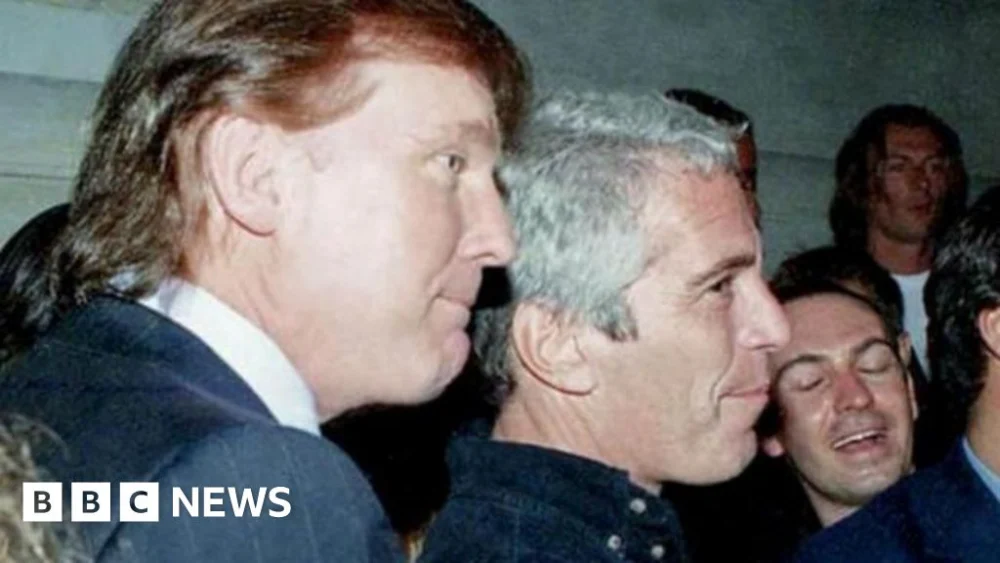
Washington D.C. – A senior Democrat on the congressional committee investigating Jeffrey Epstein has leveled serious accusations against the U.S. Department of Justice, alleging that the department is deliberately withholding crucial files that contain allegations of sexual abuse of a minor against President Donald Trump. Robert Garcia, a member of the House Oversight Committee, stated that he has personally reviewed documents detailing these allegations, which have not been made public. This assertion has ignited a fresh wave of controversy surrounding the ongoing release of Epstein’s extensive files, which have already revealed a complex web of powerful individuals entangled in the late financier’s criminal enterprise.
The Justice Department, in a swift response, vehemently denied any deliberate concealment, asserting that “NOTHING has been deleted.” Officials explained that documents are withheld only under specific circumstances: if they are redundant, protected by privilege, or part of an active federal investigation. This explanation, however, has done little to quell the escalating political tensions. President Trump has consistently denied any involvement in the Epstein scandal, recently proclaiming his complete exoneration. The Justice Department itself has previously characterized some of the Epstein files as containing “untrue and sensationalist claims against President Trump.”
The controversy intensifies with a statement from White House spokeswoman Abigail Jackson, who asserted on Tuesday that President Trump has taken more action to support Epstein’s victims than any predecessor. Jackson highlighted the release of thousands of documents, cooperation with congressional subpoenas, signing of the Epstein Files Transparency Act, and calls for further investigations into Epstein’s "Democrat friends." This defensive posture underscores the deeply partisan nature of the Epstein revelations, with both sides of the political spectrum attempting to control the narrative.
Jeffrey Epstein, the convicted sex offender whose death in federal custody in 2019 sent shockwaves through society, maintained associations with a variety of influential figures, including Donald Trump. Trump has stated that their friendship soured in the early 2000s, approximately two years before Epstein’s initial arrest. The Justice Department has been engaged in a staged release of millions of pages of documents related to the federal investigations into Epstein, a process spurred by legislation signed by President Trump, who had initially resisted the broader disclosure of the material. The redaction and withholding of certain files have been acknowledged by officials, with justifications ranging from the protection of active investigations and prosecutions to the safeguarding of victims’ identities.
Representative Garcia, as a member of Congress, possesses the legal authority to access unredacted versions of these sensitive documents at the Justice Department, given the House Oversight Committee’s ongoing inquiry into Epstein. Garcia maintains that the files he has examined “make it clear” that a woman “made additional, specific allegations” against Trump that are conspicuously absent from the publicly disseminated records. He declared his intention, along with fellow Democrats on the committee, to press for the immediate release of all withheld files, including those pertaining to the potential allegations against Trump. "We have seen the DOJ files and the archive manifest that clearly shows that the interviews and information around this survivor have been removed and are missing from the DOJ files," Garcia told reporters in New York, posing critical questions: "Where are these files? Who removed them? Those questions have to be answered."
Garcia’s concerns are not new. He had previously written to U.S. Attorney General Pam Bondi, urging the publication of the disputed documents. The Justice Department’s response to Garcia’s letter was sharp, accusing Democrats on the committee of “misleading the public while manufacturing outrage from their radical anti-Trump base.” In a separate statement on X, the department indicated it would review whether any files had been improperly withheld.
Kentucky Republican Representative James Comer, the chairman of the House Oversight Committee, confirmed on Thursday that the committee is still actively investigating the claim that the Justice Department has withheld files related to Trump. “We’re still looking to get a definitive answer on that,” Comer stated, emphasizing the gravity of the situation. Democrats on the committee collectively decried the unfolding events as potentially the “largest government cover-up in modern history,” vowing to demand accountability.
Garcia’s correspondence with Bondi was prompted by media reports suggesting the omission of three FBI witness interviews with an alleged Epstein victim from the publicly released files. NPR was the first to report that indexes and serial numbers within the released documents indicated that the FBI had conducted four interviews with this woman in 2019 as part of its investigation into Epstein’s associate, Ghislaine Maxwell, who was subsequently convicted of sex trafficking. However, summaries and notes from three of these interviews, totaling over 50 pages, are reportedly unavailable on the Justice Department’s website, a fact corroborated by reports from NPR and The New York Times.
According to one heavily redacted document, the woman informed federal agents that Epstein had raped her as a minor in the early 1980s. Further entries within the Epstein files, as noted by Garcia and confirmed in unredacted documents, suggest that the same accuser alleged she was sexually abused by Donald Trump between 1983 and 1985, during which time she would have been between 13 and 15 years old. This specific allegation also appears in another section of the Epstein files: a list compiled by the FBI of allegations made against Trump by individuals who contacted its national Threat Operation Center tip line. While many of these tips were seemingly dismissed by investigators as unsubstantiated, this particular allegation was marked by FBI agents for follow-up and forwarded to a Washington field office for an interview.
When contacted by the BBC on Wednesday, the Justice Department reiterated a statement from a January release of Epstein files: "Some of the documents contain untrue and sensationalist claims against President Trump that were submitted to the FBI right before the 2020 election. To be clear, the claims are unfounded and false, and if they have a shred of credibility, they certainly would have been weaponized against President Trump already."
Searches of the Justice Department’s publicly accessible Epstein files yield no results for FBI documents summarizing the three missing interviews with the accuser. Similarly, searches for a photograph and two other documents listed in the index also return no findings. Crucially, the available documentation provides no indication that agents were able to corroborate the woman’s accusations or that any assessment of their credibility was made.
In his letter to Attorney General Bondi, Garcia asserted that the released Epstein files demonstrate that "the FBI took these allegations seriously," and he accused the Trump administration of orchestrating a "cover up" by withholding the additional interview materials pertaining to this witness.
A woman matching the biographical details of the accuser was among several alleged Epstein victims who filed a civil lawsuit against his estate in 2019. In her lawsuit, she alleged that Epstein trafficked her to New York in the 1980s, where she was subsequently raped by men associated with him. However, the lawsuit did not identify these men. The woman voluntarily dismissed her claim against Epstein’s estate in 2021, according to a letter filed by her lawyer at the time. Her legal representative declined to comment when contacted by the BBC.
Epstein’s connection with Donald Trump reportedly began around the late 1980s, and the two were photographed together at various events throughout the 1990s. In a 2002 interview with New York Magazine, Trump described Epstein as a "terrific guy" and remarked that "it is even said that he likes beautiful women as much as I do, and many of them are on the younger side." Trump’s presence is noted within the publicly released Epstein files from the Justice Department, though such an appearance does not inherently imply any wrongdoing.
Several of the files released by both the Justice Department and House Oversight Committee Democrats contain Epstein’s discussions of Trump in emails exchanged years after their association had reportedly ended. In one such email, dated 2011 and released by the Democrats, Epstein wrote to Ghislaine Maxwell: "I want you to realize that that dog that hasn’t barked is Trump.. [VICTIM] spent hours at my house with him." At the time of this revelation, the White House stated that the victim referenced was Virginia Giuffre, a prominent Epstein accuser who passed away by suicide earlier this year. The White House further asserted that Giuffre had “repeatedly said President Trump was not involved in any wrongdoing whatsoever and ‘couldn’t have been friendlier’ to her in their limited interactions.”
The current controversy surrounding the withheld files highlights the ongoing challenges in achieving full transparency regarding the Epstein scandal. As the House Oversight Committee continues its investigation, the demand for all relevant documents, including those potentially containing sensitive allegations against powerful figures, is likely to intensify, promising further political friction and public scrutiny. The Justice Department’s commitment to a thorough review of any potentially improperly withheld files will be critical in determining the future course of this complex and deeply unsettling affair.