
 By Rifan Muazin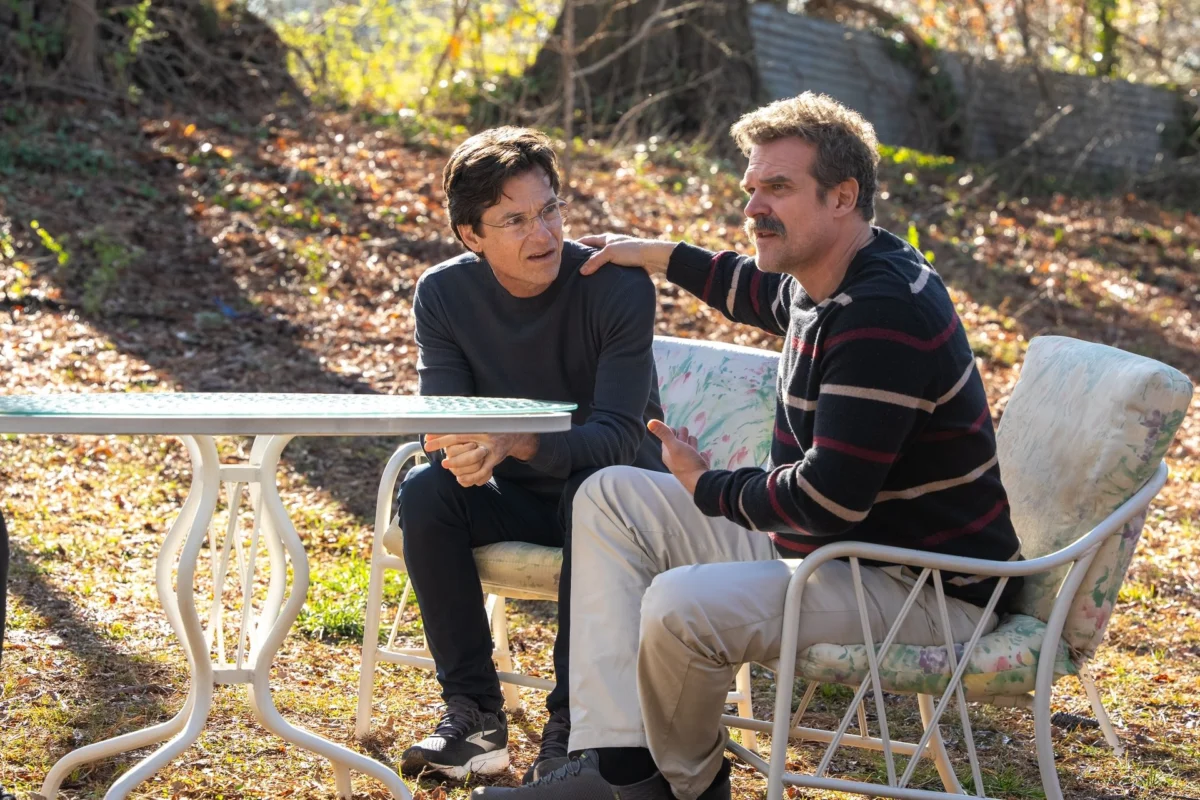
When HBO first greenlit DTF St. Louis, the project carried the weight of true-crime expectations, initially framed as a dramatization of a scandalous New Yorker exposé regarding a real-life suburban love triangle. However, as the series progressed under the idiosyncratic direction of creator Steven Conrad—the mind behind cult favorites like Patriot and Perpetual Grace, LTD—it morphed into something far more complex: a Hitchcockian exploration of middle-aged malaise, the fragility of the modern family unit, and the devastating weight of secrets. The season 1 finale, titled “No One’s Normal. It Just Looks That Way From Across the Street,” served as a jarring wake-up call for an audience that had spent six weeks expecting a traditional murder mystery. Instead, they were met with a profound character study on the finality of shame.
The series premiere set a grim hook: the discovery of a lifeless Floyd Smernitch, played with a haunting, vulnerable physicality by David Harbour. Floyd was a man of contradictions—a former Playgirl centerfold whose glory days were fading behind a career as an American Sign Language (ASL) interpreter and a marriage to Carol (Linda Cardellini), a part-time baseball umpire struggling to maintain a sense of order in their St. Louis suburb. The introduction of Clark Forrest (Jason Bateman), a local weatherman whose polished exterior masked a deep, echoing loneliness, completed a triangle that seemed destined for a violent clash. Yet, the finale revealed that the "violence" was not an act of homicide, but a desperate act of self-destruction. Floyd’s death was a suicide, catalyzed by the ingestion of a heavily medicated Bloody Mary. The trigger was not the fear of being caught in an affair, but the crushing realization that he had permanently fractured his relationship with his stepson, Richard, who witnessed an intimate, compromising moment between Floyd and Clark at a community pool.
This narrative pivot marks a significant departure from the sensationalism often found in "prestige" dark comedies. By shifting the focus from "whodunit" to "why it happened," Steven Conrad forces the viewer to confront the systemic failures of communication in middle age. The "DTF" of the title, an acronym commonly associated with casual sexual availability, is recontextualized within the show as a metaphor for the transactional nature of modern intimacy. The show introduces a fictional adultery app with the seductive tagline, “All the excitement, none of the consequences.” As Conrad notes, this promise is the ultimate "handshake with fate," a lie that middle-aged individuals tell themselves when they feel their lives have become stagnant or invisible.
The evolution of DTF St. Louis from a true-crime adaptation to an original work of fiction allowed Conrad to lean into his specific brand of neo-noir. During the height of the COVID-19 pandemic, Conrad found himself immersed in the filmography of Alfred Hitchcock, absorbing the master of suspense’s ability to turn mundane domesticity into a minefield of psychological tension. This influence is palpable in the show’s pacing and its obsession with the "consequences" of decisions. Conrad’s philosophy, heavily influenced by his early interactions with legendary filmmaker Sydney Pollack, revolves around the idea of "acting your age" as an artist. At 57, Conrad felt a responsibility to write about the specific anxieties of his demographic—the unsated appetites, the financial pressures, and the quiet desperation of realizing that "something better" is often a mirage.
David Harbour’s portrayal of Floyd Smernitch is central to this thematic resonance. Floyd is a man literally outgrowing his life; his clothes no longer fit, a physical manifestation of his internal despondency. The looming presence of his Playgirl centerfold serves as a cruel reminder of a time when he was desired and defined by his vitality. By the time he meets Clark, Floyd is drowning in debt and emotional exhaustion. Harbour’s commitment to the role included learning ASL to ensure Floyd’s professional life felt lived-in and authentic, adding a layer of tragic irony to a character who spends his life facilitating communication for others but cannot bridge the gap in his own home.
The relationship between Floyd and Clark is perhaps the most unique "bromance" depicted on television in recent years. Jason Bateman, known for his ability to play the everyman with a hidden edge, brought an "adoring energy" to Clark. Rather than a predatory or purely sexual pursuit, Clark’s attraction to Floyd is rooted in a desperate need for a "pal"—someone to make him feel safe and seen. Conrad describes the chemistry between Harbour and Bateman as "good math," likening their physical and comedic contrast to legendary duos like Laurel and Hardy or Chris Farley and David Spade. This chemistry makes the final pool scene all the more heartbreaking. The sight of these two middle-aged men, dancing in their underwear and finding a moment of genuine, vulnerable connection, is shattered the moment Richard appears. The destruction of the "step-parental bond," a relationship Conrad describes as "underassessed and complex," is the final blow Floyd cannot survive.
The technical execution of the finale also warrants analysis. The "Kevin Kline Pool" scene, filmed on a practical set during a sweltering night, required "full commitment" from the actors. Conrad’s filmmaking principle—drawing parallels to the raw honesty of Dog Day Afternoon—demanded that the actors not "blink" in the face of the scene’s absurdity and pathos. This commitment is what elevates the show from a mere satire of suburban life into a legitimate tragedy. The moment Floyd signs "I love you" to Richard before his death is a testament to the character’s "exquisite loveliness," a trait Conrad worked hard to preserve even as the character descended into despair.
Looking toward the future, the success of DTF St. Louis has opened the door for an anthology-style continuation. Much like HBO’s The White Lotus, which uses different settings to explore themes of wealth and privilege, a DTF anthology would focus on the intersection of "sex and violence" within various social strata. Conrad suggests that these two elements provide "infinite results" for a writer, offering a lens through which to examine the human condition. While the story of Floyd, Carol, and Clark has reached its definitive and somber end, the framework of investigating "sex crimes" through the eyes of characters like the detective played by Richard Jenkins remains a tantalizing prospect. Jenkins, alongside breakout star Joy Sunday, provided a comedic counterpoint to the central tragedy, and their dynamic is one Conrad is keen to explore further.
The data surrounding the show’s reception indicates a growing appetite for "middle-aged noir." In an era dominated by young adult narratives and superhero spectacles, DTF St. Louis stands out by refusing to "pretend to have younger considerations." It speaks to a demographic that understands the specific pain of a "reckless summer" and the reality that some relationships, once extinguished, cannot be resuscitated regardless of self-improvement or professional success. The show’s critique of the "app-ification" of intimacy also strikes a chord in a post-2018 landscape, where the initial naivete regarding digital anonymity has been replaced by a grim understanding of the digital trail left behind by our indiscretions.
In summary, the finale of DTF St. Louis is a masterclass in subverting genre expectations. It replaces the "who" of a murder mystery with the "how" of a soul’s erosion. Steven Conrad, David Harbour, and Jason Bateman have crafted a narrative that is as much about the silence of ASL and the stillness of a suburban night as it is about the loud, messy consequences of infidelity. By the time the credits roll on "No One’s Normal," the viewer is left not with the satisfaction of a case closed, but with the haunting image of Floyd Smernitch—a man who tried to lose weight, pay off his debts, and find a friend, only to realize that some bargains with fate come at a price that can only be paid in full. The possibility of an anthology looms, but for now, the tragedy of St. Louis remains a singular, devastating achievement in modern television.