
 By admin
Gas prices have surged to unprecedented levels, and stock markets worldwide have experienced sharp declines following a belligerent statement from an Iranian official who declared that his country would “set fire” to any entity attempting to traverse the vital Strait of Hormuz shipping route. This dramatic escalation in regional tensions has sent shockwaves through the global economy, prompting widespread concern about energy security, inflation, and the stability of international trade.
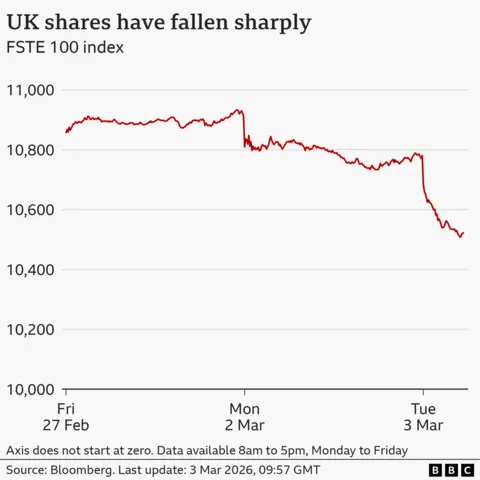
In the United Kingdom, the benchmark FTSE 100 index suffered a significant blow, plummeting by 2.6% as investors grappled with the implications of the unfolding crisis. Similar downturns were observed across continental Europe, with stock markets in France and Germany also recording substantial losses. The German Dax index shed 3.7%, while France’s Cac 40 index slid by 3%. In Asia, the downturn was even more pronounced. Japan’s Nikkei index closed 3.3% lower, with shares in major export-reliant companies such as Toyota, Panasonic, and Sony among the hardest hit. Hong Kong’s Hang Seng and the Shanghai Composite in mainland China also experienced declines. The Kospi in South Korea, which had been closed for a public holiday on Monday, saw a dramatic fall of over 7% upon reopening.
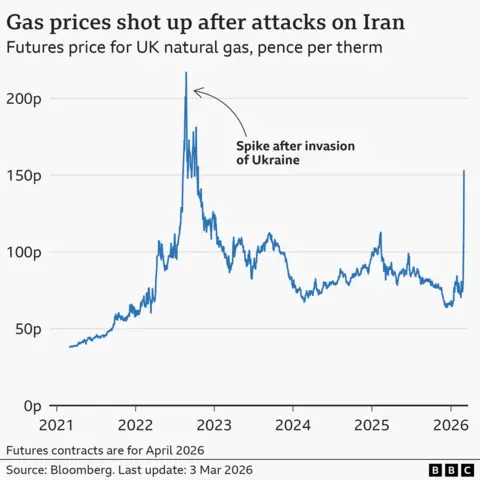
Investors are meticulously analyzing the potential ramifications of this escalating conflict on the global economic landscape. Key concerns revolve around the impact on inflation and the future trajectory of interest rates. The specter of rising energy prices, reminiscent of the disruption caused by Russia’s full-scale invasion of Ukraine four years ago, looms large. That conflict had a profound effect on energy costs, leading to widespread price increases for both businesses and consumers across the globe.
The current situation has already led to a dramatic spike in UK gas prices, which on Tuesday breached the 165 pence per therm mark. This level has not been seen since shortly after the commencement of the Ukraine war, underscoring the severity of the current market reaction. The price of gas had already experienced a significant leap on Monday following an announcement by QatarEnergy, one of the world’s leading energy exporters. The company stated it had halted production due to "military attacks" on its facilities. In a further development, QatarEnergy subsequently announced a cessation of production for other key materials, including aluminum and methanol, signaling a broader impact on industrial supply chains.
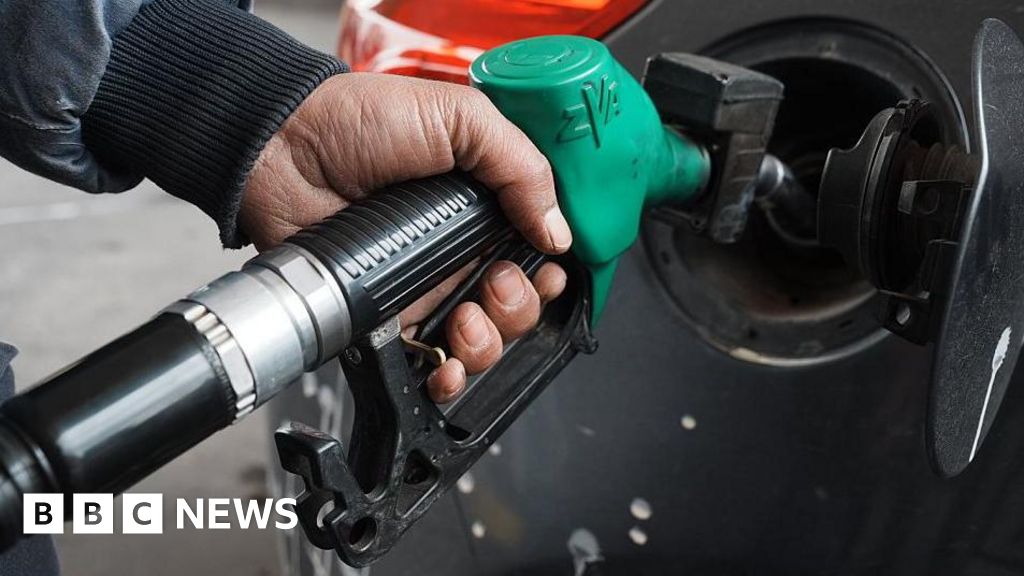
The surge in gas prices has the potential to exert considerable pressure on household energy bills. However, consumers in the UK will not immediately feel the impact due to the existing price cap, which is in effect until July. Nevertheless, the underlying increase in wholesale costs points to potential future rises once the cap is lifted. Simultaneously, escalating oil prices pose a significant threat to the broader economy. These increases translate directly into higher costs for essential goods and services, including transportation and food, thereby contributing to inflationary pressures.
If inflation, which measures the rate of price increases, continues to accelerate, central banks may be compelled to delay or reconsider plans for interest rate cuts in the coming months. This would have a dampening effect on economic growth and could make borrowing more expensive for businesses and individuals.
The gravity of the situation in the Strait of Hormuz was underscored by a statement from Ebrahim Jabbari, an advisor to the commander-in-chief of Iran’s Islamic Revolutionary Guard Corps (IRGC). Speaking to state television, Jabbari issued a stern warning: "They should not come to this region. They will certainly face a serious response from us." This thinly veiled threat highlights Iran’s determination to assert control over this critical maritime chokepoint.
The Strait of Hormuz is an absolutely indispensable artery for global trade, with approximately 20% of the world’s oil and gas passing through its narrow waters annually. The recent attacks on several vessels in the region have brought shipping traffic to a standstill, creating a significant disruption to the global energy supply.
Beyond the immediate impact on energy prices, the conflict has triggered a steep rise in the cost of transporting oil. On Monday, the cost of chartering a supertanker to move crude oil from the Middle East to China reached an all-time high of over $400,000 (£298,300) per day. This figure is nearly double the cost recorded just a week prior, according to data compiled by the London Stock Exchange Group. This surge in shipping expenses is a direct consequence of the increased risks associated with navigating the Strait of Hormuz.
Sanne Manders, president of the logistics technology platform Flexport, described the situation as the Strait of Hormuz being "effectively closed." She elaborated that this closure is not solely due to carriers’ reluctance to assume the risks involved, but also because "insurance companies are not willing to insure this risk anymore." Manders further predicted that shipping companies are likely to begin increasing rates for all global shipments in anticipation of sustained higher fuel prices and increased operational costs.
The potential for prolonged disruption to oil shipments raises concerns about further price hikes. Srinivaasan Balakrishnan, a representative from the risk research firm Avellon Intelligence, suggested that crude oil prices could surpass $100 a barrel if the current blockage of shipments continues unabated. He projected that if oil prices were to remain at that elevated level, US gasoline prices could see an increase of up to 25 cents per gallon.
In response to the escalating crisis, United States officials are reportedly preparing to address the economic fallout. Secretary of State Marco Rubio indicated that Washington would soon announce plans to counteract the impact of rising energy prices. "We knew that going in would be a factor," Rubio stated. "Starting tomorrow you will see us rolling out those phases to try to mitigate against that." He is scheduled to meet with Treasury Secretary Scott Bessent and Energy Secretary Chris Wright on Tuesday to deliberate on the issue.
In the UK, the impact of sustained high oil prices is also expected to translate into higher fuel costs at the pump. Alasdair Locke, chairman of Motor Fuel Group, the country’s largest independent forecourt operator, commented, "With the price of oil going up, that is inevitably going to feed through in due course to higher prices at the pump." He cautioned that the extent of the increase in fuel prices would depend on the duration and magnitude of the rise in oil prices.
The current geopolitical instability is a stark reminder of the interconnectedness of the global economy and the significant impact that regional conflicts can have on international markets. The Strait of Hormuz, a seemingly narrow strip of water, plays a disproportionately large role in global energy security. Any threat to its unimpeded passage has immediate and far-reaching consequences for energy prices, inflation, and overall economic stability. The coming days and weeks will be critical in determining the trajectory of this unfolding crisis and its long-term implications for the global economic outlook.