
 By admin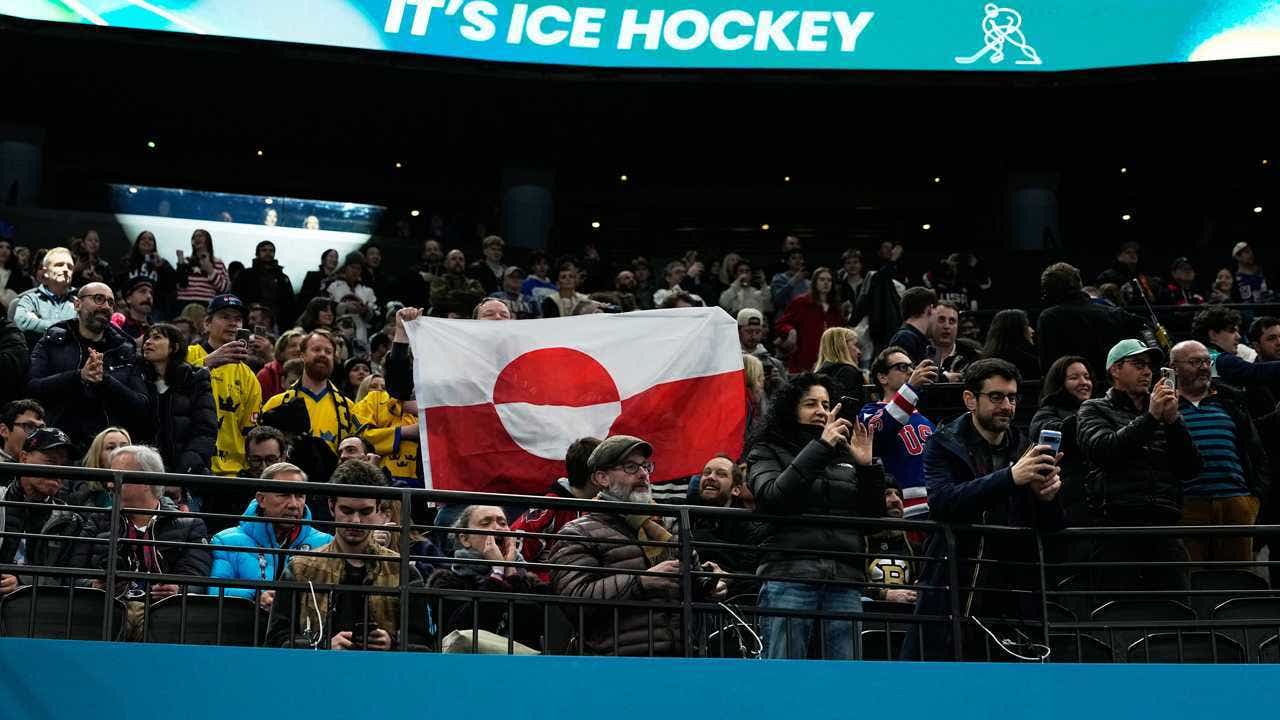
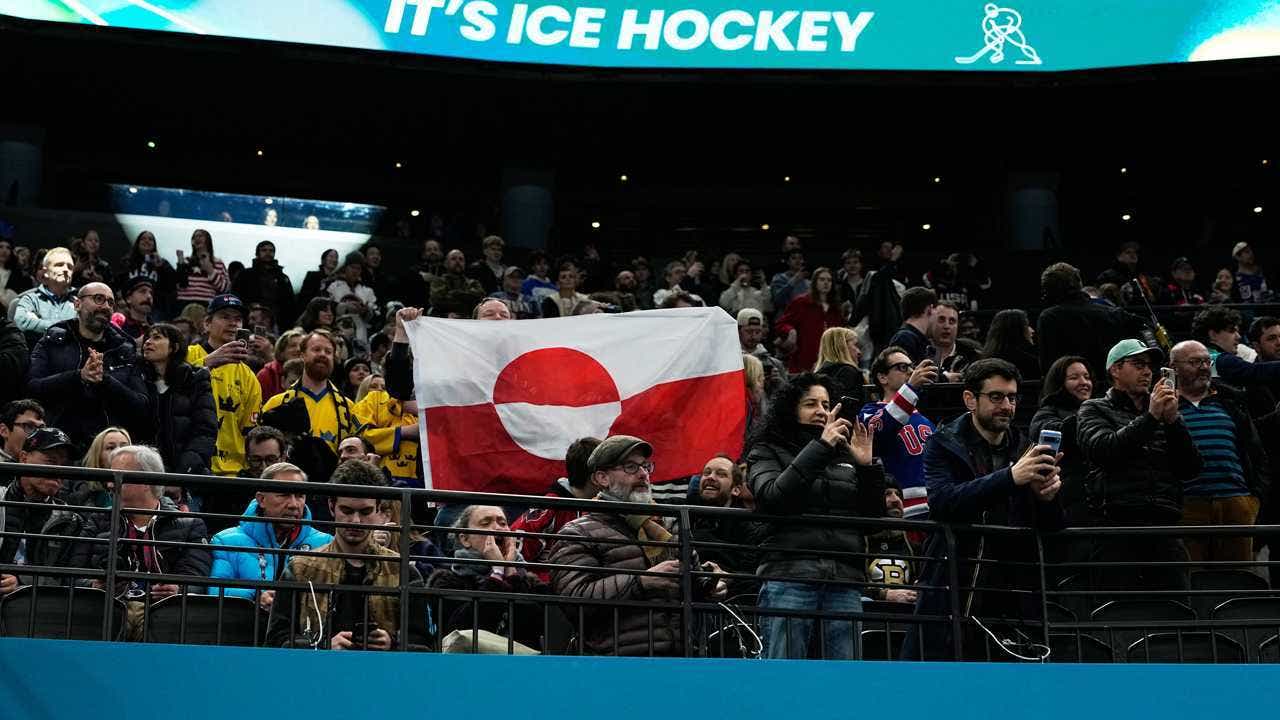
In a striking display of political commentary intertwined with athletic competition, the flag of Greenland was unfurled in the stands during Team USA’s thrilling comeback victory over Denmark in Olympic men’s hockey. The act, carried out by fans expressing their dissent, directly addressed President Donald Trump’s widely publicized interest in acquiring Greenland for the United States. The incident occurred during the preliminary round of the Winter Olympics, a stage where national pride and international relations often converge in unexpected ways.
The Greenlandic flag, a symbol of self-governance and cultural identity, made its appearance during the game’s initial stages. It was raised enthusiastically by Vita Kalniņa and her husband Alexander Kalniņš, who identify as fans of the Latvian hockey team and reside in Germany. Their decision to display the flag was a deliberate protest against what they perceive as an overreach of American political ambition. The flag was prominently displayed during warm-ups and again when the Danish team secured an early lead, underscoring their solidarity with Denmark and, by extension, Greenland’s autonomy.
Despite the initial setback and the political statement in the stands, the U.S. men’s hockey team staged a remarkable turnaround, ultimately defeating Denmark with a decisive 6-3 victory. This comeback win, while a moment of athletic triumph for the Americans, also served as a backdrop for the ongoing geopolitical discussion sparked by the flag display. The juxtaposition of a dominant sporting performance with a pointed political message created a unique narrative that resonated beyond the ice rink.
Vita Kalniņa articulated their motivations to the Associated Press, stating, "We are Europeans, and I think as Europeans we must hold together." This sentiment highlights a broader European perspective on the potential implications of an American acquisition of Greenland, emphasizing a sense of regional solidarity. She further elaborated on the legal and political status of Greenland, asserting, "The Greenlandic people decide what will happen with Greenland, but, as it is now, Greenland is a part of the Danish kingdom and, as Greenland is a part of Denmark, as in this case, we support both countries against the U.S." Their stance underscores a belief that Greenland’s future should be determined by its own people and that any external attempts to acquire it are unwelcome, particularly when it involves a nation with whom Denmark shares a historical and political bond.
The incident also drew reactions from other fans present at the game. Dennis Petersen, a Danish fan, expressed his view that sports should remain separate from politics. "It doesn’t matter whatever sport it is – it could be tennis, it could be bobsledding, it can be ice hockey, it could be football – it has nothing to do with politics. … They are athletes, not politicians," Petersen stated. His perspective reflects a common sentiment that the Olympic Games should be a platform for international goodwill and athletic achievement, free from the divisiveness of political disputes.
Conversely, American fan Rem de Rohan offered a more conciliatory viewpoint, suggesting, "I think this is the time for people to kind of put that down and compete country versus country and enjoy. We love rooting on every country that’s been here." This perspective emphasizes the spirit of competition and the shared experience of the Olympics, advocating for a focus on sportsmanship and mutual respect among participating nations.
The flag display and the game’s outcome quickly became a topic of discussion on social media, with fans engaging in a mixture of lighthearted banter and pointed commentary. Some users, drawing a direct line from the U.S. victory to President Trump’s proposal, humorously questioned if the win meant Denmark would now cede Greenland. One notable comment read, "Now that the USA is up 4-2 could we place a wager that if the USA wins the game, Denmark gives up Greenland?" This sentiment was echoed by another user who quipped, "Team USA won, do we get Greenland now?" These reactions, while often framed as jokes, highlight how the political discourse surrounding Greenland has permeated public consciousness, even finding its way into casual Olympic discussions.
The playful online commentary was further amplified by some American conservative influencers who seized upon the U.S. victory as an opportunity to generate viral content related to the annexation of Greenland. This trend underscores the way in which geopolitical events and nationalistic sentiments can be amplified and reinterpreted through the lens of social media and popular culture.
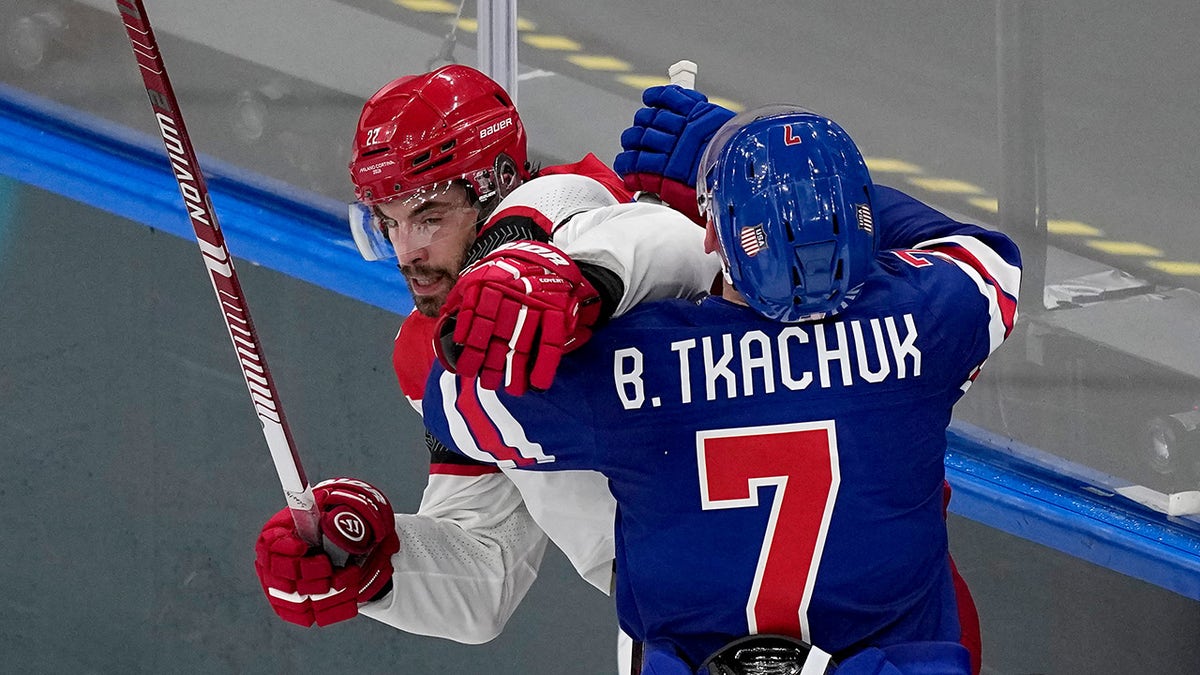
The U.S. hockey team’s path to victory was not without its dramatic turns. After trailing 2-1 at the end of the first period, the Americans mounted a significant offensive surge in the second period, scoring three unanswered goals. Key players like Brady Tkachuk (Ottawa Senators), Jack Eichel (Vegas Golden Knights), and Noah Hanifin (Vegas Golden Knights) were instrumental in this comeback, finding the back of the net and shifting the momentum of the game. The offensive depth of the U.S. team was evident, with fourteen players contributing points and a different goal scorer each time the U.S. lit the lamp. This balanced scoring attack proved overwhelming for the Danish defense.
The statistical disparity between the two teams was significant, with the Americans outshooting Denmark 47-21. This dominance in shots on goal reflected the U.S. team’s control of the game, particularly in the latter two periods. The team’s strong performance demonstrates their prowess on the ice and their potential to be a formidable contender in the tournament.
Looking ahead, the U.S. men’s hockey team was scheduled to conclude its preliminary play against Germany. Entering this matchup, the Americans were heavily favored, with a victory anticipated to secure their spot in the knockout stage of the Milan Cortina Olympic Games. The possibility of advancing to the knockout stage even with an overtime loss was also on the table. However, a regulation loss would have introduced a more complex scenario, contingent on the outcomes of other games and point differentials. The prospect of facing a German team with fewer NHL players further solidified the U.S. team’s position as strong favorites.
The context of President Trump’s interest in Greenland dates back to August 2019, when reports emerged of his inquiries into the possibility of purchasing the vast Arctic island. Greenland, an autonomous territory within the Kingdom of Denmark, is strategically located and rich in natural resources, making it an area of geopolitical significance. Trump’s proposal was met with widespread criticism and rejection from both Greenlandic and Danish officials, who emphasized Greenland’s sovereignty and its lack of interest in being sold. The proposal was widely characterized as an audacious and unrealistic diplomatic maneuver, drawing parallels to historical colonial acquisitions.
Despite the official rebuffs, the idea of American acquisition of Greenland has persisted in certain political circles and has become a point of discussion, particularly in relation to Arctic security and geopolitical strategy. NATO, for instance, has been actively launching initiatives to bolster Arctic security, a region of increasing strategic importance due to climate change and the opening of new shipping routes. Trump’s interest in Greenland, therefore, can be seen within a broader context of great power competition and the scramble for influence in the Arctic.
The fans’ decision to display the Greenlandic flag at the Olympics was a symbolic act of resistance, leveraging a global platform to voice their opposition to what they view as an infringement on national sovereignty. Their actions highlight how sporting events can become unintended venues for political expression, especially when major international political issues are at play. The Kalniņš’ statement about European solidarity and the self-determination of Greenlandic people adds a layer of complexity to the narrative, moving beyond a simple protest to articulate a broader geopolitical concern.
The reactions on social media, ranging from sarcastic commentary to more serious discussions about international relations, demonstrate the impact of such events in raising public awareness and sparking debate. The interplay between sports, politics, and public opinion is a recurring theme in global events, and the Greenland flag incident at the Olympics serves as a compelling example of this dynamic. The U.S. hockey team’s victory, while a significant sporting achievement, also inadvertently became a focal point for a political statement that resonated far beyond the confines of the arena. The incident underscores the increasingly blurred lines between athletic competition and the geopolitical landscape, particularly in an era where national interests and international relations are constantly being negotiated on various fronts.