
 By Lina Irawan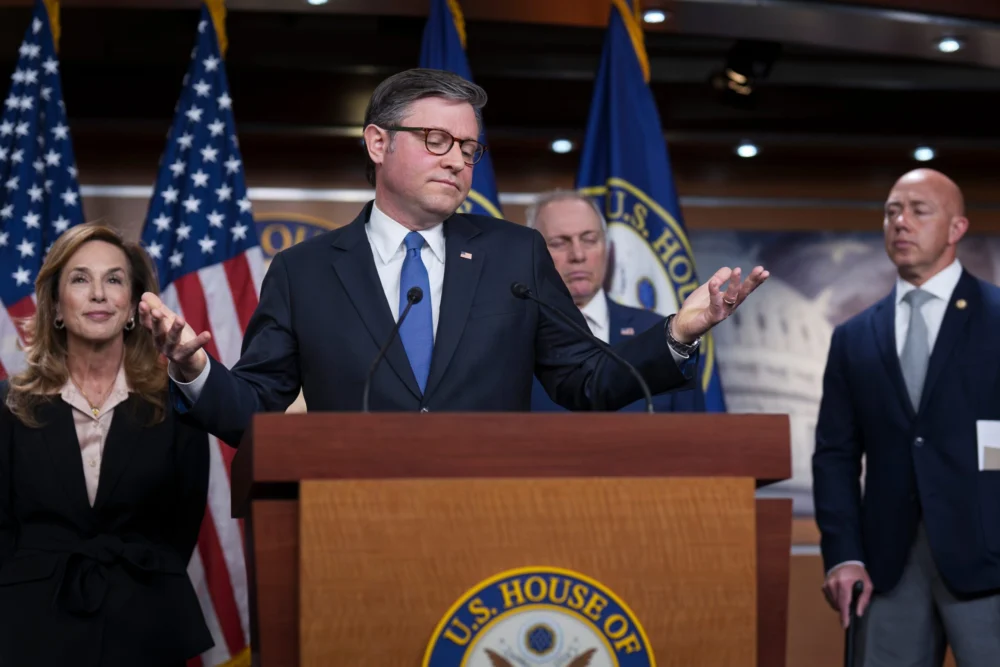
The House vote, a razor-thin 212-219, was widely anticipated to be a tight contest, yet its outcome provided a stark and clarifying snapshot of the deeply entrenched political divisions regarding the U.S.-Israel military operation and President Trump’s controversial rationale for bypassing Congress. The U.S. Constitution explicitly grants Congress the sole power to declare war, a foundational principle that has been increasingly challenged by executive actions in recent decades. For many, this latest escalation represented a critical test of that constitutional balance, raising profound questions about presidential authority versus legislative oversight in matters of national security.
“Donald Trump is not a king, and if he believes the war with Iran is in our national interest, then he must come to Congress and make the case,” asserted Rep. Gregory Meeks (D-NY), the ranking Democrat on the House Foreign Affairs Committee. Meeks’ statement underscored a widespread sentiment among Democrats and some Republicans that the executive branch had overstepped its constitutional bounds. The argument centered not necessarily on the justification for military action itself, but on the process by which such a momentous decision was made. Critics argued that failing to consult Congress undermined democratic principles, eroded checks and balances, and risked dragging the nation into another costly and potentially endless conflict without proper debate or public mandate. The perceived lack of a clear, consistent strategy from the administration further fueled these concerns, leading to an urgent call for congressional reassertion of its war powers.
In a related but distinct action, the House also approved a separate measure affirming that Iran is the largest state sponsor of terrorism. This vote, while seemingly contradictory to the war powers debate, reflected a bipartisan consensus on the nature of the Iranian regime, even as lawmakers disagreed vehemently on the appropriate response. It highlighted the complex and often bifurcated approach Congress takes – acknowledging the threat posed by adversaries while simultaneously seeking to constrain presidential power in confronting those threats.
President Trump’s Republican Party, which holds narrow majorities in both the House and Senate, largely interpreted the conflict with Iran not as the genesis of a new war, but rather as the decisive culmination of decades of hostility against a regime that has consistently menaced the West. The recent operation resulted in the death of Iran’s Supreme Leader Ayatollah Ali Khamenei, an event that some Republicans viewed as a potential catalyst for long-desired regime change. This perspective often framed the military action as a necessary strike to neutralize a dangerous adversary and liberate the Iranian people from an oppressive theological dictatorship. However, others within the party, and many foreign policy experts outside it, cautioned against the inherent dangers of creating a chaotic power vacuum, warning that such instability could lead to unforeseen consequences, regional proxy wars, or even the rise of a more extreme successor.
Republican Rep. Brian Mast of Florida, chairman of the House Foreign Affairs Committee, emerged as a vocal proponent of the president’s actions. Mast publicly thanked Trump for what he described as decisive leadership against Iran, asserting that the president was operating within his constitutional authority to defend the U.S. against an “imminent threat.” A decorated Army veteran who served as a bomb disposal expert in Afghanistan, Mast’s background lent weight to his argument that swift, executive action was sometimes necessary in the face of grave dangers. He dismissed the war powers resolution as effectively asking “that the president do nothing,” framing it as an attempt to hamstring the commander-in-chief during a critical national security juncture. From this viewpoint, delaying action for congressional debate could jeopardize American lives and strategic interests.
For Democrats, however, Trump’s attack on Iran, perceived by many as heavily influenced by Israeli Prime Minister Benjamin Netanyahu’s hawkish stance, represented a clear “war of choice” rather than an unavoidable defensive measure. This perspective brought into sharp focus the intricate balance of powers enshrined in the Constitution. Rep. Jamie Raskin (D-Md.) eloquently articulated this constitutional argument, stating, “The framers weren’t fooling around.” Raskin emphasized that the Constitution unequivocally vests the power to declare war with Congress, making it “up to us” to decide such matters of grave consequence. Democrats argued that bypassing Congress set a dangerous precedent, further eroding the legislative branch’s role in foreign policy and potentially leading the nation into conflicts based on executive fiat rather than collective deliberation.
While the views in Congress largely cleaved along partisan lines, there were notable crossover coalitions. The War Powers Resolution, if it had been signed into law, would have immediately halted Trump’s ability to conduct the war unless Congress explicitly approved the military action within a specified timeframe. Given the president’s strong stance on executive authority, a presidential veto of such a measure would have been highly probable, setting up a constitutional showdown that would have tested the legislative branch’s ability to override it.
Adding to the legislative friction was the Trump administration’s often-shifting rationale for the conflict. Following the surprise attack against Iran on a Saturday, the administration found itself scrambling to garner support for a conflict that many Americans, across the political spectrum, were already deeply wary of entering. Senior Trump administration officials spent countless hours behind closed doors on Capitol Hill throughout the week, attempting to reassure skeptical lawmakers that they had the situation under control and a coherent strategy in place. However, these briefings were frequently met with frustration and skepticism, with many members of Congress reporting a lack of clarity and consistent messaging.
The human cost of the escalating tensions quickly became tragically apparent. Six U.S. military members were killed over the weekend in a drone strike in Kuwait, a stark reminder of the dangers facing American personnel in the region. President Trump himself acknowledged that more American lives could be lost, adding to the somber mood. The rapidly deteriorating security situation prompted thousands of Americans abroad to scramble for flights, desperate to flee the Middle East. Congressional offices were inundated with phone calls from concerned constituents seeking assistance and information, highlighting the direct impact of the conflict on ordinary citizens.
The administration’s messaging continued to be inconsistent. On one hand, President Trump declared on Thursday that he “must be involved” in choosing Iran’s new leader, implying a desire for regime change and active nation-building. Yet, just days earlier, House Speaker Mike Johnson (R-La.) had stated that America had enough problems at home and was "not about to be in the nation-building business," seemingly contradicting the president’s implied ambition. Such conflicting signals from senior leaders sowed confusion and undermined confidence in the administration’s long-term objectives.
Defense Secretary Pete Hegseth further complicated the narrative by suggesting the war could extend for eight weeks, twice as long as the president had initially estimated. Trump, meanwhile, left open the possibility of deploying U.S. ground troops into what had largely been a bombing campaign conducted by air, raising the specter of a much larger and more prolonged engagement. On the Iranian side, the casualties mounted, with reports indicating that more than 1,230 people in Iran had died in the conflict, underscoring the devastating human toll.
The administration’s stated goals for the military action also evolved. Initially, it was framed as a preemptive strike to destroy Iran’s ballistic missiles, which the U.S. believed were shielding its clandestine nuclear program. Later, officials added that Israel was reportedly ready to act independently, and American bases in the region faced imminent retaliation if the U.S. did not strike Iran first. In a dramatic escalation, the U.S. announced on Wednesday that it had torpedoed an Iranian warship near Sri Lanka, demonstrating the widening scope of the conflict beyond the immediate Middle Eastern theater.
“This administration can’t even give us a straight answer of as to why we launched this preemptive war,” lamented Rep. Thomas Massie (R-Ky.), an outspoken libertarian and an outlier within his Republican party. Massie, along with Rep. Ro Khanna (D-Calif.), who had previously teamed up to force the release of the Jeffrey Epstein files, spearheaded the effort to bring the War Powers Resolution to the House floor, successfully pushing it past objections from Speaker Johnson’s GOP leadership. Their bipartisan alliance, formed on principles of transparency and congressional oversight, underscored the depth of concern cutting across traditional party lines. Another Republican, Rep. Warren Davidson of Ohio, a former Army Ranger, was also expected to back the war powers resolution, signaling a principled stand against executive overreach from within the military veteran community.
Conversely, Speaker Johnson warned that it would be “dangerous” to limit the president’s authority while the U.S. military was already engaged in conflict. Rep. Michael McCaul (R-Texas) echoed this sentiment, arguing, “Congress must stand with the president to finally close, once and for all, this dark chapter of history,” suggesting a resolute commitment to seeing the conflict through to a definitive conclusion.
The debate also brought deeply personal perspectives to the forefront. Rep. Yassamin Ansari (D-Ariz.), the daughter of Iranian immigrants who fled their homeland, offered a nuanced view. While she celebrated the death of Ayatollah Khamenei, viewing it as a symbolic victory against oppression, she cautioned that a democratic transition for the people of Iran never seemed to be a priority for Trump and his officials during their briefings with lawmakers. Her remarks highlighted the complex aspirations of the Iranian diaspora and the potential for U.S. actions to inadvertently undermine genuine democratic movements. “War carries profound and deadly consequences for our troops, for the American people and for the entire world,” Ansari stated emphatically. “It’s the most serious decision that a nation can make and the American people deserve debate, transparency and accountability before that decision is made.”
In an attempt to find a middle ground, other Democrats proposed an alternative resolution that would allow the president to continue the war for 30 days before he would be required to seek congressional approval. This proposal, while not yet expected for a vote, reflected the ongoing struggle within Congress to balance executive agility in times of crisis with legislative oversight.
Meanwhile, in the Senate, the atmosphere was equally charged. Republican leaders had successfully, though narrowly, defeated a series of war powers resolutions pertaining to several other conflicts during Trump’s second term. This particular resolution, however, felt different. Underscoring the gravity of the moment on Wednesday, Democratic senators filled the chamber, sitting solemnly at their desks as the voting process commenced, a rare display of unity and seriousness.
Senate Democratic leader Chuck Schumer of New York framed the vote in stark terms before the proceedings. “Do you stand with the American people who are exhausted with forever wars in the Middle East or stand with Donald Trump and Pete Hegseth as they bumble us headfirst into another war?” Schumer’s rhetoric aimed to tap into widespread public fatigue with prolonged military engagements and to portray the administration’s actions as reckless.
In response, Sen. John Barrasso of Wyoming, the third-ranking Republican in Senate leadership, retorted that “Democrats would rather obstruct Donald Trump than obliterate Iran’s national nuclear program.” This encapsulated the deep partisan divide, with Republicans accusing Democrats of prioritizing political opposition over national security.
Ultimately, the legislation failed in the Senate on a 47-53 tally, largely along party lines. However, the vote was not entirely monolithic: Sen. Rand Paul (R-Ky.), a staunch non-interventionist, voted in favor of the resolution, aligning with Democrats who sought to rein in presidential power. Conversely, Sen. John Fetterman (D-Pa.), known for his more hawkish stance on certain foreign policy issues, voted against it, demonstrating that while partisan loyalty played a significant role, individual convictions and specific policy perspectives also influenced some votes.
The dual votes in Congress underscore a persistent and unresolved tension in American democracy: the struggle to balance executive authority in foreign policy with legislative oversight, particularly concerning the power to declare war. As the conflict with Iran unfolds, the debate over who holds the ultimate authority for committing U.S. forces abroad will undoubtedly continue to shape both domestic politics and the trajectory of American foreign policy on the global stage, with profound implications for peace, stability, and the constitutional fabric of the nation.