
 By admin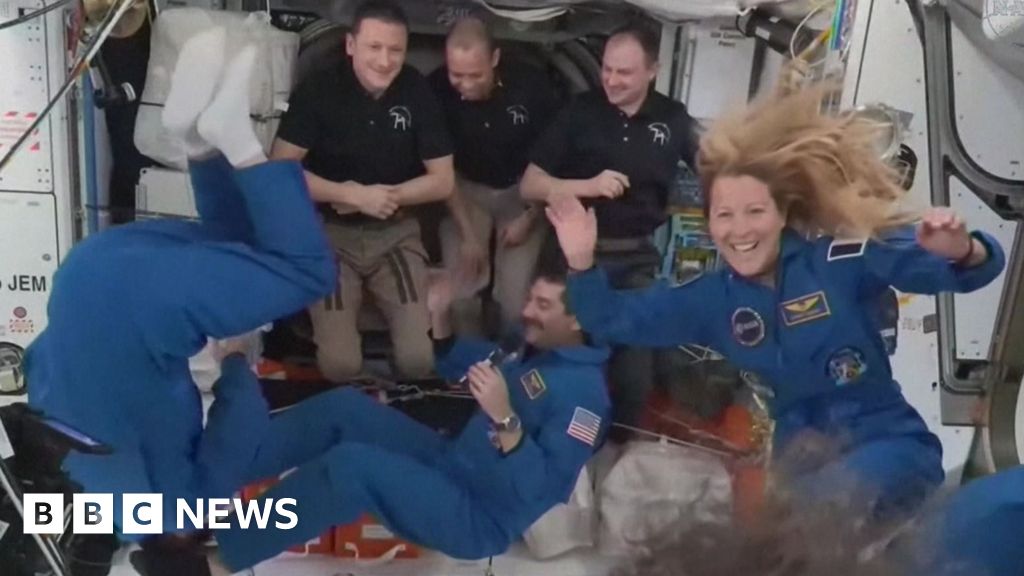
In a triumphant display of international cooperation and human ingenuity, four intrepid astronauts successfully docked with the International Space Station (ISS) on Friday, marking a significant milestone in ongoing space exploration efforts. The arrival of this diverse crew, comprising two NASA astronauts, one European Space Agency (ESA) astronaut, and one Russian cosmonaut, signals the commencement of an eight-month mission aboard the orbiting laboratory. This vital deployment comes at a critical juncture, following the recent, urgent evacuation of a previous team due to an unforeseen medical emergency, underscoring the inherent risks and the unwavering dedication of those who venture beyond Earth’s atmosphere.
The four individuals now making their home in orbit are integral to the mission designated as Crew-12, representing SpaceX’s twelfth crewed rotational flight to the ISS. The journey from Earth was aboard the state-of-the-art SpaceX Dragon spacecraft, a testament to the burgeoning private sector’s crucial role in facilitating human access to space. On this historic voyage were NASA astronauts Jessica Meir and Jack Hathaway, both seasoned explorers with extensive backgrounds in scientific research and spaceflight. Representing Europe was Sophie Adenot, an ESA astronaut hailing from France, bringing a wealth of expertise in engineering and experimental science. Completing the quartet was Andrey Fedyaev, a cosmonaut from Russia’s Roscosmos, embodying the enduring spirit of collaboration between former Cold War rivals in the pursuit of shared scientific goals.
The International Space Station, a marvel of engineering and a beacon of global partnership, has been a continuously inhabited outpost in low Earth orbit since November 2, 2000. Its construction, a monumental undertaking involving fifteen participating space agencies from around the globe, represents one of the most ambitious and successful international collaborations in history. The ISS serves as a unique microgravity laboratory, enabling scientists to conduct a vast array of research across numerous disciplines, including biology, human physiology, physics, materials science, and astronomy. The data gathered aboard the station has profound implications for understanding life in space, developing countermeasures for the physiological effects of long-duration spaceflight, and advancing fundamental scientific knowledge that benefits life on Earth.
The timely arrival of Crew-12 is particularly significant given the circumstances surrounding the departure of their predecessors. While details of the medical emergency that necessitated the earlier evacuation remain confidential for privacy reasons, the incident highlights the inherent risks associated with human spaceflight and the robust emergency protocols in place to ensure astronaut safety. The swift and effective response by mission control and the outgoing crew demonstrates the resilience and professionalism of the international space community. The successful docking of Crew-12 not only replenishes the ISS complement but also ensures the continuity of critical scientific experiments and station maintenance operations.
Jessica Meir, a marine biologist by training and a veteran of a previous ISS mission, brings a deep understanding of biological processes in extreme environments. Her expertise is invaluable for ongoing research into how microgravity affects cellular function, immune systems, and bone density – crucial knowledge for future long-duration missions to the Moon and Mars. Jack Hathaway, a distinguished aerospace engineer and pilot, contributes his extensive technical acumen to the mission, ensuring the smooth operation of the station’s complex systems and any necessary repairs or upgrades. His role is pivotal in maintaining the ISS as a safe and functional habitat for the crew.
Sophie Adenot’s presence on Crew-12 marks a significant achievement for France and the European Space Agency. As an accomplished helicopter pilot and engineer, her background is well-suited to the demanding operational and scientific requirements of the ISS. Her contributions are expected to further ESA’s research objectives, which often focus on materials science, fluid physics, and advanced manufacturing techniques in microgravity, with potential applications in terrestrial industries.
Andrey Fedyaev, representing Roscosmos, underscores the continued importance of the partnership between NASA and Russia on the ISS. Despite geopolitical tensions on Earth, the collaboration in space has remained a steadfast example of peaceful coexistence and shared scientific ambition. Fedyaev’s experience as a seasoned cosmonaut will be vital in supporting the station’s operations and contributing to the diverse research portfolio. The seamless integration of astronauts and cosmonauts from different agencies aboard the ISS has consistently served as a powerful symbol of what humanity can achieve when working together towards common goals.
The SpaceX Dragon spacecraft, named "Endeavour" for this mission, is a cornerstone of NASA’s Commercial Crew Program. This program, initiated to restore domestic human launch capability after the retirement of the Space Shuttle in 2011, has revolutionized access to the ISS. SpaceX’s innovative approach, leveraging reusable rocket technology, has significantly reduced the cost of spaceflight and increased the frequency of missions. Crew-12’s successful journey is a testament to the program’s maturity and reliability, building upon years of development and previous successful crewed flights.
The eight-month duration of Crew-12’s mission is standard for long-duration ISS expeditions. During this time, the astronauts will engage in a rigorous schedule of scientific research, spacewalks (Extravehicular Activities or EVAs) for maintenance and upgrades, and daily operations of the station. They will be responsible for tending to experiments that have been meticulously planned and set up by scientists on the ground, often involving biological samples, material specimens, and astronomical observations. The data they collect will fuel discoveries that could lead to new medical treatments, advanced materials, and a deeper understanding of the universe.
One of the primary focuses of research aboard the ISS often revolves around understanding the long-term effects of microgravity on the human body. Astronauts experience bone density loss, muscle atrophy, and changes in cardiovascular function, mirroring some aspects of aging on Earth. Studying these phenomena in a controlled microgravity environment provides invaluable insights into these terrestrial health challenges. Furthermore, the ISS serves as a crucial testbed for technologies and procedures essential for future deep-space missions, such as those planned for lunar bases and eventual human expeditions to Mars.
The scientific payload for Crew-12 is likely to include a diverse range of experiments. These might encompass studies on plant growth in space, which could be vital for sustainable food production on long voyages, or investigations into the behavior of complex fluids and materials in microgravity, potentially leading to advancements in manufacturing processes and pharmaceuticals. The station’s unique vantage point also allows for unparalleled Earth observation, aiding in climate research, disaster monitoring, and atmospheric studies.
Beyond the scientific endeavors, the ISS serves as a powerful platform for education and public outreach. Astronauts frequently engage with students and the public through live video calls, sharing their experiences and inspiring the next generation of scientists and engineers. The image of diverse crews working harmoniously aboard the ISS, looking back at our shared planet, is a potent reminder of our interconnectedness and the potential for human collaboration.
The geopolitical landscape surrounding space exploration has seen shifts in recent years, with an increasing number of nations developing their own space programs and private companies playing a more prominent role. However, the ISS remains a cornerstone of international cooperation, and missions like Crew-12 exemplify the benefits of such partnerships. The shared infrastructure and expertise available on the station allow for research that would be prohibitively expensive and complex for any single nation to undertake alone.
The successful docking of Crew-12 is more than just the arrival of four individuals; it represents the continuation of a grand human experiment. It is a testament to our innate drive to explore, to push the boundaries of what is known, and to seek answers to fundamental questions about our place in the cosmos. As Jessica Meir, Jack Hathaway, Sophie Adenot, and Andrey Fedyaev embark on their eight-month journey, they carry with them the hopes and aspirations of billions on Earth, venturing into the vast expanse to expand our knowledge and pave the way for future generations of explorers. Their presence aboard the International Space Station signifies a commitment to scientific progress, international harmony, and the enduring spirit of human endeavor.