
 By Lina Irawan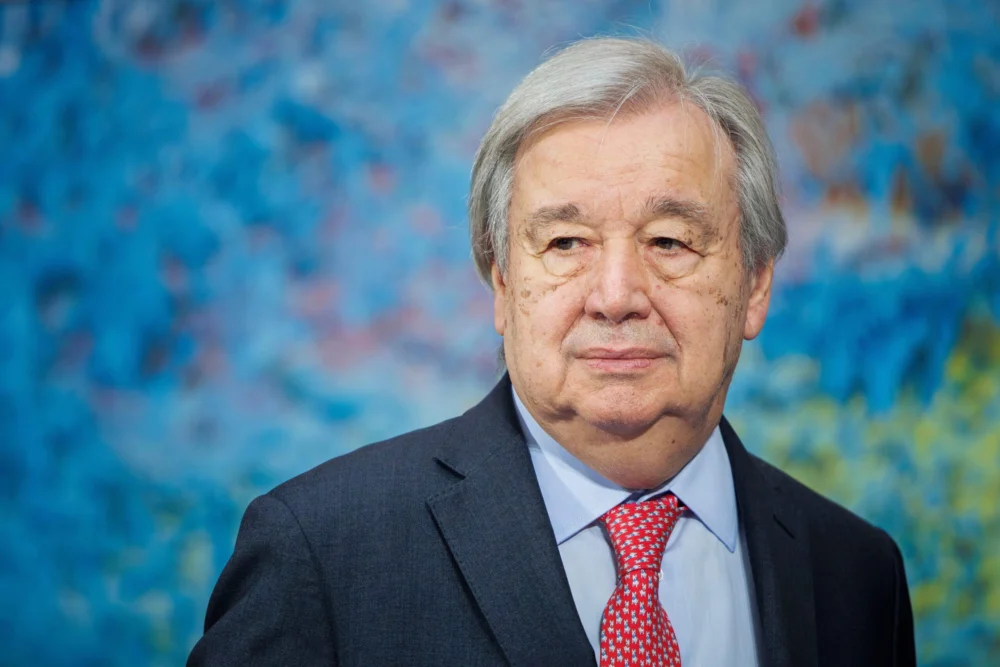
The hallowed halls of the United Nations Security Council became the latest battleground in the escalating confrontation between the United States, Israel, and Iran. Convening an emergency session on Saturday, the world’s most powerful diplomatic body grappled with the profound implications of recent military exchanges that have brought the Middle East to the precipice of a wider, potentially catastrophic conflict. The urgent call from the U.N. chief and numerous member states for an immediate cessation of hostilities and a return to the negotiating table underscored the global alarm at the deteriorating situation.
U.N. Secretary-General António Guterres opened the session with a stark warning, emphasizing that "everything must be done to prevent an escalation." His words, delivered with gravity, painted a grim picture: "The alternative," he cautioned, "is a potential wider conflict with grave consequences for civilians and regional stability." Guterres, a seasoned diplomat, did not shy away from assigning blame, asserting that both sides had violated fundamental tenets of international law. He specifically condemned the U.S. and Israeli airstrikes, stating they contravened international law, including the foundational principles enshrined in the U.N. Charter, which strictly governs the use of force between states. Simultaneously, he denounced Iran’s retaliatory attacks for infringing upon the sovereignty and territorial integrity of no less than seven regional nations: Bahrain, Iraq, Jordan, Kuwait, Qatar, Saudi Arabia, and the United Arab Emirates. This even-handed condemnation aimed to highlight the multilateral nature of the violations and the broad impact of the current cycle of aggression. The U.N. Charter, a cornerstone of international relations since 1945, explicitly prohibits the use of force against the territorial integrity or political independence of any state, save for self-defense under strict conditions or with Security Council authorization. Guterres’s invocation of these principles served as a powerful reminder of the global rules of engagement that he argued had been flagrantly disregarded by all parties involved.
Responding for the United States, Ambassador Mike Waltz firmly insisted that the U.S. military actions were entirely lawful. His defense hinged on the principle of preventing nuclear proliferation and safeguarding global security. "Iran cannot have a nuclear weapon," Waltz declared to the council, framing this as a non-negotiable imperative. "That principle is not a matter of politics. It’s a matter of global security. And to that end, the United States is taking lawful actions." This assertion reflects a long-standing U.S. policy position, reiterated across administrations, that a nuclear-armed Iran poses an unacceptable threat to regional and international stability. The U.S. often cites the right to self-defense, or pre-emptive action against perceived threats, as justification for its military engagements, a legal interpretation frequently debated in international forums.
Israel’s U.N. Ambassador Danny Danon echoed the sentiment of existential threat, vigorously defending his country’s airstrikes as a necessary measure. "We are stopping extremism before it becomes unstoppable," Danon asserted, articulating Israel’s profound security concerns regarding Iran’s nuclear program, its development of ballistic missiles, and its extensive network of proxy forces across the Middle East. For Israel, the Iranian threat is often viewed through the lens of national survival, a perspective deeply rooted in its history and geopolitical realities. Danon’s statement, "We will ensure that no radical regime armed with nuclear weapons and ballistic missiles can threaten our people or the entire world," underscored the pre-emptive nature of Israel’s military doctrine, which prioritizes disrupting perceived threats before they materialize into direct attacks.
In a fiery rebuttal, Amir Saeid Iravani, Iran’s ambassador to the U.N., condemned the U.S. and Israeli airstrikes as "war crimes and a crime against humanity," citing hundreds of Iranian civilian casualties. His address was not only a defense of Iran’s actions but also a scathing indictment of the Security Council itself. Iravani blasted the U.N. and its most powerful body for what he perceived as a failure to heed Tehran’s repeated warnings about the "warmongering statements" emanating from the U.S. in recent weeks. He urged the council to finally take decisive action to uphold international law. "The issue before the council is straightforward," Iravani posited, "whether any member state may, including a permanent member of this council, through the use of force, coercion or aggression, determine the political future or system of another state or impose control over its affairs." This argument centered on the fundamental principle of state sovereignty and non-interference, a cornerstone of Iran’s foreign policy narrative.
However, a dramatic and unforeseen development overshadowed much of the diplomatic posturing during the session. While Ambassador Iravani conspicuously refrained from mentioning or commenting on President Donald Trump’s earlier statement claiming the death of Supreme Leader Ayatollah Ali Khamenei in the strikes, Iranian state media later confirmed his demise. This confirmation sent shockwaves through the diplomatic community and global markets. The assassination of the second Supreme Leader of the Islamic Republic, a figure who had ruled Iran for over three decades, immediately raised the specter of a protracted and even more volatile conflict. Khamenei, revered by his followers as a spiritual and political guide, had no publicly designated successor, plunging Iran into an unprecedented power vacuum. His long tenure had provided a degree of stability and continuity in Iran’s complex political system, and his sudden absence promised internal upheaval and a fierce struggle for succession. This development profoundly altered the strategic calculus, given Iran’s prior threats of severe retaliation for any attack on its leadership, now compounded by the potential for internal instability and an emboldened response from a leaderless nation. The implications for regional stability, and indeed for global energy markets and security, were immediate and immense.
The already tense atmosphere within the Security Council chamber was further electrified by a rare, direct exchange between the U.S. and Iranian ambassadors towards the session’s conclusion. After Ambassador Waltz responded to Iranian claims of U.S. violations of international law, Ambassador Iravani requested to speak again, issuing a pointed warning: "I advise to the representative of the United States to be polite. It will be better for yourself and the country you represent." Waltz immediately shot back, his voice cutting through the diplomatic decorum: "This representative sits here, in this body, representing a regime that has killed tens of thousands of its own people, and imprisoned many more, simply for wanting freedom from your entire tyranny." This uncharacteristic and sharp personal rebuke underscored the profound depth of animosity and distrust between the two nations, revealing the raw emotions simmering beneath the surface of diplomatic discourse and hinting at the extreme difficulty of finding common ground for de-escalation.
Other Security Council members also weighed in, reflecting the diverse geopolitical interests and alignments within the global body. Russia’s Ambassador Vassily Nebenzia unequivocally condemned the U.S.-Israeli airstrikes, aligning with Moscow’s long-standing position of challenging what it views as Western unilateralism and advocating for strict adherence to international law, often interpreted through a lens critical of American interventionism. "We demand that the United States and Israel immediately cease their aggressive actions," Nebenzia declared, adding, "We insist on the immediate resumption of political and diplomatic settlement efforts… based on international law, mutual respect and a balance of interests." This call for a diplomatic solution, while condemning U.S. actions, highlights Russia’s desire to position itself as a proponent of multilateralism, albeit one that often clashes with Western powers.
China’s U.N. Ambassador Fu Cong adopted a more measured tone, characteristic of Beijing’s diplomatic approach which often prioritizes stability and non-interference. He expressed "very concern by the sudden escalation of regional tensions" and broadly supported Russia’s call for a return to diplomatic negotiations. China, a major energy importer from the Middle East, has significant economic interests in regional stability and consistently advocates for de-escalation and dialogue, often avoiding direct criticism of specific parties while emphasizing respect for sovereignty.
Maged Abdelaziz, the permanent observer of the 22-nation Arab League, introduced a critical point of contention by suggesting Israeli hypocrisy. He argued that Israel’s justification for its military attack, premised on preventing Iran from acquiring nuclear weapons, was undermined by its own refusal to subject its nuclear facilities to inspection by the U.N. nuclear watchdog, the International Atomic Energy Agency (IAEA). Abdelaziz, a former Egyptian ambassador to the U.N., highlighted a long-standing grievance among Arab states: Israel’s undeclared nuclear arsenal and its refusal to sign the Nuclear Non-Proliferation Treaty (NPT). This stance, he implied, weakened Israel’s moral authority to demand nuclear transparency from Iran, complicating regional non-proliferation efforts and fueling accusations of a double standard.
The emergency meeting itself was a testament to the broad international concern, called by a diverse group of five council members: Bahrain (representing Arab interests on the council), France, Russia, China, and Colombia, reflecting a wide array of geopolitical concerns from regional stability to international law.
Adding another layer of diplomatic pressure, the leaders of Britain and France—both veto-wielding members of the Security Council—along with Germany’s chancellor, issued a joint statement. These three European powers, signatories to the 2015 nuclear deal with Iran (the Joint Comprehensive Plan of Action, or JCPOA), have consistently led efforts to reach a negotiated solution following the U.S. withdrawal from the deal under the Trump administration in 2018. Their statement called for an immediate resumption of U.S.-Iranian talks on Tehran’s nuclear program. Notably, their condemnation was selectively aimed at "Iranian airstrikes in the region," not the U.S.-Israeli actions, reflecting a nuanced European position that seeks to de-escalate tensions while maintaining pressure on Iran regarding its regional activities and nuclear ambitions. Their concluding remark, "Ultimately, the Iranian people must be allowed to determine their future," subtly alluded to the potential for internal political change within Iran and the importance of self-determination.
The Security Council meeting also took place on a transitional note, marking the last day of the United Kingdom’s rotating presidency before the United States assumed the presidency for the month of March. This shift in leadership for the council’s agenda and priorities added another dynamic to the already complex diplomatic landscape, potentially influencing how future discussions on the escalating crisis might be steered.
The emergency session, therefore, concluded without any concrete resolution or immediate path to de-escalation, but rather underscored the deep divisions and the profound risks involved. The tragic confirmation of Supreme Leader Khamenei’s death transforms an already perilous standoff into an unprecedented crisis, raising fundamental questions about Iran’s future leadership, its response capabilities, and the potential for a cascading conflict that could destabilize the entire Middle East and reverberate globally. The urgent calls for negotiation from the international community now face the formidable challenge of navigating a leadership vacuum in Tehran and overcoming deeply entrenched animosities, making the prospect of a diplomatic breakthrough more daunting than ever before.