
 By Isnaini Azizah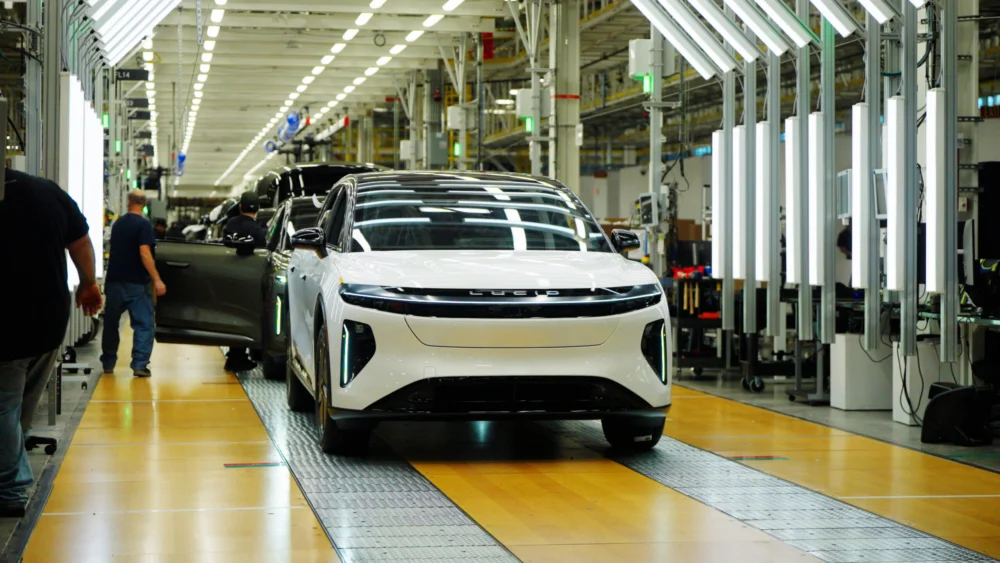
Lucid Group, the luxury electric vehicle manufacturer known for its industry-leading range and efficiency, reported a complex set of fourth-quarter and full-year financial results on Tuesday, painting a picture of a company in the midst of a rigorous transition. As the broader automotive industry grapples with a cooling demand for high-end electric vehicles (EVs), Lucid is attempting to balance the scales between aggressive growth and fiscal responsibility. The company’s latest disclosures reveal a significant miss on Wall Street’s earnings expectations, even as it managed to outperform revenue estimates, highlighting the immense costs associated with scaling a boutique EV brand into a mainstream contender.
For the fourth quarter, Lucid’s financial performance was a study in contrasts. While the company exceeded average revenue estimates by approximately 12%, the bottom line remained under heavy pressure. The electric vehicle maker reported a net loss of $814 million for the quarter, contributing to a total annual net loss of $2.7 billion for 2025. This figure is strikingly similar to the $2.71 billion loss reported in the previous year, suggesting that while revenue is growing, the cost of production and the capital expenditures required for new models continue to offset gains. Specifically, the company’s annual revenue for 2025 reached $1.35 billion, a robust 68% increase year-over-year, driven largely by a doubling of results during the final quarter of the year. However, the loss per share for the year stood at $12.09, reflecting the dilution and heavy burn rate typical of a capital-intensive startup in the manufacturing sector.
The disclosure of these financial figures comes at a sensitive time for Lucid’s workforce. Just days prior to the earnings release, the company announced it was laying off 12% of its U.S. salaried employees. This move is part of a broader initiative to "streamline operations" and "operate with greater efficiency," as the company seeks to improve its gross margins and secure long-term sustainability. Interim CEO Marc Winterhoff addressed these cuts directly, describing them as a necessary "realignment" rather than a sign of systemic failure. Speaking to CNBC, Winterhoff emphasized that the reduction was a response to shifting market dynamics and the need for internal efficiency. "We are adjusting and going to a level where we think we want to be and need to be," Winterhoff stated, adding that the company does not anticipate further rounds of layoffs in the near future.
One of the most scrutinized aspects of the report was the revision of Lucid’s 2025 production figures. The company adjusted its year-end production results downward, from an initial figure of 18,378 units to a finalized 17,840 units. The discrepancy of 538 vehicles was attributed to "internal validation issues." According to Lucid, these vehicles had not completed the rigorous internal procedures required to be officially classified as "produced" under the company’s final quality control standards. While this revision did not impact the reported financial results for the year, it underscored the technical challenges inherent in producing high-complexity luxury vehicles. Lucid assured investors that these vehicles are expected to be completed and accounted for within the current calendar year.
Despite the 2025 adjustment, Lucid is setting its sights on a significant ramp-up for 2026. The company announced a vehicle production target of between 25,000 and 27,000 units for the coming year. This represents a projected growth of 40% to 51% compared to the 2025 output. Winterhoff characterized this growth as "healthy" but "conservative," noting that the company’s initial internal plans were even higher. The decision to guide for a more moderate increase reflects the current "EV winter"—a period of slowing sales growth across the electric vehicle sector caused by high interest rates, consumer anxiety over charging infrastructure, and the saturation of the early-adopter market. "We wanted to really be conservative and make sure that we are hitting the numbers that we are projecting," Winterhoff explained.

The cornerstone of Lucid’s 2026 strategy is the Gravity SUV. As the company’s first foray into the highly lucrative SUV segment, the Gravity is expected to account for the majority of production and sales this year. Built on the same high-efficiency platform as the Lucid Air sedan, the Gravity aims to offer a combination of space, luxury, and performance that few competitors can match. Industry analysts believe the Gravity is essential for Lucid’s survival, as the market for high-end sedans is significantly smaller than that for premium SUVs. Following the Gravity, the Lucid Air sedan will remain a core component of the lineup, targeting the executive and enthusiast demographics.
Looking further ahead, Lucid is preparing to diversify its portfolio to attract a broader consumer base. At the end of this year, the company expects to begin production of a new, less expensive midsize vehicle. While Winterhoff noted that this model will not be a material contributor to 2026 production volumes, it represents a pivotal shift in the company’s long-term roadmap. By entering the midsize market—likely competing with the Tesla Model 3 and Model Y—Lucid hopes to achieve the scale necessary for profitability. Furthermore, the company is venturing into the autonomous space, planning to launch its first Lucid robotaxis in collaboration with previously announced partners. This move signals Lucid’s intent to not only be a vehicle manufacturer but a provider of future mobility solutions.
Financially, Lucid remains in a relatively stable position compared to some of its struggling peers, largely due to its significant liquidity. The company ended 2025 with approximately $4.6 billion in total liquidity. CFO Taoufiq Boussaid described this capital reserve as "strong," providing the necessary "flexibility to execute near-term objectives while investing in future growth." Much of this financial backing has historically come from the Saudi Arabian Public Investment Fund (PIF), which holds a majority stake in the company. This sovereign wealth support has allowed Lucid to continue its research and development and factory expansions in Casa Grande, Arizona, even as other EV startups face the threat of bankruptcy.
However, the path to profitability remains undefined. Lucid has yet to provide a specific timeline for when it expects its cash flow to turn positive. The company’s primary objectives for the current year are reaching its production targets, expanding its sales network, and continuing to find ways to reduce costs. The upcoming Investor Day, scheduled for March 12 in New York, is expected to provide more clarity on the company’s financial trajectory and the technical milestones for the midsize platform.
The broader context of Lucid’s struggle is the intense competition in the luxury EV space. While Lucid’s technology—specifically its miniaturized powertrain and battery management—is widely considered superior to many of its rivals, the company faces a branding and distribution uphill battle. Tesla’s aggressive price cuts have pressured the entire industry, forcing luxury makers like Lucid to justify their premium pricing in a more price-sensitive environment. Moreover, legacy automakers such as Porsche, Mercedes-Benz, and BMW are rapidly expanding their own electric offerings, leveraging decades of brand loyalty and extensive dealer networks.
As Lucid moves through 2026, the success of the Gravity SUV will be the ultimate litmus test for the brand. If the company can successfully navigate its "validation issues" and hit its 27,000-unit target, it may restore investor confidence and prove that there is a sustainable market for ultra-luxury EVs that prioritize engineering excellence. For now, the interim leadership under Marc Winterhoff is focused on "not spending money that we don’t have to," a mantra that reflects the sobering reality of the current economic climate. The road ahead for Lucid is one of disciplined execution, where every vehicle coming off the line in Casa Grande represents a vital step toward a future that is both electric and profitable.