
 By Isnaini Azizah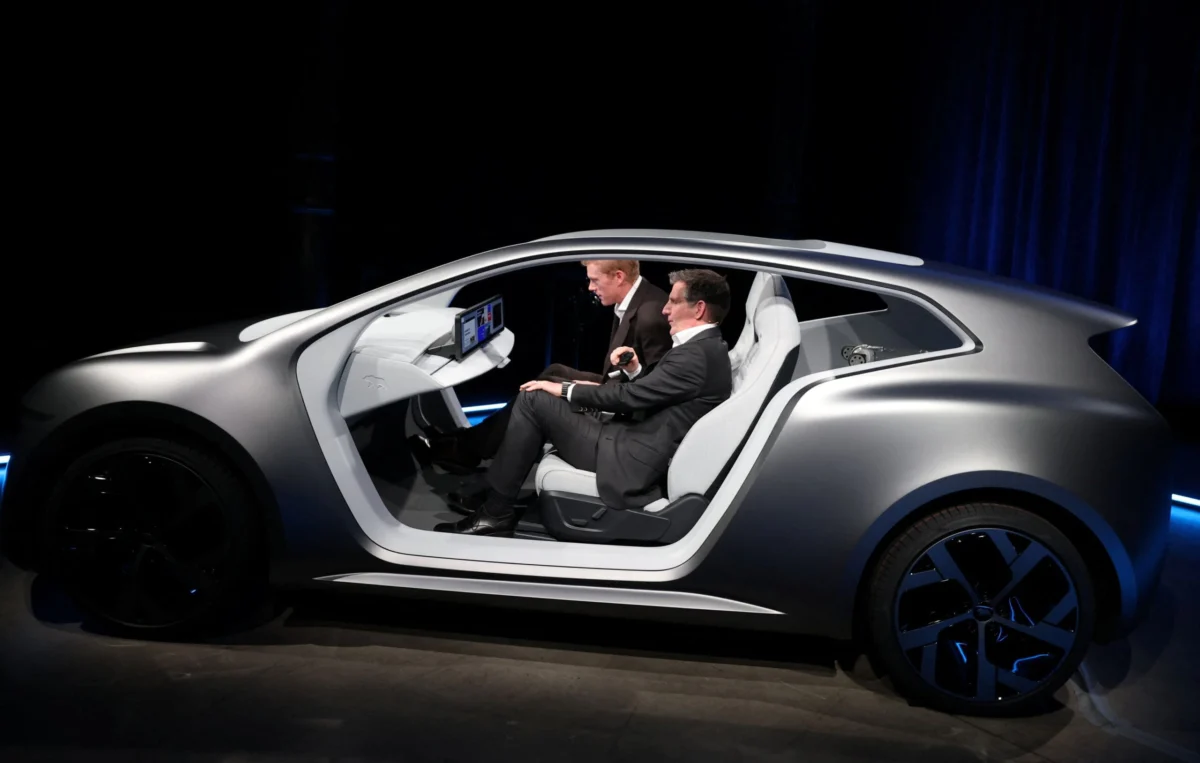
The high-stakes world of electric vehicle manufacturing converged at the New York International Auto Show on April 16, 2025, as Lucid Group executives took the stage for their first comprehensive investor day in nearly five years. Amidst a backdrop of shifting consumer demand and a volatile stock market, the Newark, California-based automaker laid out an ambitious roadmap designed to transform it from a niche luxury player into a diversified, cash-flow-positive powerhouse by the end of the 2020s. The presentation, which detailed a shift toward more affordable midsize vehicles, a bold entry into the autonomous robotaxi sector, and a significant expansion of software-based revenue streams, served as a critical attempt to reassure Wall Street of the company’s long-term viability.
Lucid’s primary objective, according to interim CEO Marc Winterhoff, is to achieve positive cash flow generation late this decade. This target is viewed as a "north star" for a company that has, until now, been defined by its world-class engineering but hampered by high production costs and a limited, high-priced product lineup. Winterhoff, who stepped into the leadership role following the unexpected departure of founder Peter Rawlinson last year, emphasized that "accelerating to profitability" is the central pillar of the company’s revised strategy. However, the path to that goal remains steep. While Lucid successfully increased its sales volume and narrowed some operational losses over the past year, the financial figures for 2025 underscore the immense capital requirements of the EV industry. The company reported a net loss of $2.7 billion on revenue of $1.35 billion for the 2025 fiscal year, with a negative free cash flow of $3.8 billion—a figure that represents a 31% widening of losses compared to the previous year.
The investor community’s reaction to the presentation was one of cautious skepticism, reflected in a 7.9% drop in Lucid’s stock price, which closed at $9.84 on Thursday. Despite the depth of the product announcements, the broader "EV winter"—characterized by high interest rates, cooling demand in the United States, and looming trade tariffs—continues to weigh heavily on investor sentiment. Ben Kallo, an analyst at Baird, noted that while the late-decade targets provide a much-needed benchmark for measuring progress and improving transparency, the near-term environment remains fraught with headwinds. For Lucid to survive until its profitability window opens, it must navigate a period of intense competition and technological transition.
Central to Lucid’s survival strategy is the expansion into the midsize vehicle market, a segment currently dominated by Tesla’s Model Y and the upcoming R2 platform from Rivian Automotive. Lucid announced plans to launch three distinct midsize models, starting with a vehicle dubbed "Cosmos" scheduled for production later this year. The Cosmos will be followed roughly a year later by a second model named "Earth," with a third, as-yet-unnamed vehicle planned for the subsequent period. Derek Jenkins, Lucid’s Senior Vice President of Design and Brand, described these vehicles as the key to reaching a "different audience" than the current luxury buyers of the Air sedan and Gravity SUV.
The Cosmos, previewed to attendees via teaser images and design concepts, departs from the sleek, aerodynamic minimalism of the Lucid Air in favor of a more "muscular" aesthetic. It features thinner, more aggressive headlights and a silhouette that echoes the Gravity SUV but in a more compact, urban-friendly package. Inside, the vehicle maintains Lucid’s signature commitment to interior volume and "miniaturization" of drivetrain components, allowing for a spacious cabin that belies its exterior dimensions. A massive, one-piece digital display traverses the dashboard, serving as the hub for the company’s new AI-driven user interface. With a target starting price of approximately $50,000, Lucid is positioning itself to compete directly with the average transaction price of new vehicles in the U.S., potentially unlocking a massive wave of volume that was previously out of reach for a brand whose flagship models often exceed $100,000.

Beyond hardware, Lucid is making a massive bet on software and autonomy to bolster its bottom line. Executives revealed a goal to generate $1 billion in annual incremental, non-vehicle revenue through recurring software subscriptions by the late 2020s. This ecosystem will be built around a tiered subscription model, expected to launch by early 2027, with pricing ranging from $69 to $199 per month depending on the level of autonomous capability and digital features. Kay Stepper, Vice President of Advanced Driving Systems, asserted that "autonomy plays an outsized role in the future of Lucid," with plans to offer vehicles capable of high-level self-driving in specific environments by 2029.
Perhaps the most surprising announcement of the day was Lucid’s formal entry into the robotaxi space. The company showcased a design concept for a dedicated two-seat autonomous vehicle developed on the upcoming midsize platform. This initiative is being bolstered by an expanded partnership with Uber. Uber President and COO Andrew Macdonald joined Winterhoff to announce that their previously established collaboration would now include the integration of Lucid’s upcoming midsize vehicles and robotaxi prototypes into the Uber network. This pivot into mobility-as-a-service is expected to dramatically increase Lucid’s Total Addressable Market (TAM). While the company’s current focus on luxury sedans and SUVs targets a $40 billion market, the expansion into midsize vehicles and autonomous ride-hailing could expand that TAM to a staggering $700 billion.
However, the competition is not standing still. Rivian is preparing to launch its R2 midsize SUV this spring with a starting price of $58,000, and Tesla continues to iterate on its "Full Self-Driving" (FSD) software. Lucid executives were quick to point out that their own AI assistant and autonomy stack are catching up rapidly, with Winterhoff claiming that Lucid’s technology would match the capabilities of Tesla’s current FSD by next year. The battle for software supremacy is becoming just as critical as the battle for battery efficiency, a field where Lucid still claims a "class-leading" advantage.
The financial lifeline for these ambitious projects continues to be Saudi Arabia’s Public Investment Fund (PIF), Lucid’s largest shareholder. However, the nature of that support is evolving. The PIF has recently shifted its strategy from direct capital investment to providing a revolving credit facility, including a $2 billion delayed draw term loan. This move suggests a more disciplined approach to funding, requiring Lucid to hit specific milestones to access further cash. Currently, Lucid reports a total liquidity of $5.5 billion, which management believes is sufficient to fund operations through the first half of 2027. This provides a narrow but vital window to get the Cosmos and Earth models into production and begin scaling the software revenue that the company’s long-term thesis depends on.
As the presentation concluded, the underlying message was clear: Lucid is no longer content being a boutique manufacturer of high-end electric "jewels." By targeting the mid-market and embracing the autonomous revolution, the company is attempting to rewrite its narrative from one of "burning cash" to one of "scaling innovation." The success of this transition will depend on the company’s ability to execute its production timelines flawlessly—a challenge that has tripped up many EV startups in the past. With the Cosmos launch looming and the "Earth" model on the horizon, the next 24 months will determine whether Lucid’s late-decade profitability target is a realistic destination or a vanishing mirage. For now, the company remains a high-risk, high-reward bet on the future of transportation, fueled by Saudi capital and a relentless focus on being the most efficient player in the electric era.