
 By Isnaini Azizah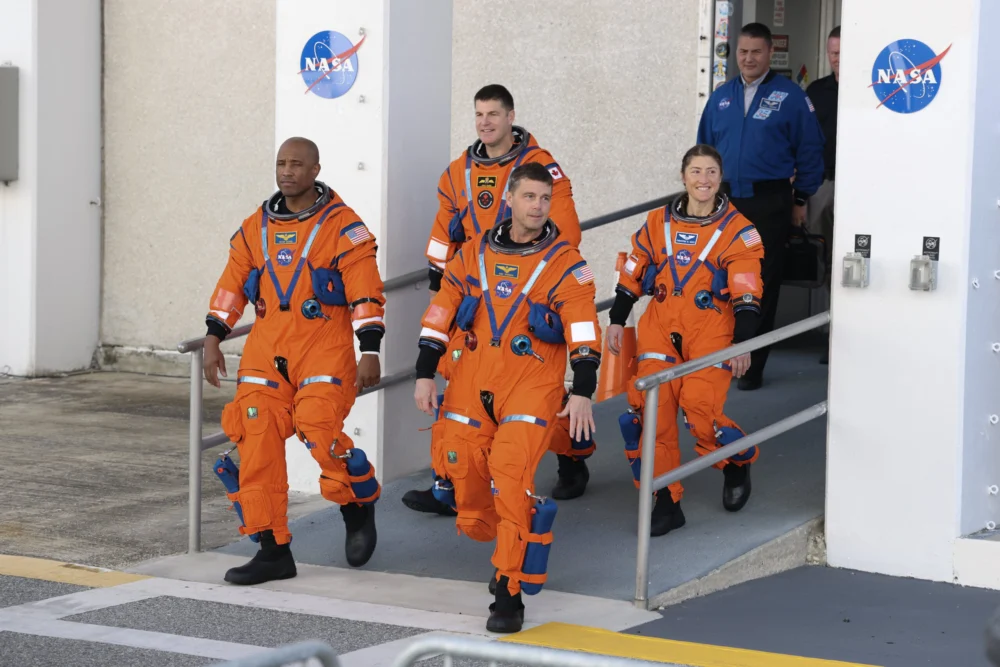
The upcoming launch of Artemis II represents far more than a routine scientific endeavor; it is a monumental pivot in the history of human spaceflight, signaling the United States’ return to deep space for the first time since the conclusion of the Apollo era in 1972. As the four-person crew—Commander Reid Wiseman, Pilot Victor Glover, and Mission Specialists Christina Koch and Jeremy Hansen—rehearsed their historic walkout from the Neil A. Armstrong Operations and Checkout Building at NASA’s Kennedy Space Center in Florida, the weight of the mission’s legacy and its future implications was palpable. This mission, currently slated for late 2025 following several technical delays, is designed to test the limits of the Space Launch System (SLS) and the Orion spacecraft, carrying humans further into the cosmos than any generation has traveled in over half a century.
The significance of Artemis II is rooted deeply in its demographic milestones. For the first time, a lunar mission will include a Black astronaut, Victor Glover, and a female astronaut, Christina Koch. Glover, a decorated U.S. Navy captain who previously served as a pilot on the SpaceX Crew-1 mission to the International Space Station (ISS), brings a wealth of experience in long-duration orbital flight. His inclusion is a symbolic and practical realization of NASA’s modern mandate to ensure that the exploration of the heavens reflects the diversity of the Earth. Glover has often spoken about the "cultural benefits" of the Artemis program, emphasizing that the mission serves as a beacon of inspiration for future generations who have previously seen space exploration through a much narrower lens.
Joining Glover is Christina Koch, an engineer who holds the record for the longest single spaceflight by a woman. Her background in scientific research and her extensive experience conducting spacewalks make her a vital asset to the crew. Koch’s career trajectory, from a NASA engineer to an astronaut, exemplifies the rigorous meritocracy of the modern space program. During the announcement of the crew, Koch noted that the mission carries the "aspirations and dreams" of the public, highlighting the emotional connection between the scientific community and the global audience watching these developments. The crew is rounded out by Commander Reid Wiseman, a veteran of the ISS known for his leadership and technical acumen, and Jeremy Hansen, a colonel in the Canadian Armed Forces representing the Canadian Space Agency (CSA). Hansen’s presence underscores the international collaboration that defines the Artemis Accords, a diplomatic framework that seeks to establish a permanent and peaceful human presence on the moon.
While Artemis II will not involve a lunar landing—instead performing a high-altitude flyby that will use the moon’s gravity to slingshot the Orion capsule back toward Earth—it serves as the ultimate "stress test" for the hardware intended to eventually land humans on the lunar South Pole. This mission follows the resounding success of Artemis I in 2022, an uncrewed flight that proved the SLS rocket’s capability and the Orion heat shield’s integrity during a high-speed re-entry. However, the transition to a crewed mission introduces exponentially higher stakes. NASA engineers must ensure that the life-support systems, communication arrays, and emergency abort protocols are flawless before risking human lives on a journey that takes them 230,000 miles away from home.
Experts like Danielle Wood, a professor in the astronautics department at the Massachusetts Institute of Technology (MIT), view Artemis II as the culmination of two decades of strategic planning. According to Wood, the mission is a bridge between the era of Low Earth Orbit (LEO) dominance—typified by the ISS—and the new frontier of deep space exploration. Wood points out that NASA has spent years preparing the government and the private sector to focus on "harder, next-generation missions" that push the boundaries of demonstrated technology. She also notes the critical importance of diversity in this new era, suggesting that breaking "glass ceilings" for Black men and women in aerospace is not just a matter of social progress but a necessary evolution to tap into the broadest possible pool of talent.
However, the path to the moon is fraught with more than just physical hazards. The Artemis program has faced significant scrutiny regarding its timeline and budget. Amy Shira Teitel, a prominent space historian, has voiced concerns about the sustainability of the program. While acknowledging that Artemis II marks a "new era of leaving low Earth orbit," Teitel highlights the "tenuous" nature of the project. The SLS rocket, while undeniably powerful, has been criticized by some as a "boondoggle" due to its immense cost—estimated at over $2 billion per launch—and its use of non-reusable components in an age where commercial entities like SpaceX have demonstrated the viability of reusable boosters. These financial pressures are compounded by political volatility; space programs often span multiple presidential administrations, making them vulnerable to shifting legislative priorities and budget cuts.
Despite these criticisms, the broader aerospace landscape is more vibrant and competitive than ever. The mission occurs within a "new space race" that includes both geopolitical rivals and private industry titans. Elon Musk’s SpaceX recently signaled a strategic pivot, intensifying its focus on lunar exploration alongside its long-term Mars ambitions. Meanwhile, smaller but highly capable firms like Intuitive Machines and Firefly Aerospace have already made strides in delivering payloads to the lunar surface through NASA’s Commercial Lunar Payload Services (CLPS) program. This synergy between government agencies and private contractors is a hallmark of the Artemis era, creating a robust ecosystem that aims to lower the cost of space access over time.
The scientific yield of Artemis II is also expected to be substantial. Beyond testing the spacecraft, the mission will conduct extensive research on the effects of deep-space radiation on the human body. Unlike the ISS, which is shielded by the Earth’s magnetosphere, the Artemis II crew will be exposed to cosmic rays and solar energetic particles that present unique health risks. Understanding these effects is a prerequisite for any future mission to Mars, which would require astronauts to spend months or even years in deep space. Furthermore, the mission involves international "goodwill" agreements with countries like Saudi Arabia and Germany, fostering a collaborative environment for lunar research that transcends national borders.
The legislative support for these endeavors remains a critical pillar of the program. The U.S. Senate has recently advanced bipartisan legislation designed to reinforce American leadership in space. This bill is not only a matter of national pride but also a significant economic driver. The aerospace industry supports thousands of high-tech jobs, particularly in regions like Alabama, where the Marshall Space Flight Center serves as the "engine" of the SLS development. By investing in Artemis, the government is essentially subsidizing the next generation of American industrial and scientific capability.
As NASA prepares to retire the International Space Station by 2030, the focus is shifting toward "Gateway"—a planned small space station that will orbit the moon. Gateway will serve as a multi-purpose outpost for lunar surface missions and a staging ground for deep-space exploration. Artemis II is the essential precursor to this vision. It validates the transportation system that will ferry astronauts to and from the lunar vicinity. While the mission has faced delays—moving from an initial 2024 window to 2025 due to the need for additional safety checks on the Orion capsule’s batteries and electronics—the consensus among the scientific community is that a cautious approach is preferable to a catastrophic failure.
Ultimately, Artemis II is a mission of both technical necessity and profound inspiration. It seeks to answer fundamental questions about our place in the solar system while demonstrating that the exploration of space is a journey for all of humanity. As Victor Glover noted, the goal is to inspire the world to "literally reach for the moon." Whether the program can overcome its budgetary and political hurdles remains to be seen, but the launch of Artemis II will undoubtedly stand as a defining moment in the 21st century—a testament to human ingenuity and the enduring desire to explore the unknown. When the four astronauts finally ascend from the Florida coast, they will carry with them the legacy of the Apollo pioneers and the hopes of a world looking toward a future among the stars.