
 By admin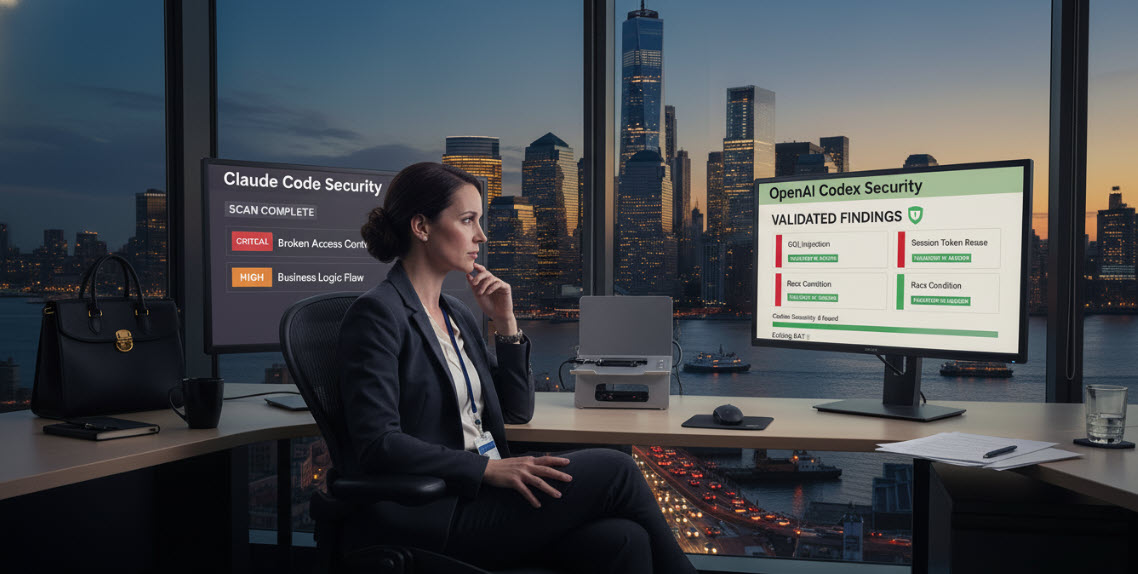
The landscape of application security testing has been dramatically reshaped with the simultaneous emergence of two powerful, AI-driven vulnerability scanners: OpenAI’s Codex Security, launched on March 6th, and Anthropic’s Claude Code Security, which debuted just 14 days prior. This rapid succession of high-profile releases signals a fundamental shift away from traditional pattern-matching methodologies in Static Application Security Testing (SAST) towards sophisticated Large Language Model (LLM) reasoning. Both OpenAI and Anthropic have demonstrated that current SAST tools are, by their very design, structurally blind to entire classes of vulnerabilities, leaving enterprises in a precarious position within their existing security stacks.
The competitive dynamic between these two AI giants, boasting a combined private market valuation exceeding $1.1 trillion, promises an accelerated pace of improvement in detection quality, far surpassing what any single vendor could achieve in isolation. While neither Claude Code Security nor Codex Security is positioned as a direct replacement for an organization’s entire existing security infrastructure, their introduction fundamentally alters the procurement calculus for application security solutions. Currently offered free to enterprise customers, these tools necessitate a strategic re-evaluation by security leaders. This article provides a comprehensive comparison and a seven-point action plan to prepare for board-level discussions regarding these new technologies.
Converging on a Shared Conclusion: Diverse Architectures, Identical Insights
Both Anthropic and OpenAI, operating with distinct architectural approaches, independently arrived at the same critical conclusion: LLM reasoning is essential for uncovering vulnerabilities that traditional SAST methods miss. Anthropic’s groundbreaking research, published on February 5th alongside the release of Claude Opus 4.6, highlighted the capabilities of its model. According to Anthropic, Claude Opus 4.6 identified over 500 previously unknown, high-severity vulnerabilities in production open-source codebases that had withstood decades of rigorous expert review and millions of hours of automated fuzzing.
A striking example of this advanced reasoning was demonstrated in the CGIF library. Claude unearthed a heap buffer overflow vulnerability by deeply understanding the LZW compression algorithm. This flaw remained undetected by coverage-guided fuzzing, even when achieving 100% code coverage. Anthropic subsequently released Claude Code Security as a limited research preview on February 20th, making it accessible to Enterprise and Team customers, and offering expedited free access to open-source maintainers. Gabby Curtis, Anthropic’s Communications Lead, emphasized in an exclusive interview with VentureBeat that the primary goal in developing Claude Code Security was to democratize defensive security capabilities.
OpenAI’s findings, derived from a different architectural foundation and a broader scanning scope, are equally compelling. Codex Security evolved from Aardvark, an internal tool powered by GPT-5 that entered private beta in 2025. During its beta phase, OpenAI’s agent meticulously scanned over 1.2 million commits across external repositories. This extensive analysis reportedly uncovered 792 critical findings and 10,561 high-severity vulnerabilities. OpenAI disclosed the identification of vulnerabilities in prominent software projects including OpenSSH, GnuTLS, GOGS, Thorium, libssh, PHP, and Chromium, resulting in the assignment of 14 CVEs. Furthermore, OpenAI reported a significant improvement in Codex Security’s performance, with false positive rates decreasing by over 50% across all scanned repositories during the beta period, and over-reported severity dropping by more than 90%.
However, a nuanced perspective is crucial. Researchers from Checkmarx Zero have demonstrated that Claude Code Security can, at times, miss moderately complex vulnerabilities. Their findings suggest that developers might be able to intentionally mislead the agent into overlooking vulnerable code segments. In a comprehensive scan of a full production-grade codebase, Checkmarx Zero observed that while Claude identified eight vulnerabilities, only two were confirmed as true positives. This indicates that the detection ceiling might be lower than the headline figures suggest, particularly when confronted with sophisticated obfuscation techniques. It is important to note that neither Anthropic nor OpenAI has yet submitted their detection claims for independent, third-party audit. Therefore, security leaders should interpret the reported numbers as strong indicators rather than definitively audited metrics.
Merritt Baer, CSO at Enkrypt AI and former Deputy CISO at AWS, provided critical insights into the implications of this rapid competitive advancement. She stressed that the intense race between these AI scanners significantly compresses the operational window for security teams. Baer strongly advises security teams to re-evaluate their patching prioritization strategies, moving beyond CVSS scores alone to consider exploitability within their specific runtime context. She also advocates for shortening the timeframes between vulnerability discovery, triage, and remediation, and emphasizes the critical importance of maintaining comprehensive Software Bill of Materials (SBOM) visibility to enable immediate identification of where a vulnerable component is deployed.
The convergence of Anthropic and OpenAI on the same fundamental conclusion, despite utilizing different scanning methodologies and examining largely distinct codebases, is a powerful testament to the limitations of traditional SAST. Their shared insight is clear: pattern-matching SAST has reached its inherent ceiling, and LLM reasoning provides the capability to extend detection beyond these limitations. The simultaneous release of this advanced capability by two formidable competitors introduces a complex dual-use scenario. Any financial institution or fintech company operating with a commercial codebase must operate under the assumption that if Claude Code Security and Codex Security can identify these vulnerabilities, malicious actors with API access are equally capable of doing so.
Baer articulated this point with stark clarity: vulnerabilities unearthed by reasoning models in open-source software should be treated with the same urgency as zero-day discoveries, not relegated to a backlog. The window between discovery and exploitation has been drastically compressed, and many existing vulnerability management programs are still relying on CVSS scoring for triage, a practice that is becoming increasingly inadequate.
Vendor Responses: Acknowledging Advancement While Highlighting Bottlenecks
The emergence of these AI-powered scanners has prompted responses from established players in the application security market. Snyk, a developer security platform widely adopted for identifying and remediating vulnerabilities in code and open-source dependencies, acknowledged the significant technical breakthrough. However, Snyk’s perspective is that the challenge has never been solely about finding vulnerabilities; the true bottleneck lies in fixing them at scale, across numerous repositories, without introducing new issues or disrupting existing functionality.
Snyk pointed to research indicating that AI-generated code is a significant contributor to security risks. According to Veracode’s 2025 GenAI Code Security Report, AI-generated code is 2.74 times more likely to introduce security vulnerabilities compared to human-written code. This highlights a paradoxical situation: the same advanced AI models capable of discovering hundreds of zero-day vulnerabilities are also introducing new classes of vulnerabilities when they are used for code generation.
Ronen Slavin, CTO of Cycode, echoed this sentiment, characterizing Claude Code Security as a genuine advancement in static analysis. However, he cautioned that AI models are inherently probabilistic. Slavin argued that security teams require consistent, reproducible, and audit-grade results. While an embedded scanning capability within an Integrated Development Environment (IDE) can be useful, it does not constitute a comprehensive security infrastructure. Slavin’s stance is that SAST is but one discipline within a much broader security scope, and that free scanning tools do not obviate the need for enterprise-scale platforms that manage governance, pipeline integrity, and runtime behavior.
Baer further elaborated on the market implications, stating, "If code reasoning scanners from major AI labs are effectively free to enterprise customers, then static code scanning commoditizes overnight." She anticipates that over the next 12 months, security budgets will increasingly shift towards three key areas: enhanced runtime security, advanced threat intelligence, and robust supply chain security.
Seven Imperatives for Board-Level Readiness
The fourteen-day gap between Anthropic’s and OpenAI’s announcements underscores the accelerating pace of innovation in this field. The interval between future releases is likely to be even shorter, a reality that adversaries are keenly observing. To navigate this evolving threat landscape and effectively communicate with executive leadership, security teams should undertake the following seven actions:
-
Establish a Pilot Program for Both Scanners: Given their current free availability, enterprise customers should immediately initiate pilot programs for both Claude Code Security and Codex Security. This hands-on experience will provide invaluable insights into their respective strengths, weaknesses, and integration challenges within your existing workflows. The objective is to understand their practical utility and potential impact on your current security posture.
-
Develop a Framework for LLM-Based Vulnerability Triage: Traditional triage processes, heavily reliant on CVSS scores, are becoming insufficient. Develop a new framework that incorporates LLM-driven reasoning capabilities. This framework should prioritize vulnerabilities based on factors like exploitability in your specific environment, potential business impact, and the complexity of the vulnerability as assessed by AI models.
-
Benchmark Against Existing SAST Tools: Conduct rigorous head-to-head comparisons between Claude Code Security, Codex Security, and your current SAST solutions. Document the types and severity of vulnerabilities each tool identifies, their false positive/negative rates, and the time required for scans. This data will be crucial for demonstrating the limitations of legacy tools and the value proposition of the new AI-powered scanners.
-
Assess Integration and Workflow Impact: Evaluate how these new scanners can be integrated into your existing CI/CD pipelines and developer workflows. Consider the technical requirements, potential disruptions, and the necessary training for development and security teams. The goal is to ensure that adopting these tools enhances, rather than hinders, developer productivity and security integration.
-
Quantify the Risk of "Structurally Blind" Vulnerabilities: Work with your teams to quantify the potential risk posed by vulnerability classes that traditional SAST tools are known to miss. This exercise should involve estimating the likelihood and impact of such vulnerabilities being exploited within your organization. The findings will provide a compelling justification for adopting LLM-based reasoning.
-
Prepare for Procurement Strategy Shifts: Understand that the "free" nature of these tools for enterprises today may not be permanent. Begin exploring potential future procurement models, licensing structures, and the total cost of ownership for AI-driven security solutions. This foresight will enable proactive budget planning and strategic decision-making.
-
Emphasize the "Dual-Use" Threat Landscape: Communicate to the board the critical implication of these advanced AI capabilities: if these tools can find vulnerabilities, so can adversaries. This understanding necessitates a heightened sense of urgency in vulnerability management and a strategic shift towards proactive threat hunting and rapid remediation, treating AI-discovered vulnerabilities with the gravity of zero-day exploits.
The rapid advancements by OpenAI and Anthropic are not merely incremental improvements; they represent a fundamental paradigm shift in application security. By embracing these changes, preparing strategically, and engaging in informed dialogue with leadership, organizations can effectively navigate this new era of AI-powered cybersecurity and bolster their defenses against an increasingly sophisticated threat landscape. The window for adaptation is narrowing, and proactive engagement is paramount.