
 By admin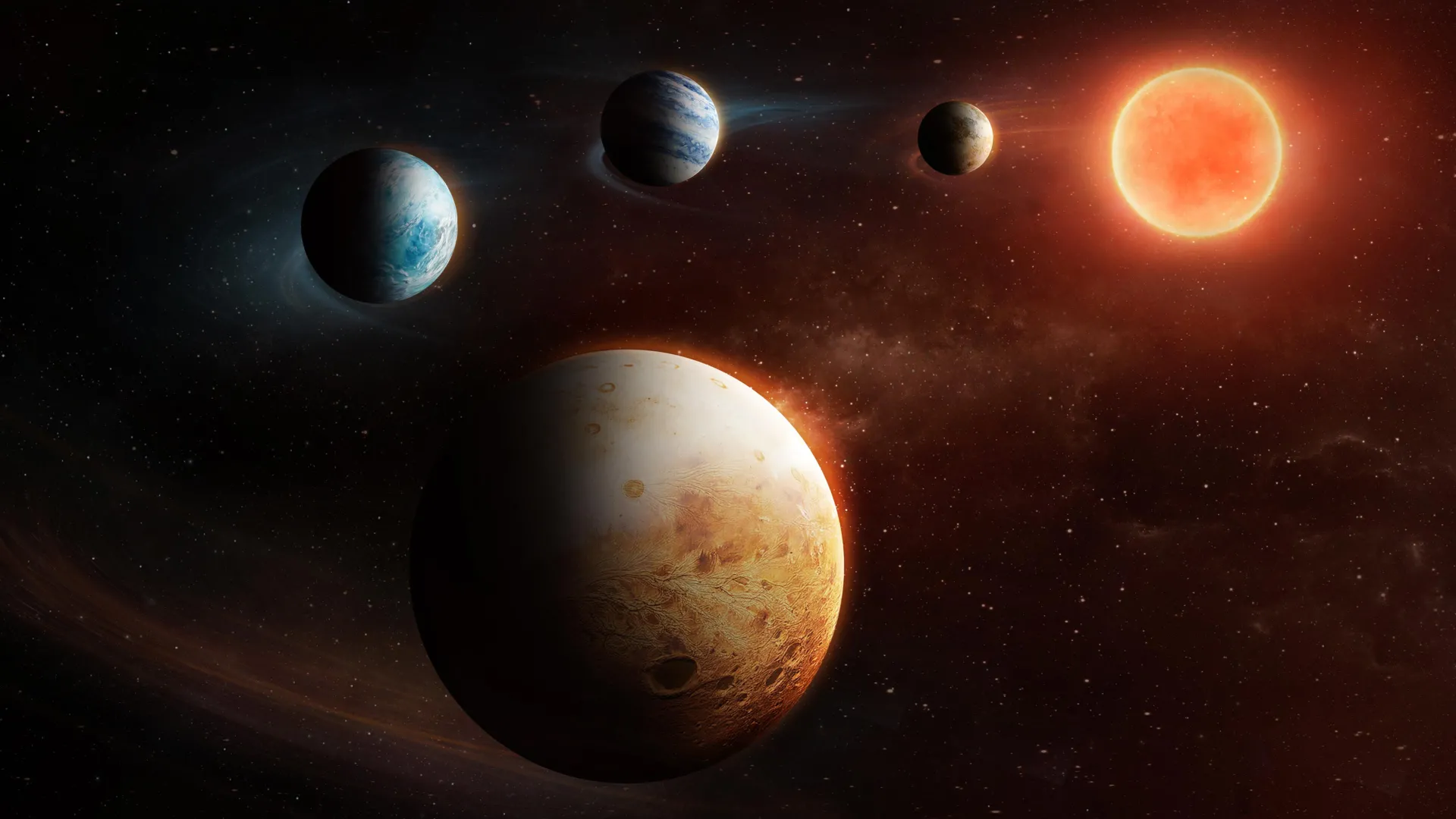
Our own Solar System perfectly exemplifies this established pattern. Mercury, Venus, Earth, and Mars, the inner quartet, are primarily composed of rock and metal, stripped of most volatile elements by the intense radiation and heat of the young Sun. Further out, beyond the asteroid belt, Jupiter, Saturn, Uranus, and Neptune stand as colossal gas and ice giants, their massive atmospheres and deep envelopes of hydrogen, helium, and heavier elements a testament to the colder, more quiescent environment in which they accreted. This neat segregation is elegantly explained by the leading theory of planet formation, known as core accretion. In this model, planets begin as tiny dust grains within a protoplanetary disk—a swirling, flattened cloud of gas and dust surrounding a nascent star. These grains gradually stick together, forming pebbles, then planetesimals, and eventually larger planetary embryos.
The crucial factor dictating a planet’s final composition in the core accretion model is its distance from the central star. A young star emits prodigious amounts of energy, particularly in the form of ultraviolet radiation and powerful stellar winds. Close to the star, this intense radiation effectively "bakes" the inner disk, heating volatile compounds like water, methane, and ammonia past their condensation points, preventing them from solidifying. Any nascent planets in this region are thus stripped of their gaseous envelopes, leaving behind rocky cores. This region is often referred to as the "snow line" or "ice line," marking the boundary beyond which water ice can condense. Beyond this line, cooler temperatures prevail, allowing these volatile compounds to condense into solids. This provides a much larger reservoir of material for planets to accrete, leading to the rapid growth of massive cores. Once a core reaches a critical mass (typically around 5-10 Earth masses), its gravitational pull becomes strong enough to rapidly accrete vast amounts of hydrogen and helium gas from the surrounding disk, culminating in the formation of gas giants. This elegant theory has successfully accounted for the architecture of our Solar System and countless other exoplanetary systems observed by missions like Kepler and TESS, reinforcing its status as the standard model.
A Rule-Breaking System Around LHS 1903
However, the universe, in its boundless complexity, frequently delights in presenting exceptions that challenge our most cherished theories. A newly identified planetary system, orbiting the star LHS 1903, has now presented just such an anomaly. The discovery, detailed in a recent issue of the prestigious journal Science, spotlights a small, faint red dwarf star—LHS 1903—which is significantly cooler and less massive than our Sun. Red dwarfs are the most common type of star in the Milky Way, comprising about 75% of the stellar population. Their long lifespans, low luminosity, and relatively small size make them prime targets for exoplanet searches, particularly in the quest for potentially habitable worlds, as planets orbiting them often have shorter orbital periods and larger transit signals relative to the star.
The research team, spearheaded by Professor Ryan Cloutier, an assistant professor in the Department of Physics and Astronomy at McMaster University, and Professor Thomas Wilson of the University of Warwick, meticulously combined data from a suite of both ground-based and space-borne telescopes to unravel the secrets of this distant system. Their initial observations revealed a relatively compact system comprising three planets. The innermost world, designated LHS 1903 b, appeared to be rocky, consistent with expectations for a planet orbiting close to its star. Further out, two subsequent planets, LHS 1903 c and LHS 1903 d, were identified as gas-rich worlds, akin to smaller versions of Neptune. This initial lineup, with a rocky planet followed by gas-rich ones, perfectly matched the standard expectations derived from the core accretion model. The scientists could have, at that point, simply added LHS 1903 to the long list of systems conforming to the prevailing theory.
But the pursuit of scientific truth often demands persistence and an open mind. Years of additional, meticulous observations, employing advanced instrumentation and sophisticated analytical techniques, brought forth an unexpected twist that would dramatically alter their understanding of this system. New, highly precise measurements from the European Space Agency’s CHEOPS (CHaracterising ExOPlanet Satellite) satellite proved to be the pivotal factor. CHEOPS, launched in 2019, is specifically designed to perform ultra-high precision photometry, enabling it to accurately measure the radii of known exoplanets through the transit method. This precision allows astronomers to determine a planet’s density when combined with mass measurements from radial velocity data, thereby inferring its bulk composition.
It was CHEOPS that unveiled the presence of a fourth planet, now named LHS 1903 e, orbiting farthest from the central star among the known planets in the system. And here lay the astonishing revelation: surprisingly, this outermost world, despite its distant perch, appeared to be rocky, a stark contradiction to the expectation of finding another gas or ice giant in that region.
"We’ve seen this pattern: rocky inside, gaseous outside, across hundreds of planetary systems. It’s almost become an axiom of planetary science," says Professor Cloutier. "But now, the discovery of a rocky planet in the outer part of a system forces us to fundamentally rethink the timing and conditions under which rocky planets can form. It challenges the very universality of the core accretion model as we’ve understood it." This statement underscores the profound implications of LHS 1903 e, which essentially flips the script on conventional wisdom.
Ruling Out Collisions and Planetary Shifts
Faced with such a significant anomaly, the research team, driven by scientific rigor, immediately set out to explore alternative explanations that might reconcile their observation with existing theories. Two primary hypotheses were considered: either the planet initially formed as a gas giant but subsequently lost its atmosphere, or it formed elsewhere in the system and migrated to its current, unusual position.
The first hypothesis posited that LHS 1903 e might have once been a gas-rich planet, similar to its inner neighbors, but suffered a catastrophic event that stripped away its thick atmosphere. A massive impact, for instance, akin to the giant impact thought to have formed Earth’s Moon, could potentially eject significant portions of a planet’s atmosphere and mantle into space. However, detailed computer simulations and analyses of the system’s dynamics quickly ruled out this scenario. Such an impact would likely leave observable evidence, such as a debris disk, an unusually high planetary rotation rate, or highly eccentric orbits for the remaining planets, none of which were detected. Moreover, the energy required to completely strip a Neptune-sized atmosphere, leaving behind a bare rocky core, would be immense and difficult to sustain without completely disrupting the system.
The second leading alternative involved planetary migration. It is well-established that planets can migrate significantly from their birth locations within a protoplanetary disk due to gravitational interactions with the disk itself or with other planets. For instance, the "hot Jupiters"—gas giants found orbiting extremely close to their stars—are thought to have formed farther out and migrated inwards. Could LHS 1903 e have formed closer to the star as a rocky world and then migrated outward to its current position? While outward migration is less common than inward migration, it is not entirely impossible under specific disk conditions or through gravitational scattering events. However, extensive computer simulations modeling the long-term orbital stability of the LHS 1903 system, taking into account the masses and orbital periods of all four planets, found no plausible scenario where LHS 1903 e could have migrated outward without destabilizing the orbits of the inner planets. The system appears to be remarkably stable in its current configuration, suggesting that its planets have likely remained close to their formation locations. The lack of strong orbital resonances, which often indicate past migration, also argued against this explanation.
Instead, after meticulously ruling out these conventional explanations, the findings began to point towards a more unexpected and exciting idea: the planets in this system may not have formed simultaneously, as is often assumed in the standard core accretion model. Rather, they could have developed one after another, sequentially, as the conditions within the protoplanetary disk around LHS 1903 changed over time.
Inside-Out Planet Formation: A New Paradigm?
The standard core accretion model, as previously described, proposes that planets arise within a protoplanetary disc where clumps of material form several planetary embryos at roughly the same time. Over millions of years, these growing bodies sweep up surrounding material, evolving into fully formed planets with a range of sizes and compositions dictated primarily by their initial distance from the star. This "simultaneous formation" paradigm has been highly successful in explaining the observed order in most planetary systems.
However, the peculiar structure of the LHS 1903 system suggests a distinctly different pathway, a hypothesis gaining traction in some theoretical circles: "inside-out planet formation." In this scenario, planets do not all spring into existence at once across the disk. Instead, they take shape sequentially, one after another, in environments that are themselves dynamically shifting and evolving. Crucially, the local conditions at the precise time each planet finishes forming determine its final composition—whether it becomes gas-rich or remains rocky.
To understand this, consider the dynamic nature of a protoplanetary disk. Over millions of years, the gas and dust within the disk are gradually depleted. The star’s radiation, stellar winds, and internal viscous forces slowly dissipate the gas, either by driving it away from the system (photoevaporation) or by causing it to accrete onto the star itself. Dust grains also coagulate and settle, or are incorporated into forming planets.
In an inside-out formation scenario, the inner planets might form relatively early, when the disk is still dense with gas. These planets, even if close to the star, might still have enough time and access to gas to accrete substantial atmospheres before the gas begins to dissipate significantly. As the disk evolves and thins, the conditions for planet formation change. If the outermost planet, LHS 1903 e, formed last, much later than its inner counterparts, then it might have assembled in a significantly depleted disk. By the time LHS 1903 e began to accrete its final mass, the vast majority of the gas in the surrounding disk might have already dissipated, leaving too little material—specifically, hydrogen and helium—to build a thick atmosphere. What remained would primarily be refractory materials: rock and metal. Thus, even at a relatively distant orbit where colder temperatures would normally favor the condensation of volatiles and the accretion of gas, LHS 1903 e would be "starved" of atmospheric building blocks, resulting in a rocky world.
"It’s truly remarkable to see a rocky world forming in an environment that, according to our conventional understanding, shouldn’t favor that outcome," remarks Professor Cloutier. "It challenges the fundamental assumptions built into our current models about the availability of gas and the timescales of planetary accretion." He further adds that this discovery raises broader and tantalizing questions: Is LHS 1903 an isolated anomaly, a unique cosmic quirk? Or is it, perhaps, an early example of a previously unrecognized pattern of planetary system architecture that scientists are only just beginning to discern?
The rapid advancement of exoplanet detection methods and telescopic capabilities is continually pushing the boundaries of our understanding. "As telescopes and detection methods become more precise, we are strengthening our ability to find planetary systems that don’t resemble our own and that don’t conform to longstanding theories," Cloutier emphasizes. Missions like NASA’s Transiting Exoplanet Survey Satellite (TESS) continue to identify thousands of exoplanet candidates, while specialized observatories like CHEOPS and the upcoming James Webb Space Telescope (JWST) are providing unprecedented detail about their compositions and atmospheres. JWST, in particular, with its powerful infrared capabilities, will be instrumental in characterizing the atmospheres of exoplanets, potentially revealing the chemical fingerprints that could support or refute models like inside-out formation. Future ground-based observatories, such as the Extremely Large Telescope (ELT) and the Thirty Meter Telescope (TMT), will further enhance our ability to precisely measure planetary masses and refine orbital parameters, providing the crucial data needed to test these evolving theories.
This discovery around LHS 1903 is more than just an interesting outlier; it serves as a powerful reminder of the universe’s inherent diversity and the dynamic nature of scientific inquiry. "Each new system adds another crucial data point to a growing, increasingly complex picture of planetary diversity," Cloutier concludes. "It’s a picture that continually forces scientists to rethink the fundamental processes that shape worlds across the galaxy, pushing us towards a more complete and nuanced understanding of planet formation and the prevalence of life in the cosmos." The universe, it seems, is far more imaginative in its planetary designs than we have ever dared to imagine.