
 By admin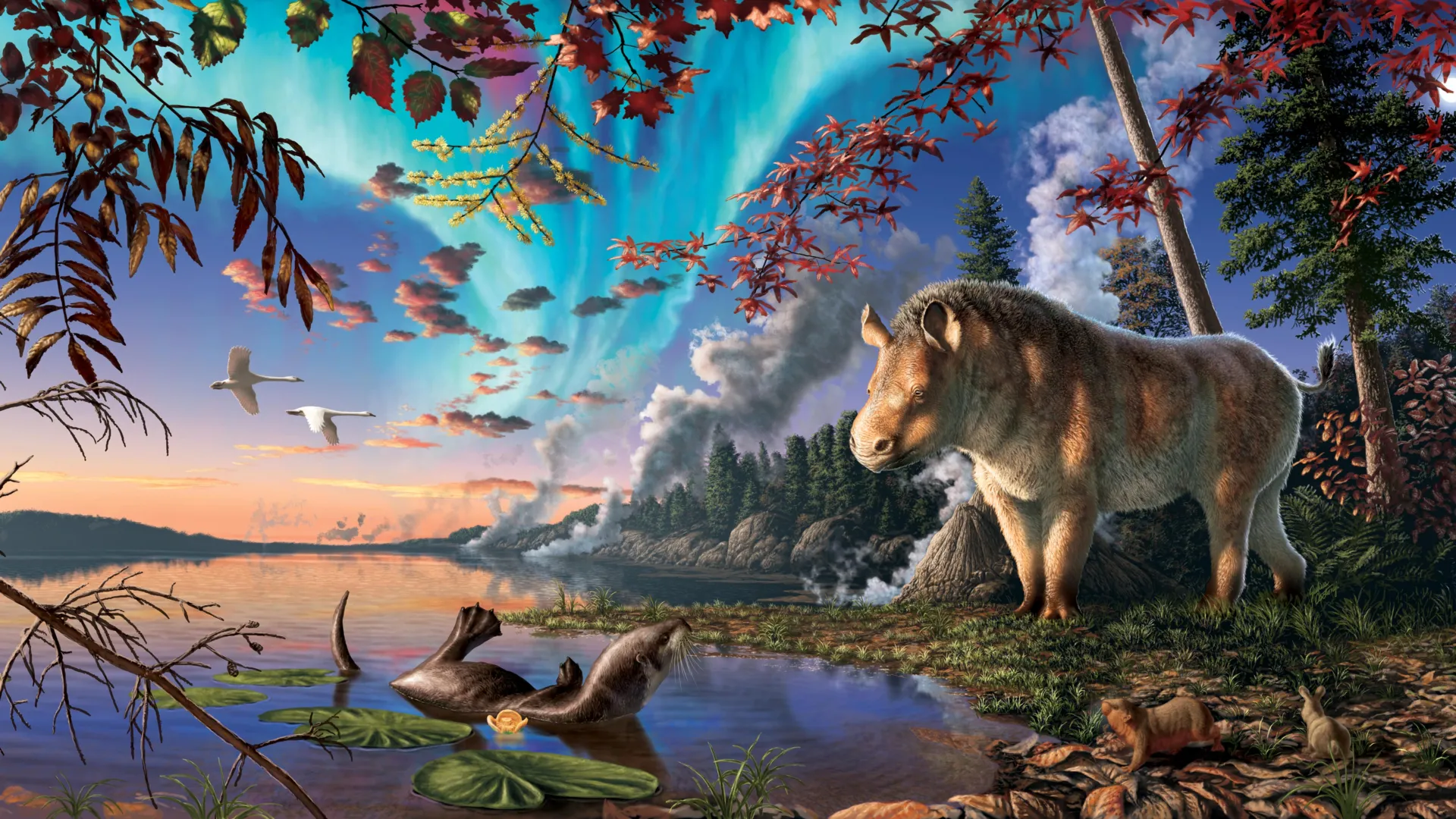
Rhinoceroses boast an extensive and complex evolutionary history, stretching back more than 40 million years. During their peak diversification, these iconic mammals roamed across nearly every continent, with significant populations in Asia, Africa, Europe, and North America, conspicuously absent only from South America and Antarctica. This newly identified "Arctic rhino," named Epiatheracerium itjilik, thrived approximately 23 million years ago during the Early Miocene epoch, a period characterized by warmer global temperatures than today. Intriguingly, phylogenetic analysis reveals its closest relatives are species that inhabited Europe millions of years earlier, suggesting a complex pattern of intercontinental dispersal.
The scientific description of Epiatheracerium itjilik [eet-jee-look] is detailed in a groundbreaking new study published in the prestigious journal Nature Ecology and Evolution. This publication not only formally introduces the species to the scientific community but also revises the existing rhinoceros family tree, offering fresh perspectives on their evolutionary trajectories and geographic spread.
"Today there are only five species of rhinos in Africa and Asia, a stark contrast to their historical diversity. In the past, they were found throughout Europe and North America, with more than 50 species known from the fossil record, showcasing a remarkable evolutionary radiation," explains Dr. Danielle Fraser, head of palaeobiology at the Canadian Museum of Nature (CMN) and lead author of the study. "The addition of this Arctic species to the rhino family tree is not just a discovery; it fundamentally alters our understanding of their evolutionary history and biogeography, particularly regarding their capacity for adapting to and dispersing through high-latitude environments."
A pivotal finding from the research suggests that this Arctic species reached North America via a previously underestimated land bridge connecting Europe and North America through Greenland. This route, the North Atlantic Land Bridge, may have remained active for land mammals much later into geological time than previously believed, potentially extending its functionality well into the Miocene. This challenges earlier models that proposed its cessation as a viable migration corridor around 56 million years ago.
A Smaller, Hornless Arctic Rhino Adapted to its Environment
The Rhinocerotidae family exhibits an astonishing range of forms, from the massive, heavily built rhinoceroses familiar today to smaller, more lightly constructed, and often hornless types. Epiatheracerium itjilik falls into the latter category, presenting a relatively small and lightly built physique. Its size has been estimated to be comparable to a modern Indian rhinoceros, yet notably, it lacked the prominent horn that characterizes many of its contemporary and later relatives. The moderate wear observed on the individual’s cheek teeth provides valuable insight into its life history, indicating that the animal likely died in early to middle adulthood, suggesting a fully grown but not elderly specimen.
The species’ evocative name, "itjilik," translates to "frosty" or "frost" in Inuktitut, a poignant tribute to its High Arctic origins. The selection of this name was a deeply collaborative process, involving the researchers and Jarloo Kiguktak, a respected Inuit Elder and former mayor of Grise Fiord, Canada’s northernmost Inuit community. Kiguktak’s direct connection to the land, having visited the fossil site and participated in several Arctic paleontology expeditions, ensured that the name not only reflected the species’ environment but also honored the Indigenous heritage and stewardship of the region. This collaborative approach underscores the importance of integrating traditional knowledge and local perspectives in scientific endeavors, especially in culturally sensitive areas like the Arctic.
The majority of the fossil material for Epiatheracerium itjilik was originally collected in 1986 by Dr. Mary Dawson, Curator Emeritus at Carnegie Museum of Natural History in Pittsburgh, Pennsylvania. Dr. Dawson was a true pioneer in Arctic paleontology, whose foresight and dedication to exploring these remote regions laid the groundwork for countless discoveries. Her painstaking efforts recovered crucial anatomical features, including a significant portion of the skull, teeth, and jawbones. These key elements proved indispensable, later allowing scientists to confidently identify the specimen as a distinct new species and to place it within the broader rhinoceros family tree.
"What’s truly remarkable about the Arctic rhino is the exceptional condition of the fossil bones. They are three-dimensionally preserved, meaning they haven’t been flattened or distorted by geological pressure, and have only been partially replaced by minerals," marvels paleobiologist Marisa Gilbert, a study co-author and Senior Research Assistant with the CMN. "This level of preservation is incredibly rare and significant. Approximately 75% of the skeleton was discovered, which is an astounding degree of completeness for a fossil, offering an unparalleled window into the anatomy and biology of this ancient creature." Such pristine preservation allows for more accurate anatomical reconstructions and detailed studies of bone microstructure.
Gilbert later joined follow-up expeditions to Haughton Crater in the late 2000s, led by Dr. Natalia Rybczynski, a CMN Research Associate and co-author. These rigorous field studies, which built upon Dawson’s foundational work, proved highly fruitful, also leading to the discovery of another globally significant species: Puijila darwini, the transitional seal ancestor, further cementing Haughton Crater’s status as a paleontological treasure trove. Additional remains of E. itjilik were uncovered during these subsequent expeditions, which involved Dawson, Rybczynski, and Gilbert, creating a continuous thread of scientific exploration. Dr. Dawson, whose enduring legacy continues to inspire, passed away in 2020 at the age of 89 and is rightfully recognized as a co-author on the study, a testament to her foundational contributions.
Arctic Fossil Reveals Revolutionary Insights into Rhino Migration Routes
The discovery of Epiatheracerium itjilik at such a high latitude spurred researchers to undertake a comprehensive re-evaluation of the evolutionary history and geographic spread of rhinos. This investigation falls under the scientific discipline of biogeography, which meticulously examines how species evolve, disperse, and move across different regions and continents over vast stretches of geological time. Understanding these movements is crucial for reconstructing ancient ecosystems and paleogeography.
To precisely place this newly described species within the complex rhinoceros family tree, Dr. Fraser and her dedicated team embarked on an exhaustive analysis. Their methodology involved scrutinizing data from 57 other rhinocerotid species, the vast majority of which are extinct, drawing upon a wealth of information from museum collections, previously published scientific studies, and extensive morphological datasets. This rigorous approach allowed for a robust phylogenetic analysis, mapping the evolutionary relationships between these diverse rhino lineages.
Each species in their dataset was also meticulously mapped to one of five major continental regions: North America, Europe, Asia, Africa, and South America (though rhinos never inhabited the latter, it served as a geographical boundary for models). Utilizing sophisticated mathematical models and statistical phylogeography, the team then estimated the frequency and timing of rhino migrations between these continents within the expansive Rhinocerotidae family. This allowed them to infer ancestral distributions and reconstruct dispersal events.
Their findings unequivocally suggest a significant and previously underappreciated migratory pathway: rhinos moved between North America and Europe, with Greenland serving as a critical stepping stone via the North Atlantic Land Bridge. This revelation is particularly impactful because earlier research, based primarily on geological evidence and less comprehensive fossil data, had proposed that this land bridge ceased functioning as a viable migration route for terrestrial mammals around 56 million years ago, during the Eocene. However, the new analysis, anchored by the presence of E. itjilik in the Arctic Miocene, strongly indicates that these movements may have continued much later, possibly extending deep into the Miocene epoch. This extended timeframe has profound implications for understanding the dispersal patterns of numerous other mammalian groups that populated the northern continents during this period.
Ancient Proteins and New Evolutionary Insights: A Biomolecular Frontier
The scientific significance of Epiatheracerium itjilik was further underscored in July 2025, when a separate, groundbreaking study published in Nature reported the successful recovery of partial proteins from the animal’s exquisitely preserved tooth enamel. This pioneering research, led by post-doctoral fellow Ryan Sinclair Paterson at the University of Copenhagen, represents a monumental leap forward in the field of paleoproteomics. It extends the known time range for obtaining meaningful protein sequences by millions of years, shattering previous limitations and opening up unprecedented opportunities for studying ancient biomolecules.
The ability to extract and sequence ancient proteins, even partially, from such old fossils provides a powerful new tool for tracing mammalian evolution. Proteins offer a more direct genetic signal than morphological features alone, allowing for more precise phylogenetic placements and potentially revealing insights into physiological adaptations. This breakthrough paves the way for a deeper, molecular-level understanding of the evolutionary relationships and adaptive traits of long-extinct species, complementing and validating morphological analyses. It marks a new era where paleontology can increasingly integrate molecular data with traditional fossil evidence.
"It’s always exciting and incredibly informative to describe a new species, as each new discovery adds another piece to the complex puzzle of life’s history," says Dr. Fraser. "But there is more that comes from the identification of Epiatheracerium itjilik. Our comprehensive reconstructions of rhino evolution now show that the North Atlantic played a much more important role in their evolution and dispersal than previously thought, highlighting a major biogeographic corridor. More broadly, this study powerfully reinforces that the Arctic, despite its remote and challenging nature, continues to offer up new knowledge and discoveries that fundamentally expand on our understanding of mammal diversification and adaptation over vast stretches of geological time." The fossilized remains of E. itjilik are now meticulously housed within the Canadian Museum of Nature’s national collection, ensuring its long-term preservation and accessibility for future research, while initial preparation work was expertly carried out at the Carnegie Museum of Natural History.
The extensive and complex research leading to this discovery was made possible through generous funding from the Natural Sciences and Engineering Research Council of Canada (NSERC) and The W. Garfield Weston Foundation. Crucially, the challenging fieldwork and logistical support required for expeditions to such a remote High Arctic location were facilitated by multiple organizations in Nunavut, with permits diligently granted by territorial authorities and the Qikiqtani Inuit Association. This collaborative framework, involving both scientific and Indigenous partners, is essential for successful and ethical research in the Canadian Arctic.
Haughton Crater: A High Arctic Window into a Temperate Past
At an impressive 23 kilometers across, Haughton Crater stands as the northernmost known fossil site from the Miocene epoch (approximately 23 to 5.6 million years ago). This period was a critical juncture in Earth’s history, a time when many modern mammal groups underwent significant diversification and subsequently spread between continents, shaping the mammalian fauna we see today. The unique geological context of Haughton Crater, formed by a meteorite impact, created a pristine environment for fossil preservation.
Following the impact, the crater gradually filled with water, forming a large, freshwater lake. This ancient lake served as a remarkable natural archive, meticulously preserving a diverse array of plants and animals that thrived in the region millions of years ago. Geological and fossil evidence from Haughton Crater paints a vivid picture of a landscape radically different from the one that exists today. Instead of the cold, dry permafrost and sparse tundra characteristic of modern Devon Island, the area was once covered in temperate forest, indicative of a much warmer and wetter climate. This stark contrast highlights the profound climatic shifts that have occurred in the Arctic over geological timescales, likely influenced by global warming trends during the Early Miocene, often referred to as the Miocene Climatic Optimum, which saw warmer temperatures extending to the poles.
The process of seasonal freezing and thawing of the ground, known as cryoturbation, has played a unique role in the recovery of fossils at Haughton Crater. While often destructive, in this instance, it caused the buried fossils to gradually break apart and shift toward the surface, making them accessible to researchers. Despite the challenges posed by this natural process, the bones of E. itjilik were recovered from a relatively small and concentrated area of about 5 to 7 square meters, a testament to the localized richness of the fossil deposit and the meticulous work of the paleontological teams. This extraordinary discovery not only adds a new, crucial branch to the rhinoceros family tree but also fundamentally reshapes our understanding of ancient Arctic ecosystems and the dynamic interplay between climate, geography, and mammalian evolution.