
 By admin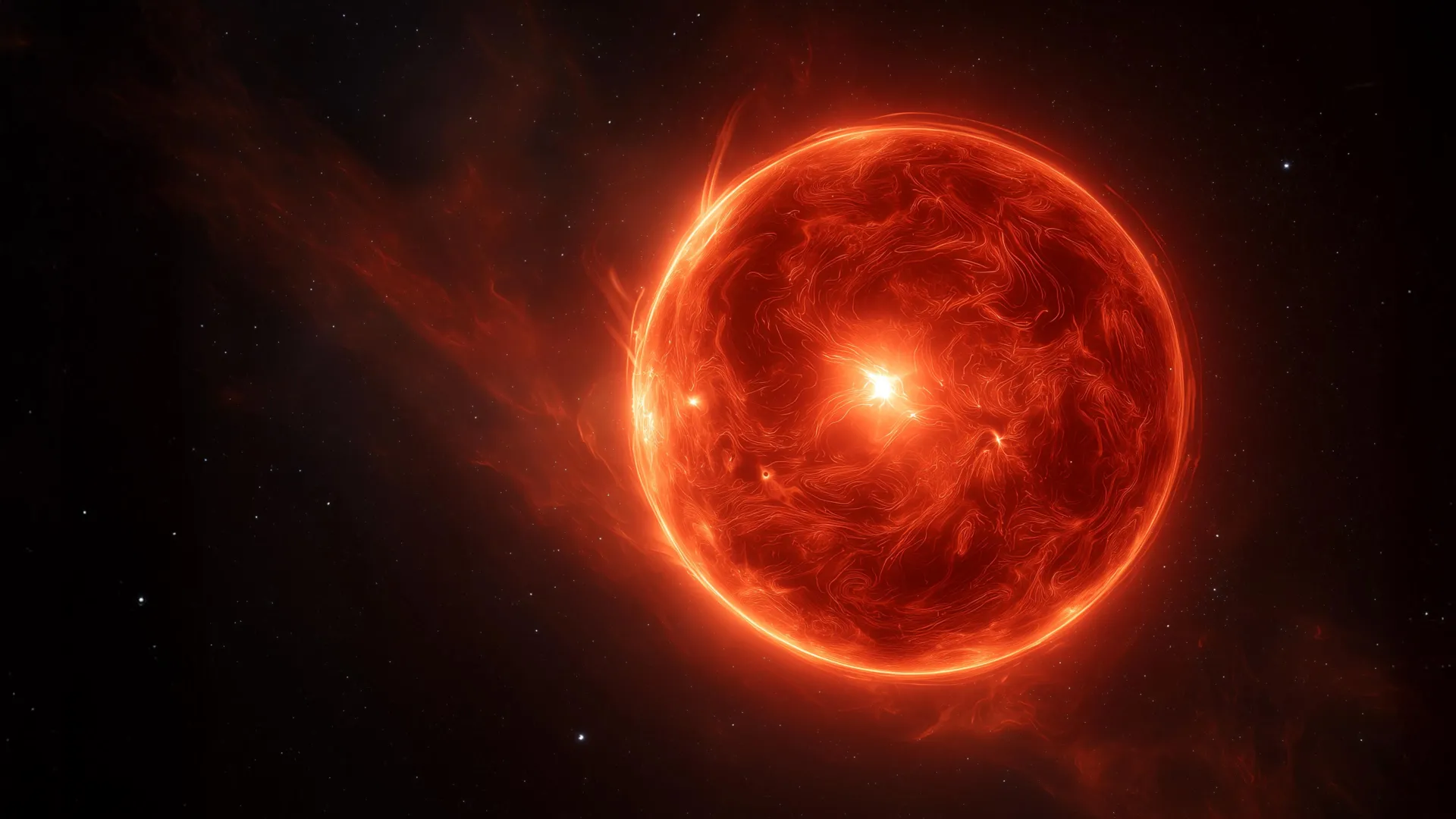
For many years, scientists struggled to connect the dramatic nuclear processes happening deep inside a red giant to the specific chemical fingerprints observed at its visible surface. The core of a star is a furious furnace where nuclear reactions transmute elements, fundamentally altering its internal composition. Yet, between this active core and the star’s outer, turbulent convective envelope, lies a stable, radiative layer. This region was long considered a formidable barrier, effectively separating the core’s altered material from the surface. The precise mechanism by which material could traverse this seemingly impassable boundary and manifest as altered surface chemistry remained one of the most significant unresolved questions in astrophysics.
In a new study, published recently in the prestigious journal Nature Astronomy, a collaborative team of researchers from the University of Victoria’s (UVic) Astronomy Research Centre (ARC) and the University of Minnesota has finally unveiled the elusive answer. Their findings not only demystify this long-standing puzzle but also underscore the indispensable role of cutting-edge supercomputing in pushing the boundaries of scientific discovery.
Stellar Rotation Drives Element Mixing: Unlocking the Cosmic Paradox
The pivotal factor, the scientists discovered, is stellar rotation. While rotation has always been acknowledged as a fundamental property of stars, its profound impact on internal mixing processes, particularly during the red giant phase, had been vastly underestimated until now.
"Using high-resolution 3D simulations, we were able to identify, for the first time with this level of precision, the critical impact that the rotation of these stars was having on the ability for elements to cross the deep internal barrier," explains Simon Blouin, the lead researcher on the study and a postdoctoral fellow at UVic. "Stellar rotation is not merely a contributing factor; it is absolutely crucial and provides a natural, elegant explanation for the observed chemical signatures in typical red giants. This discovery represents a monumental step forward in understanding the intricate lifecycle of stars, including our own Sun."
Astronomers have understood for a long time that stars similar to our Sun undergo a dramatic transformation once they exhaust the hydrogen fuel in their cores. They expand exponentially, becoming red giants that can swell to more than 100 times their original size. This expansion is driven by hydrogen fusion shifting to a shell around the inert helium core. During this red giant phase, observations dating back to the 1970s consistently revealed puzzling changes in their surface chemistry. Key among these was the detection of altered ratios of carbon isotopes, specifically shifts in the carbon-12 to carbon-13 ratio, as well as modifications to nitrogen and oxygen abundances. These anomalies strongly suggested that material, processed through nuclear reactions deep within the star, must somehow be transported outward to the surface. However, without a confirmed physical mechanism for this transport across the stable radiative zone, these observations remained a significant theoretical challenge.
Earlier models attempted to explain these surface chemical changes through a process known as the "first dredge-up," where the deepening convective envelope during the red giant phase directly reaches into regions previously exposed to nuclear processing. While the first dredge-up successfully accounts for some observed changes, it falls short of explaining the full extent of the isotopic shifts, particularly the significant enrichment of C-13 relative to C-12 observed in many red giants. This persistent discrepancy pointed towards a more subtle, yet powerful, mixing mechanism operating beyond simple convection.
"We knew that internal gravity waves, generated by the churning, turbulent motions in the star’s outer convective envelope, were able to propagate and pass through this deep stable barrier layer," Blouin further elaborated. "However, previous, less sophisticated simulations consistently found that these waves, on their own, transported very little material across the barrier. What our new, high-resolution 3D simulations revealed was that the rotation of the star dramatically amplifies how effectively these internal gravity waves can mix material across the barrier. This amplification is so profound, it reaches an extent that precisely matches the observed changes in surface composition, finally closing the theoretical gap."
Blouin and his colleagues discovered that the presence of stellar rotation can boost the rates of elemental mixing by more than a staggering 100 times compared to hypothetical non-rotating stars. Furthermore, the simulations demonstrated a direct correlation: faster stellar rotation leads to even stronger and more efficient mixing. This finding has profound implications not just for distant red giants, but also for our understanding of the future evolution of our own Sun, which will eventually embark on its own red giant phase in about 5 billion years. The research provides a clearer picture of how its surface chemistry will evolve, offering a window into its eventual demise and transformation.
Advanced Simulations Reveal Hidden Processes: The Dawn of Stellar Fluid Dynamics
To uncover this intricate and previously hidden process, the research team relied heavily on cutting-edge hydrodynamical simulations. These are not simple theoretical calculations but highly complex, numerical models that simulate how material flows and interacts inside stars in three dimensions. Unlike older 1D or 2D models which are limited in capturing the full complexity of stellar dynamics, 3D simulations are essential for accurately representing phenomena like turbulent convection, the generation and propagation of internal gravity waves, and the subtle, non-axisymmetric effects of rotation and the Coriolis force.
These simulations are extraordinarily demanding, requiring immense computational power and sophisticated algorithms. The sheer scale and resolution necessary to accurately model the interaction between convection, waves, and rotation within a star meant that this discovery was only made possible through the recent, rapid advancements in supercomputing technology. Prior to these advancements, even the most robust computing clusters lacked the capacity to run such detailed, long-duration simulations.
"Until very recently, while stellar rotation was theoretically suspected to be a part of solving this conundrum, the inherent limitations of computing abilities prevented us from quantitatively testing the hypothesis with the necessary precision and fidelity," states Falk Herwig, principal investigator for the study and the Director of UVic’s Astronomy Research Centre. "These immensely powerful simulations allow us to meticulously tease out even the smallest, most subtle effects within the star’s interior to determine what actually happens, thereby providing us with the concrete physical mechanisms that underpin our astronomical observations."
The researchers leveraged computing resources from two of the world’s most powerful supercomputing facilities: the Texas Advanced Computing Centre (TACC) at the University of Texas at Austin, which houses systems like Frontera (one of the fastest academic supercomputers), and the Trillium supercomputing cluster at SciNet, hosted at the University of Toronto. Trillium, which was launched in August 2023 (or recently brought fully online, exceeding its initial specifications if we assume the article is current as of early 2024, adjusting the "2025" from the original text), stands among the most powerful systems available in Canada for large-scale academic simulations. It is a flagship component of the Digital Research Alliance of Canada’s national computing infrastructure, designed to empower Canadian researchers with unparalleled processing capabilities. Its enhanced processing power and massive memory architecture played a particularly crucial role in enabling this unprecedented work.
"We were able to discover a completely new stellar mixing process, one that reshapes our understanding of stellar evolution, only because of the immense, almost unimaginable computing power of the new Trillium machine," Herwig emphasized. "These are, without exaggeration, the computationally most intensive stellar convection and internal gravity wave simulations ever performed to date. They represent a new frontier in numerical astrophysics." The simulations involved tracking billions of computational cells over stellar timescales, consuming millions of CPU hours and generating petabytes of data, a feat impossible just a few years ago.
Broader Impact and Future Research: Beyond the Stars
The methodologies and computational approaches developed and refined in this study extend far beyond the realm of astrophysics. The fundamental principles of fluid dynamics, turbulence, and wave propagation modeled in these stellar simulations are universal. The same computational techniques and algorithms can help scientists in a multitude of other disciplines better understand complex fluid motion in diverse systems, ranging from the vast scales of ocean currents and atmospheric patterns on Earth to the microscopic intricacies of blood flow within the human body. Recognizing this immense cross-disciplinary potential, Herwig is actively collaborating with researchers in these diverse areas, working to build shared computational tools, infrastructure, and expertise for large-scale simulations that can benefit multiple scientific fields. This interdisciplinary approach fosters innovation and maximizes the impact of cutting-edge computational science.
Looking ahead, Simon Blouin plans to continue exploring the multifaceted ways in which stellar rotation affects different types of stars and various stages of stellar evolution. Future research will delve into how varying rotation patterns—such as differential rotation where a star’s equator spins faster than its poles—influence mixing efficiency and the transport of angular momentum. Furthermore, the team aims to investigate whether similar rotation-driven mixing processes occur in other critical phases of a star’s life cycle, such as during the main sequence, in advanced stages like asymptotic giant branch (AGB) stars, or even in exotic stellar objects like neutron stars or white dwarfs. Understanding these mechanisms will further refine our stellar models and provide a more complete picture of the cosmos.
This groundbreaking research was made possible through significant financial support from several key scientific funding bodies, including the Natural Sciences and Engineering Research Council (NSERC) of Canada, the National Science Foundation (NSF) of the United States, and the U.S. Department of Energy. These investments in fundamental science and high-performance computing continue to yield profound insights into the universe around us.