
 By Rifan Muazin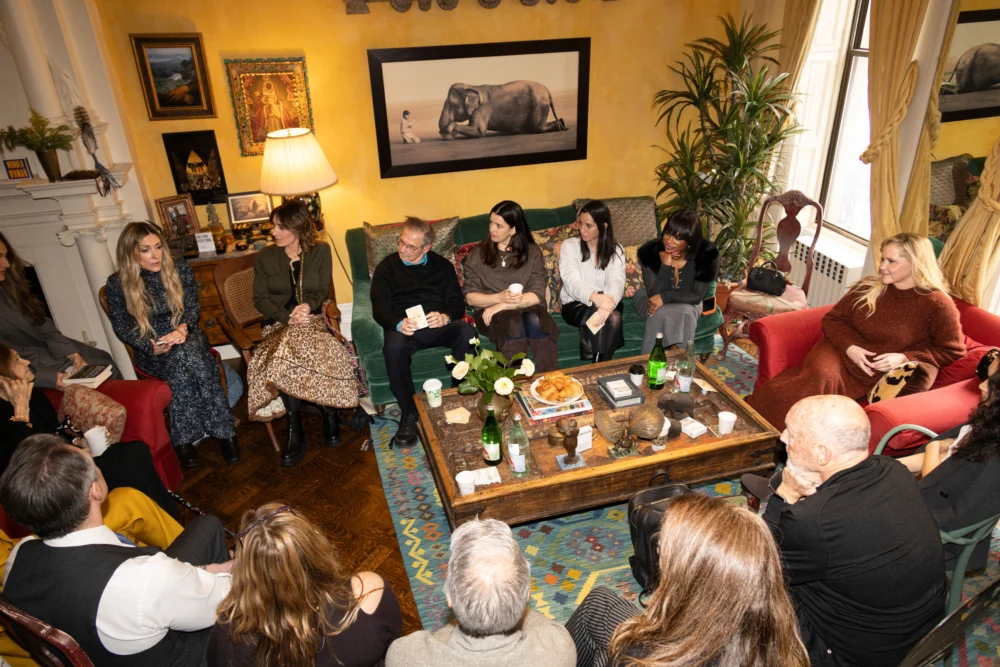
On a biting Tuesday afternoon on the Upper East Side of Manhattan, the interior of Gloria Steinem’s apartment offers a stark contrast to the wintry chill outside. The space is a living archive of feminist history, filled with decades of books, artifacts, and the kind of cozy, eclectic knick-knacks that suggest a life lived at the epicenter of social change. Steinem, now 91, remains an indomitable figure in the American consciousness, and today she is hosting one of her signature "talking circles." The gathering is more than a social tea; it is a rigorous, often uncomfortable exploration of one of the most persistent friction points in modern society: the intersection of masculinity and domestic labor.
The room is packed with a curated cross-section of cultural influence. Comedian Amy Schumer, actress Emmy Rossum, and Real Housewives of Atlanta star Kandi Burruss sit alongside academic and legal heavyweights. Among them are Dr. Corinne Low, an associate professor at Wharton and author of Having It All, and James Sexton, a prominent divorce lawyer whose social media presence has made him a leading voice on the dissolution of modern marriages. The prompt that kicks off the afternoon is deceptively simple: "Imagine your dad throwing your birthday party."

The reaction from the room is immediate and visceral—a wave of laughter followed by a collective scoff. The imagery conjured is not one of seamless celebration, but of a domestic comedy of errors characterized by last-minute logistics, mismatched decorations, and a general lack of foresight. This shared skepticism serves as the entry point for a deeper discussion on the "mental load"—the invisible, non-stop labor of managing a household. The group’s reaction underscores a pervasive cultural assumption: that while mothers are the architects of domestic life, fathers are often mere guests in their own homes, prone to "weaponized incompetence," a term used to describe the intentional or subconscious fumbling of tasks to avoid future responsibility.
Steinem, anchored in a red armchair and clutching a mug that reads "Keep Calm and Watch Call the Midwife," presides over the circle with the quiet authority of a veteran strategist. The conversation, facilitated by author Eve Rodsky and Danielle Robay, founder of the "Question Everything" platform, is conducted under the Chatham House Rule. This diplomatic protocol allows participants to speak freely, ensuring that while their ideas can be shared, their specific identities remain shielded to foster radical honesty. In a room where the history of Ms. magazine was forged in 1971, the stakes feel high. Steinem has long maintained that "women are not going to be equal outside the home until men are equal in it," and this afternoon is a testament to how far—or how little—the needle has moved.
Eve Rodsky, whose book Fair Play has become a manifesto for equitable domestic labor, distributes cards from her eponymous game. Each card represents a specific household task—what she defines as any unpaid chore taking more than two minutes. The tasks range from the mundane, such as "bedtime routine" and "dishes," to the emotionally complex, like "holidays." Rodsky asks the 31 women, one non-binary person, and four white men in attendance to assign a gender to the task they hold. The exercise quickly unearths a reservoir of unspoken resentment.

The stories shared are micro-dramas of the modern gender struggle. One working mother recounts a breaking point: she was juggling a toddler’s pickup, a high-stakes client contract, and a breast pump in the passenger seat when her husband texted to ask why she had forgotten to buy blueberries. It was not the fruit that mattered, but the assumption that the "inventory management" of their lives remained solely her burden. Another guest shares a poignant story of cultural assimilation through labor; her Jewish mother had to master Chinese recipes to accommodate her father’s heritage because he simply never learned to cook for himself.
The anecdotal evidence is backed by the hard data of Dr. Corinne Low. Her research highlights a sobering reality: even in households where women earn more than their husbands, or where the husband is unemployed, the woman typically performs the lion’s share of housework and childcare. Sociological data suggests that for many women, the presence of a man in the house actually increases their total workload. Conversely, studies show that men’s domestic contributions often spike only after a divorce, when the "safety net" of a female partner is removed. This phenomenon suggests that domestic inequality is not a matter of capability, but of socialized expectations.
The conversation eventually turns to the current cultural fixation on masculinity. Panels and podcasts on "the crisis of masculinity" are ubiquitous, yet they often reach a familiar impasse. The dialogue frequently devolves into a circular argument about the "proverbial dishes"—a stand-in for the broader failure of men to step into the domestic sphere with the same intentionality as women. Steinem chimes in with surgical precision, reminding the room that gender and race are social constructs designed to maintain power imbalances.

As the discussion intensifies, a rift emerges regarding the solution. One guest suggests a strategy of "radical neglect"—simply letting men fail at domestic tasks until they are forced to learn. This is met with immediate pushback. For many women, the consequences of a partner’s failure are too high to ignore. "Just letting them fuck up" could mean a child is left in an unsafe car seat or a crucial medical appointment is missed. The "mental load" exists because someone has to care about the outcome, and the room largely agrees that, historically, that "someone" has been the woman.
A rare moment of defense for the male perspective comes from Dr. Warren Spielberg, a psychologist and faculty member at the New School. He expresses disappointment at the pervasive sense of frustration in the room, suggesting that the "lens" needs to be turned to look at what is "good about men." He argues that the message of male value is missing from the conversation. This is followed by a challenge from James Sexton, who asks the room to define "non-toxic masculinity." He posits that if the only alternative to toxic masculinity is femininity, then the concept of a distinct, positive masculinity may not exist at all.
Perhaps the most profound insight comes from comedian Sam Jay, who identifies as a "masculine of center" lesbian. Jay offers a unique perspective on the gender divide, having moved through the world with different gender presentations. She notes that while she often experiences the same "incompetence" label from her female friends when she occupies a masculine role, she has also noticed a tragic lack of community among men. "I didn’t realize how much people didn’t care about men until I became a man," Jay observes. She describes the "instant community" women build—checking in on each other, ensuring safety, providing emotional scaffolding—that is conspicuously absent in male friendships. When Jay is with her "homegirls," they wait until she is safely inside her house before driving away. When she is with her "homeboys," the car is gone before she even reaches the door.

This observation shifts the tone of the room. The domestic divide is not just about who washes the dishes; it is about a profound difference in how genders are socialized to care—for their homes, for their children, and for each other. The "disappointment" expressed by the women in the room is mirrored by the "isolation" experienced by the men. However, as the afternoon draws to a close, the consensus remains that the burden of bridge-building still falls disproportionately on women.
In the storied living room where the second wave of feminism found its voice, the conversation concludes without a neat resolution. The road to divorce, as one participant notes, is often paved with the exhaustion of "just figuring it out later." Yet, the mere existence of the circle—the gathering of celebrities, academics, and activists in a 91-year-old icon’s home—suggests that the dialogue itself is the work. Steinem’s apartment, once the site of a revolution for rights in the workplace and the voting booth, is now the frontline of the final frontier: the revolution of the home. As guests spill back out into the Manhattan evening, the message remains clear: true equality cannot be achieved in the world until it is practiced in the kitchen, the nursery, and the heart of the domestic sphere.