
 By Titik Puspa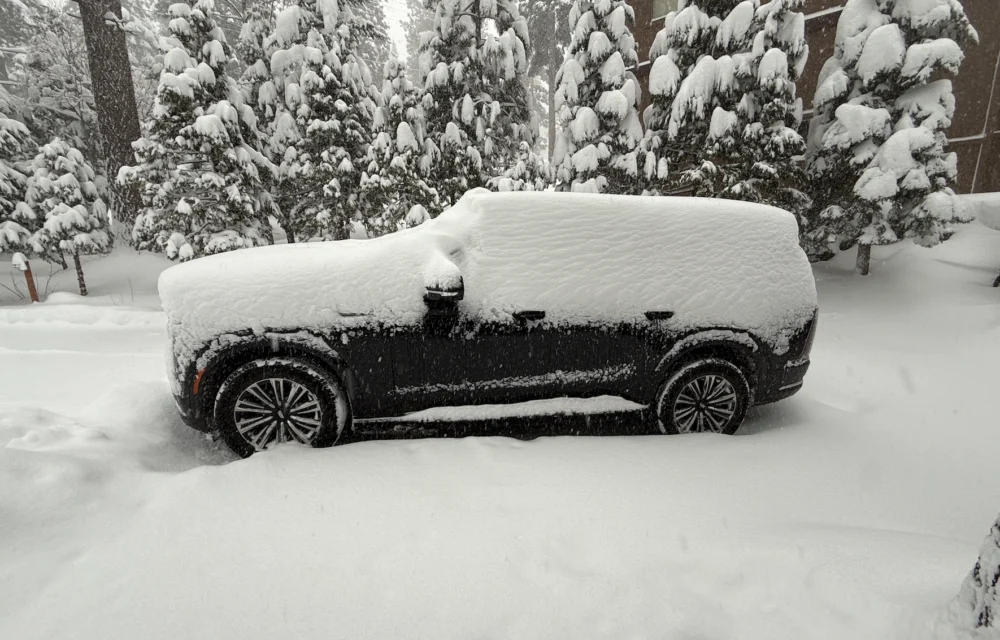
Before embarking on a weekend getaway to the majestic Tahoe region, General Motors extended an intriguing offer: the use of their latest, nine-thousand-pound testament to automotive opulence, the 2026 Electric Escalade IQL, for a week-long test drive. With a starting price of $130,405, this behemoth of an electric SUV represents a significant statement in the burgeoning luxury EV market. It’s important to preface this review by acknowledging that I am not a professional automotive journalist; that esteemed role is better filled by writers at publications like TechCrunch, who possess a deeper technical understanding of vehicles. My own automotive experience is rooted in daily driving an electric car, a perspective that likely informs my appreciation for different aspects of the IQL’s electric offering.
My initial encounter with the Escalade IQL had been at a car show the previous summer. Positioned amidst a collection of exquisite vintage automobiles, its sheer scale immediately struck me. "Jesus, that’s enormous," was my visceral, unvarnished reaction. Yet, this initial awe was quickly followed by a surprising admiration for its design. Despite its gargantuan dimensions, there was a remarkable restraint evident in its lines, a certain "strapping" aesthetic that made its proportions feel surprisingly coherent and, dare I say, handsome.
This initial positive impression, however, began to fray at the edges upon the vehicle’s arrival at my home the day before our departure. The reality of its colossal footprint became undeniably apparent. Measuring a staggering 228.5 inches in length and 94.1 inches in width, the Escalade IQL made our own vehicles appear like mere toys in comparison. The sheer volume of the vehicle was such that it dwarfed the memory of my first apartment in San Francisco, a space that, by comparison, felt positively bijou. Navigating it up my moderately sloped driveway proved to be a somewhat harrowing experience. The hood of the IQL is so high, and the vehicle so long, that when ascending a significant incline, such as the one leading to my mailbox at the crest of our hill, the direct forward view becomes entirely obscured. This blind spot, a direct consequence of its imposing stature, raised immediate concerns about its practicality in everyday driving scenarios.
For a fleeting moment, the temptation to simply leave the colossal EV parked in the driveway for the duration of the trip, eschewing its use altogether, was strong. However, the prospect of a 200-mile journey to Tahoe City necessitated a more proactive approach to familiarization. I spent that evening and the following day "tooled around" in the IQL, performing mundane tasks like picking up dinner and attending an exercise class. Even during these brief excursions, the vehicle’s presence was undeniable. Encountering a friend on the street, I felt an immediate urge to preemptively explain that this was not my new acquisition, but rather a vehicle I was considering for review. The question, "Isn’t its size ridiculous?" naturally arose. It truly felt like piloting a tank, prompting a contemplation of its intended user: aside from luxury hotels employing such vehicles for guest transport, what kind of individual would actively choose to operate such a monstrous machine on a daily basis?
Five days later, and much to my own surprise, the answer to that question became undeniably clear: I was that kind of individual.
The initial hurdle, quite literally, was the act of ingress and egress. Despite my personal athleticism, I found myself questioning whether a vehicle of this magnitude shouldn’t, perhaps, come equipped with an automated step stool. The climb into the cabin requires a discernible effort, a sensation that one simply doesn’t associate with modern automotive design, even in the luxury segment.
Once ensconced within, however, the interior of the Escalade IQL transforms into a sanctuary of digital maximalism. The dashboard is dominated by a breathtaking 55-inch curved LED screen boasting an 8K resolution. This colossal display eschews the conventional automotive interface, presenting information with the clarity and density of a high-level situation room. Front passengers are not left wanting, with their own dedicated screens providing access to various functions and entertainment. For those in the second row, an equally impressive experience awaits, featuring 12.6-inch personal screens, stowable tray tables, dual wireless charging pads, and, in the most lavish trim, massaging seats designed to make occupants forget they are even in a vehicle. Navigation is seamlessly handled by Google Maps, and the polarized screen technology deserves particular commendation. During one instance, my child was engrossed in a Hulu binge in the front seat, and not a single pixel of that entertainment bled into my line of sight from the driver’s seat, a testament to intelligent design and execution.

The cabin’s architecture is meticulously crafted with the principle of spatial generosity in mind, ensuring no occupant feels confined. Front legroom extends to a palatial 45.2 inches, the second row offers a generous 41.3 inches, and even the third row provides a respectable 32.3 inches. This means seven adults could comfortably coexist within this machine for extended journeys without succumbing to cabin fever. The comfort is further amplified by standard heated and ventilated leather seats with 14-way power adjustment for the first two rows, all seamlessly integrated with a 5G Wi-Fi connection, ensuring constant connectivity.
The inclusion of GM’s Super Cruise, the hands-free driving system, is standard on the Escalade IQL. While lauded by professional reviewers, my personal experience with it was somewhat less assured. During my attempts to utilize the system, the vehicle exhibited a disconcerting tendency to drift alarmingly close to the lane boundaries. This behavior triggered an escalating series of warnings, beginning with a red steering wheel icon on the display, followed by haptic feedback through the seat, and culminating in an insistent chime that served as both reminder and reproach. GM refers to this sequence as a "driver takeover request."
And then there is the audio experience. The 38-speaker AKG Studio sound system is, in a word, phenomenal. Its immersive quality transforms the cabin into a concert hall on wheels, elevating the driving experience to an entirely new level.
The exterior, while undeniably handsome, certainly demands a period of adjustment. The grille, a purely aesthetic element, initially struck me as almost comically imposing. This is unequivocally a vehicle for those who command authority, aspire to it, or perhaps wish to project an image of control while wrestling with their inner demons. One evening, pulling up to a glass-fronted restaurant, the Escalade’s headlights, as I executed a perpendicular parking maneuver, seemed to illuminate and momentarily blind half the patrons within.
Adding to its theatrical presence is the car’s sophisticated lighting system, which initiates a dazzling display upon detecting the approach of the key fob or the MyCadillac app. It’s as if the vehicle itself is issuing a greeting: "Hey, chief, where we headed?" This elaborate welcome is attributed to Cadillac’s "advanced, all-LED exterior lighting system," featuring an illuminated "crystal shield" grille and crest, flanked by vertical LED headlamps and "choreography-capable tail lamps." Objectively, it’s a bit much. And yet, I found myself utterly captivated by it.
Despite its considerable bulk, the Escalade IQL exhibits a surprising degree of nimbleness. While it won’t be mistaken for a sports car darting through urban traffic, it defies its colossal dimensions with a certain grace. The sensation is less like maneuvering a battleship and more like piloting a remarkably well-behaved, albeit enormous, luxury liner.
However, no vehicle is without its quirks, and the Escalade IQL presented its share of frustrations. The front trunk, or "frunk" as it’s known in EV enthusiast circles, operates with a peculiar and at times exasperating logic. Opening requires a sustained press of the button until the lift completes its cycle. A premature release results in the trunk halting mid-ascension, leaving it suspended in a state of automotive limbo, necessitating a complete restart of the operation. Closing demands the same sustained pressure. The rear trunk, in contrast, requires a more nuanced two-tap sequence, followed by an immediate release of the button. Holding the button too long renders the mechanism inert.

Adding to this minor user-interface confusion, on two separate occasions, the vehicle refused to power down completely after I had finished driving. The engine remained engaged, even when shifted into park and with the door ajar, actions that should logically trigger shutdown. A rather clunky workaround involved opening and closing the frunk, shifting from drive to park, and then exiting the vehicle entirely.
The vehicle’s software, while functional, falls short when compared to the benchmark set by Tesla. For those accustomed to the seamless integration and intuitive responsiveness of Tesla’s operating system, the Escalade IQL’s software may feel like a compromise. This sentiment appears to be a recurring theme among owners who possess both a Tesla and another EV, regardless of the latter’s luxury credentials. The effortless bridge between intention and execution found in Tesla’s software is a difficult standard for other manufacturers to meet.
The nadir of the trip, undoubtedly, was the experience of attempting to charge the Escalade IQL in Tahoe during winter. Despite its many virtues, the IQL is, by all accounts, a thirsty machine. Its massive 205 kWh battery pack, while necessary to power its considerable mass, requires a substantial energy draw. The vehicle consumes approximately 45 kWh per 100 miles, a figure considerably higher than many comparable electric SUVs. While Cadillac estimates a robust 460 miles of range on a full charge, this figure is contingent on ideal conditions. Tahoe in winter, however, is far from ideal. Compounding the challenge, we had arrived with less charge than anticipated, a consequence of several unscheduled detours en route, including an emergency stop to procure essential clothing for a family member. By the time we genuinely needed to replenish the battery, the urgency was palpable.
Our initial attempt involved navigating to a Tesla Supercharger in Tahoe City, which was indeed listed on the MyCadillac app. Upon plugging into the designated stall, however, nothing happened. Further investigation revealed that even Tesla stations capable of accepting non-Tesla vehicles often throttle charging speeds to a mere 6 kilowatts per hour, a disappointingly slow rate. Our frustration mounted as we discovered a nearby EVGo station had shuttered a month prior. The ChargePoint units at the Tahoe City Public Utility lot proved equally unhelpful: one was broken, and the other would connect but refused to initiate charging. A brief consideration of a 35-mile drive to Incline Village was quickly abandoned as we calculated the potential ramifications of becoming stranded. Finally, a glimmer of hope emerged with the discovery of an Electrify America station a mere 12 miles away. We navigated through the gathering snow, arriving shortly before 11 p.m. Thankfully, the station worked, and we endured an hour of charging, battling exhaustion, before making the drive home.
The following morning brought another unwelcome surprise: an app alert indicating critically low tire pressure. The front tires registered 53 and 56 PSI (with a recommended 61 PSI), and the rear tires were at 62 PSI (recommended 68 PSI). Whether this was a delivery issue or a consequence of the frigid conditions remained unclear. Regardless, it meant a rather unpleasant task for my husband: standing in the driving snow, being pelted directly in the face with ice, as he attempted to inflate the tires at a gas station. Despite this ordeal, the tires maintained their pressure throughout the remainder of the week, a testament to their resilience in the face of challenging conditions.
At this juncture, I would have readily declared the Escalade IQL an undeniably luxurious vehicle, perfectly suited for families of four or more who prioritize space and cutting-edge technology. I would have detailed its inherent trade-offs: the compromised forward visibility due to its commanding hood, the parking challenges intrinsic to its dimensions, the limited charging infrastructure for such an energy-hungry machine, and the tires tasked with supporting its formidable 9,000-pound curb weight. It is, I would have conceded, a beautiful car, but ultimately, not the one for me.
Then, the weather, with a characteristic Tahoe flourish, intensified. The snow that had begun to fall escalated into a full-blown blizzard, accumulating eight feet within two days. This rendered skiing, the very purpose of our trip, impossible and made driving a genuinely terrifying prospect. Yet, paradoxically, I found myself not terrified, but remarkably serene. The Escalade IQL, with its immense weight, felt like an unstoppable force, a veritable tank plowing through the snow. What could have been a harrowing ordeal transformed into a tranquil experience. The vehicle exuded a quiet strength, confidently navigating a precarious situation.

I also, astonishingly, adapted to its size. By the week’s end, the mumbled apologies to those waiting for me to maneuver into a parking spot had ceased. I no longer cared about the statement this vehicle made about me – that the owner of this vehicle does not wait in line. With eight feet of snow on the ground, a need for groceries, and the Escalade as my personal tank, a sense of defiant empowerment emerged. My husband, too, was clearly succumbing to the Escalade’s considerable charms.
Eventually, as is often the way in Tahoe, the snow abated, and the sun emerged, revealing the Escalade IQL as a rather dirty, albeit still imposing, fixture in the driveway. It was in this moment of post-blizzard clarity that the realization struck: I still liked it, and not solely due to the emergency circumstances. I cherished the feeling of riding high, with the extraordinary sound system flooding the cabin with my favorite music. The theatrical light show still elicited a childlike delight. The expansive, curved LED screen remained a marvel, alongside a host of other impressive features.
The frunk, however, remained an enigma, its operational quirks unaddressed. The panic of not being able to charge the vehicle where I had expected to was a vivid memory. Parking this behemoth remained a true exercise in patience. My strong opinions regarding unnecessary consumption and overt displays of wealth had not wavered.
And yet, somehow, I found myself wanting this car. So much so that when the GM representative arrives to reclaim it, I may be tempted to conceal it beneath a very, very large tarp and feign ignorance of their arrival. The Electric Escalade IQL, a monument to excess, had, against all my initial judgments, conquered my skepticism and, in a rather surprising turn of events, my heart.