
 By Isnaini Azizah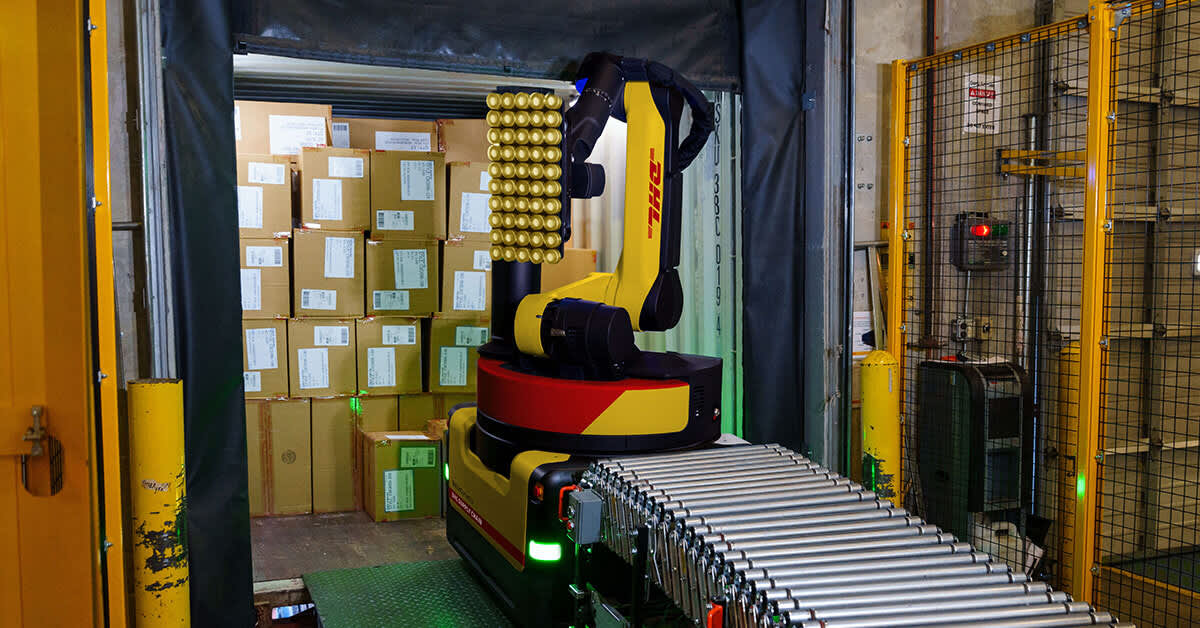
The image of a warehouse worker navigating miles of aisles to fulfill orders is rapidly becoming a relic of the past as the world’s largest logistics providers undergo a seismic shift toward total automation. At DHL Group, the transformation is perhaps most visible in the physical toll on its workforce. For decades, warehouse employees were essentially endurance athletes, often walking the equivalent of a half-marathon—roughly 10 to 13 miles—during a single shift just to classify, pick, and transport items across sprawling distribution centers. Today, those distances are being slashed not by a reduction in volume, but by the deployment of sophisticated autonomous mobile robots (AMRs) that can unload containers with a relentless speed of 650 cases per hour, far outpacing the physical limits of human labor.
This transition is not merely a pilot program but a massive, global scaling of technology. Tim Tetzlaff, DHL’s global head of digital transformation, recently highlighted the company’s aggressive trajectory, noting that the firm has moved from just 240 automation projects in 2020 to a staggering 10,000 projects currently active. This rapid acceleration has integrated autonomous innovations into 95% of DHL’s global warehouse network. The results are quantifiable and significant: in specific facilities, item-picking robots have boosted the number of units handled per hour by 30%, while autonomous forklifts have contributed a 20% increase in overall facility efficiency. For a company operating in a razor-thin margin industry where labor represents one of the highest variable costs, these gains are transformative.
The push for automation is driven by a confluence of economic pressures and shifting demographics. As Tetzlaff noted, the logistics industry is fundamentally labor-intensive, yet finding workers is becoming increasingly difficult. Distribution centers are often located in geographic clusters where the local labor pool is already exhausted, and building new warehouses in regions with available labor is often cost-prohibitive due to real estate prices or lack of infrastructure. By automating the most grueling and repetitive tasks, DHL aims to maintain its growth ambitions without being tethered to the constraints of a shrinking or increasingly expensive labor market.
DHL is far from alone in this pursuit. The entire fulfillment and supply chain landscape is currently locked in an "automation arms race" as companies leverage artificial intelligence and robotics to meet the demands of an e-commerce-driven economy. United Parcel Service (UPS) has signaled a similar commitment to high-tech infrastructure. During a late-January earnings call, UPS CEO Carol Tomé revealed that the company successfully deployed automation in 57 buildings in the fourth quarter of the previous year alone. This brought the company’s total to 127 automated facilities, with an additional 24 slated for completion by 2026. Tomé’s strategy is clear: by the end of 2026, UPS expects to process 68% of its U.S. package volume through automated facilities, up from 66.5% at the end of 2025. This incremental percentage growth represents millions of packages handled with minimal human intervention, driving down the cost per piece and increasing the speed of the network.
FedEx is also aggressively pursuing a tech-forward strategy, viewing automation as a way to enhance operational safety and efficiency. The company has integrated robotic arms at its massive Memphis World Hub to process small packages and has partnered with AI firm Dexterity to develop robots capable of the complex task of loading boxes into containers—a job that requires sophisticated spatial reasoning and "Tetris-like" precision. FedEx’s "Network 2.0" initiative is the umbrella for these efforts, aiming to create a more integrated and efficient processing flow. Recently, the company announced a partnership with Berkshire Grey to launch fully autonomous robots for unloading trailers, a move designed to eliminate one of the most physically demanding and injury-prone roles in the warehouse. FedEx estimates that the global warehouse automation market is on track to exceed $51 billion by 2030, a testament to the massive capital being poured into these technologies. CEO Raj Subramaniam reported that approximately 24% of the company’s eligible daily volume is already flowing through 355 Network 2.0-optimized facilities.
However, the rise of the machines brings inevitable questions about the future of the human workforce. The transition has not been without friction. UPS, for instance, has announced layoffs exceeding 75,000 over the past year. While some of these cuts are attributed to a cooling relationship with Amazon and a broader multiyear turnaround plan, the company’s focus on automation is a primary driver of its ability to operate with fewer people. UPS Executive Vice President Nando Cesarone explained that the company is seeing a "cascading effect" where legacy, labor-heavy facilities are being shuttered in favor of "nimble, quicker, automated, consolidated" sites. In 2025 alone, UPS closed 93 buildings, with another 24 closures planned for the first half of 2026.
Despite these closures, the industry narrative remains focused on "augmentation" rather than "replacement." A UPS spokesperson emphasized that AI and robotics are intended to handle repetitive tasks, freeing humans to focus on more complex functions. DHL’s Tetzlaff echoed this sentiment, pointing out a surprising statistic: during the same period that DHL deployed 8,000 collaborative robots, it still hired 40,000 additional human workers. This suggests that the growth of the logistics sector is currently outpacing the rate at which robots can replace human hands. The dexterity required for varied packaging and shipping tasks remains a human-dominated domain. DHL’s strategy involves a "flexible stability" model, where a core human fleet is complemented by a robotic fleet that can be scaled up or down to handle seasonal peaks, such as Black Friday or the Christmas rush. During the most recent holiday season, DHL increased its robotic fleet capacity by 30% to meet demand without having to go through the lengthy process of hiring and training thousands of temporary workers.
Expert perspectives from firms like Accenture provide a more nuanced view of where this technology is heading. Benjamin Reich, Accenture’s logistics and fulfillment lead, suggests that while humanoid robots—like those being developed by Boston Dynamics, Tesla, and Nvidia—are garnering significant media attention, they are not yet ready for mass deployment in the warehouse. While Nvidia CEO Jensen Huang and others believe the development of "general-purpose" humanoid robots is accelerating, Reich observes that in the current market, "humans are still in the lead." The current trend is toward "task-specific" automation—robots designed to do one thing, like unload a truck or pick a specific item, very well—rather than a machine that can mimic all human movements.
The shift in the labor market is also one of "upskilling." Ronny Horvath, transportation and logistics lead at Accenture, notes that the industry is facing a chronic shortage of skilled workers who possess both the manual dexterity for warehouse work and the technical literacy to operate modern systems. Automation, in this context, fills a "void" left by a labor pool that is increasingly looking for technical or technical-adjacent roles rather than pure manual labor. "We see a lot of clients who have a robotic strategy but still have plans to hire human workers as well," Horvath said. The goal is to redirect hiring toward technical roles that oversee the robots, rather than eliminating job growth entirely.
The long-term outlook for the sector is one of profound change. According to a March study by Accenture, 51% of factories and warehouses globally expect to be fully automated by 2040. Furthermore, 70% of transportation and logistics executives now treat autonomous supply chains as their top investment priority. While the "lights-out" warehouse—a facility that operates entirely in the dark without human presence—remains a rarity today, the foundation for that future is being laid. For organizations like the Teamsters union, the challenge is ensuring that this evolution does not come at the expense of worker dignity and livelihood. Lena Melentijevic, a spokesperson for the Teamsters, noted that while the union does not want to block technological progress, it insists that technology must support workers rather than work against them.
As the industry moves forward, the success of companies like DHL, UPS, and FedEx will likely depend on their ability to master this delicate dance between human ingenuity and robotic efficiency. The "human fleet" remains the backbone of the global supply chain for now, but as the $51 billion automation market matures, the definition of what it means to be a "warehouse worker" will continue to evolve from a role of physical labor to one of technological management. In this new era of logistics, the "half-marathons" of the past are being replaced by the silent, high-speed whir of autonomous arms and the sophisticated algorithms of artificial intelligence.