
 By admin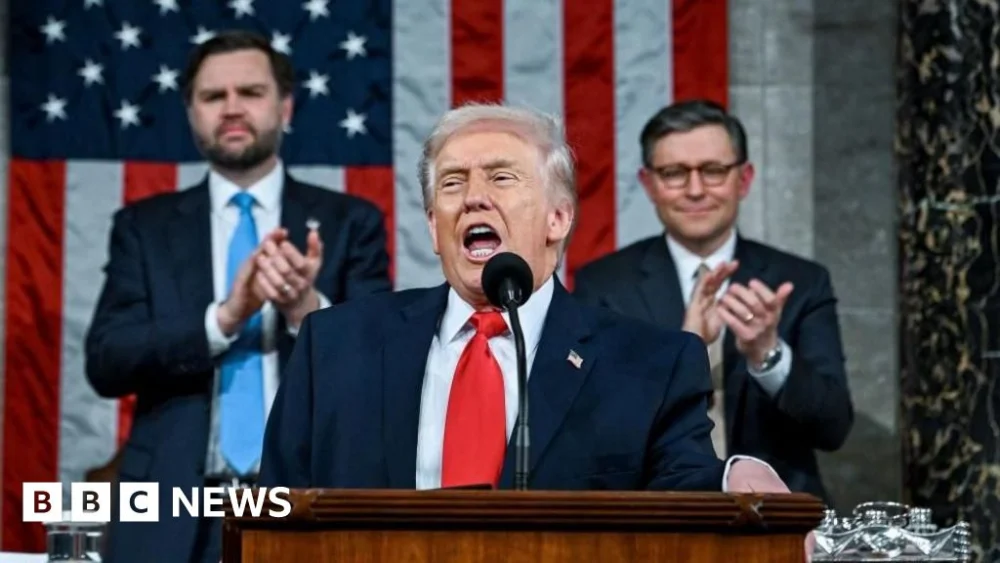
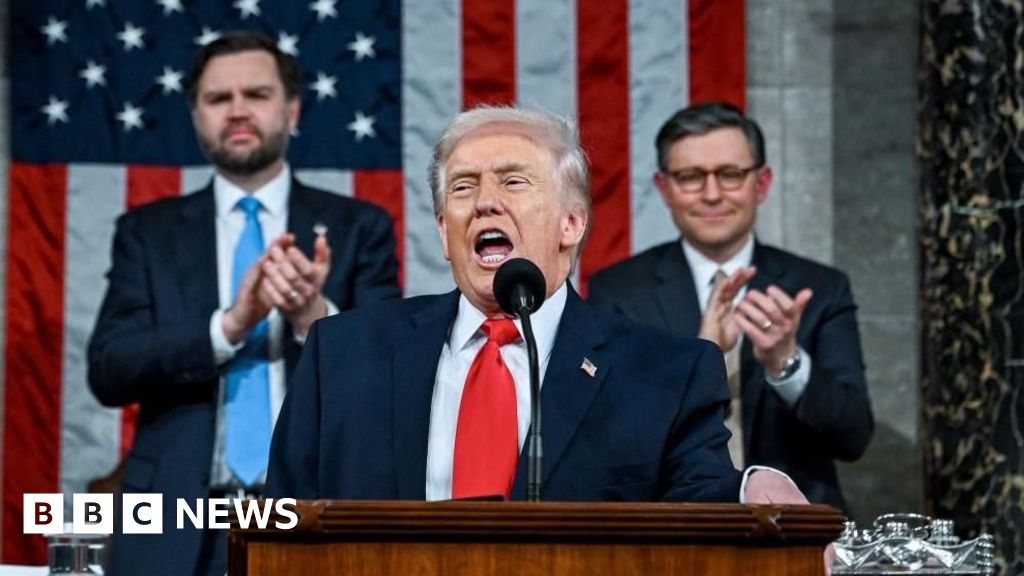
Donald Trump delivered a fiery and defiant State of the Union address Tuesday night, proclaiming a "turnaround for the ages" and offering little indication of altering his course, despite poll data suggesting widespread dissatisfaction with the nation’s current state and his leadership. With crucial midterm elections looming later this year, the president framed the evening as a high-stakes sales pitch to the American public, a potent rallying cry for his dedicated base, and a series of pointed barbs aimed squarely at his political adversaries. The address, imbued with the theatrical flair and manufactured drama characteristic of the former reality television star, was designed for maximum impact on the national stage.
The evening commenced with a grand gesture of national pride as Trump welcomed the United States men’s Olympic hockey team to the Capitol’s gallery. The athletes proudly displayed their gold medals, eliciting thunderous "USA!" chants from Republican lawmakers and even drawing applause from across the aisle. This patriotic spectacle set the tone for a speech that would repeatedly celebrate American exceptionalism and military might. Later, Trump paid homage to national heroes, singling out a 100-year-old World War Two veteran and a Coast Guard swimmer who performed a heroic rescue of 165 individuals stranded during the previous year’s devastating Texas floods. The swimmer was posthumously awarded the Congressional Medal of Honor, while the veteran received the Legion of Merit for Extraordinary Heroism, underscoring Trump’s focus on valor and sacrifice. Despite its considerable length, clocking in at a record-breaking 107 minutes, these carefully curated moments of human triumph served to punctuate the president’s overarching narrative of American resilience and achievement.
Trump’s opening remarks echoed familiar themes: "Our nation is back. It’s the hottest country in the world." He asserted that under his administration, economic conditions had dramatically improved, painting a picture of robust growth and prosperity. He attributed this resurgence to a combination of factors, including rising incomes, a booming stock market, lower gasoline prices, a significantly curtailed flow of undocumented migrants across the southern border, and successfully tamed inflation. "We are doing really well," he declared at one point, juxtaposing this optimistic assessment with a pointed critique of Democrats, whom he blamed for creating an "affordability" crisis. The address culminated in a resounding declaration: "Our country is winning again."
However, the president’s optimistic pronouncements stood in stark contrast to his public approval ratings, which hovered around a modest 40 percent. A significant portion of the American electorate, according to numerous polls, expressed a desire for more substantive action on their pressing concerns. This sentiment echoed a previous national address delivered from the White House just last month, where Trump employed similar rhetoric and cited comparable statistics to highlight his administration’s perceived successes. The lack of a discernible shift in public opinion following that address suggests that the president and his advisors were hoping the larger, more captive audience of the State of the Union – estimated to reach tens of millions – would yield a different outcome.
A notable absence in Trump’s speech was the unveiling of significant new policy initiatives. While the nearly two-hour address did include a handful of proposals, such as the creation of new retirement savings accounts specifically designed for working-class Americans and a proposed partnership with artificial intelligence companies to ensure sufficient electricity supply for their operations, thereby shielding consumers from potential price hikes, these were largely incremental. He also revisited some long-standing policy proposals, including a healthcare plan that would provide direct financial assistance to Americans to help cover insurance premiums, legislation mandating proof of citizenship for all voters, and a ban on issuing commercial driver’s licenses to undocumented migrants. Furthermore, Trump reiterated his commitment to maintaining his broad tariff regime, even in the wake of a recent Supreme Court decision that struck down many of the duties he had previously imposed.
The Supreme Court’s ruling on tariffs cast a subtle shadow over the proceedings. Three justices who had ruled against the president remained stoic as they observed from the front row. Earlier, Trump and Chief Justice John Roberts, who authored the court’s opinion on tariffs, exchanged a brief handshake, but neither man displayed any outward signs of warmth. The president’s discussion of tariffs, while met with enthusiastic cheers from his Republican supporters, elicited murmurs of discontent from Democrats and a palpable sense of unease from some Republicans. Many within the GOP have expressed reservations about the economic ramifications of these tariffs and the potential negative impact on their electoral prospects due to their perceived unpopularity with the public.
If tariffs cast a pall over the chamber, immigration ignited a firestorm of partisan animosity. Trump’s pronouncements on the perceived threat posed by "illegal aliens" generated some of the most fervent applause from Republicans, while simultaneously provoking angry retorts and icy glares from Democrats. Immigration had historically been a cornerstone of Trump’s political appeal. However, a recent surge in enforcement actions in Minneapolis, which tragically resulted in the shooting deaths of two American citizens by federal agents, had significantly eroded his standing on this issue. Notably absent from Trump’s address was any mention of these fatal shootings or the "softer approach" to enforcement that had been alluded to in their aftermath. Instead, the president’s speech, with its pointed focus on crimes allegedly committed by undocumented migrants – including murders, accidents, and instances of corruption – represented a strategic attempt to reclaim the narrative and reassert his hardline stance. "The only thing standing between Americans and a wide-open border right now is President Donald J Trump and our great Republican patriots in Congress," he declared, a tacit acknowledgment of the impending midterm elections, where the composition of both chambers of Congress hangs in the balance.
As is customary with these presidential addresses, foreign policy typically occupied a secondary role. Despite a significant military buildup near Iran, Trump offered limited justification to the American public for the necessity of sustained U.S. military engagement. "My preference is to solve this problem through diplomacy, but one thing is certain: I will never allow the world’s number one sponsor of terror to have a nuclear weapon," he stated, before swiftly moving on to other topics.
At present, the political climate appears challenging for the president, with prevailing winds seemingly blowing against him. However, Trump may harbor a conviction that the national mood is poised for a shift. He might be banking on the public beginning to perceive the tangible economic benefits of his policies, or perhaps he anticipates a resurgence of patriotism, particularly as the nation approaches its 250th anniversary celebrations this summer. His deliberate inclusion of tributes to military heroes and the celebrated Olympic hockey team in the audience could be interpreted as a clear indication of this calculated political gamble.
For ongoing analysis of Trump’s presidency and the evolving political landscape, North America correspondent Anthony Zurcher provides weekly insights in his "US Politics Unspun" newsletter. Readers in the UK can subscribe by visiting https://www.bbc.co.uk/newsletters/zgmn46f, while those outside the UK can sign up at https://cloud.email.bbc.com/US_Politics_Unspun_Newsletter_Signup.