
 By admin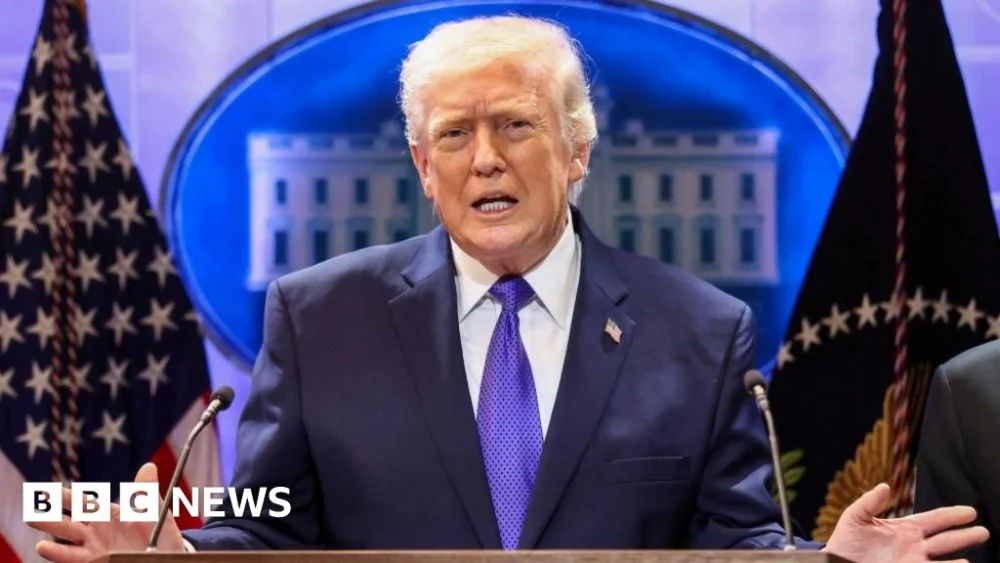
In a dramatic and contentious move that has sent shockwaves through the global trade landscape, U.S. President Donald Trump has unveiled a new 10% global tariff, effectively replacing tariffs struck down by the Supreme Court. The president, in a fiery press conference from the White House, did not mince words, branding the Supreme Court’s decision as "terrible" and vociferously lambasting the justices who rejected his administration’s trade policy as "fools" and "lap dogs." This bold executive action comes on the heels of a significant 6-3 Supreme Court ruling that declared most of the global tariffs, initiated by the White House in the preceding year, to be an overreach of presidential authority.
The Supreme Court’s landmark decision, a major victory for a coalition of businesses and U.S. states that had vigorously challenged the imposition of these duties, potentially opens the door to billions of dollars in tariff refunds. However, it has simultaneously injected a substantial degree of new uncertainty into the intricate web of global commerce. President Trump, speaking from the Oval Office, indicated that any prospect of swift refunds would likely face significant legal hurdles, predicting that the matter would be mired in court proceedings for years to come. Undeterred, he affirmed his administration’s intent to pursue its tariff agenda through alternative legal avenues, emphasizing his belief that these measures are crucial for stimulating domestic investment and bolstering American manufacturing. "We have alternatives – great alternatives, and we’ll be a lot stronger for it," Trump declared, projecting an air of defiance and strategic resilience.
The legal battle that culminated in the Supreme Court’s ruling centered on import taxes that President Trump had unveiled in the previous year, targeting goods from nearly every nation worldwide. Initially, these tariffs were aimed at key trading partners including Mexico, Canada, and China. However, the scope of these levies expanded dramatically, encompassing dozens of trade partners by what the president dramatically termed "Liberation Day" in April of the previous year. The White House had invoked the International Emergency Economic Powers Act (IEEPA) of 1977, a statute that grants the president the authority to "regulate" trade in response to national emergencies. This broad interpretation, however, sparked widespread condemnation both domestically and internationally. Businesses, facing an abrupt and significant increase in taxes on imported goods, voiced grave concerns about the potential for escalating prices for consumers.
The core of the legal challenge, presented by lawyers representing the aggrieved states and small businesses before the Supreme Court, hinged on the argument that the specific law cited by the president to impose these levies did not explicitly contain the word "tariffs." Their contention was that Congress had never intended to delegate its fundamental power to tax or grant the president an "open-ended power to junk" existing trade agreements and tariff structures. This interpretation found a powerful ally in Chief Justice John Roberts, a conservative jurist, who authored the majority opinion. "When Congress has delegated its tariff powers, it has done so in explicit terms and subject to strict limits," Roberts wrote, underscoring the principle of clear statutory authorization. "Had Congress intended to convey the distinct and extraordinary power to impose tariffs, it would have done so expressly, as it consistently has in other tariff statutes."
The decision to invalidate the tariffs was not a partisan one, with the court’s three liberal justices concurring with the majority. Notably, two justices nominated by President Trump, Amy Coney Barrett and Neil Gorsuch, also sided with the view that the president had exceeded his authority. This alignment meant that the dissenting opinions came from three conservative justices: Clarence Thomas, Brett Kavanaugh, and Samuel Alito. President Trump, however, expressed profound disappointment and anger towards his own judicial appointees who voted against his trade policy. He characterized them as "just being fools and lap dogs" and accused them of being "very unpatriotic and disloyal to our Constitution."
The immediate aftermath of the Supreme Court’s decision saw a positive reaction on Wall Street, with the S&P 500 index closing up approximately 0.7%. Businesses across the United States cautiously welcomed the ruling, seeing it as a significant reprieve from the financial pressures imposed by the tariffs. Beth Benike, owner of Busy Baby products in Minnesota, which manufactures its goods in China, expressed profound relief, stating, "I feel… like a thousand-pound weight has been lifted off my chest." Similarly, Nik Holm, chief executive of Terry Precision Cycling, one of the small businesses involved in the legal challenge, described the ruling as a "relief." He added, "Though it will be many months before our supply chain is back up and running as normal, we look forward to the government’s refund of these improperly-collected duties."
State leaders were quick to demand accountability. California’s Democratic Governor Gavin Newsom urged the administration to issue refunds for what he termed an "illegal cash grab." He posted on X, "Time to pay the piper, Donald. Every dollar your administration unlawfully took needs to be immediately refunded – with interest." In a similar vein, Illinois Governor JB Pritzker sent President Trump an invoice demanding nearly $9 billion (£6.6 billion) in tariff refunds, an amount equivalent to $1,700 per family in his state. "Compensation is owed to the people of Illinois, and if you do not comply we will pursue further action," Pritzker declared.
Despite the anticipated refunds and the relief from tariff costs, the path forward for businesses remains complex. On Friday, President Trump signed a proclamation enacting a new 10% global tariff under Section 122 of the U.S. Code. This seldom-used provision allows the president to impose tariffs of up to 15% for a period of 150 days, after which Congress must intervene. This new tariff is slated to take effect on February 24th. The presidential order outlines a range of exemptions, including certain minerals, natural resources, and fertilizers; select agricultural products such as oranges and beef; pharmaceuticals; some electronics; and certain vehicles. However, the exemptions for many of these categories are broadly defined, leaving ambiguity about specific items that might be excluded. Notably, Canada and Mexico will retain exemptions on a vast majority of goods under the terms of the United States-Mexico-Canada Agreement (USMCA).
A White House official clarified that countries that have previously negotiated trade deals with the U.S., including the United Kingdom, India, and the European Union, will now be subject to the new 10% global tariff under Section 122, superseding the tariff rates they had previously secured through their respective agreements. The administration anticipates that these countries will continue to adhere to the concessions agreed upon in those trade deals. Analysts widely expect the White House to explore other legislative tools, such as Section 232 and Section 301, which permit the imposition of import taxes to address perceived national security risks and unfair trade practices. President Trump has previously utilized these provisions for tariffs, including those imposed last year on sectors like steel, aluminum, and automobiles, which were unaffected by the Supreme Court’s ruling.
Geoffrey Gertz, a senior fellow at the Center for a New American Security in Washington, commented on the evolving situation, stating, "Things have only gotten more complicated and more messy today." Major trading partners have reacted with relative restraint. Olof Gill, a spokesman for the European Commission, acknowledged the Supreme Court’s ruling on social media, stating, "We take note of the ruling by the U.S. Supreme Court and are analysing it carefully." French President Emmanuel Macron, speaking on Saturday, highlighted the ruling as evidence of the importance of "checks and balances in democracies." He indicated that France would carefully consider the implications of the new 10% tariff and reiterated France’s commitment to continuing its exports to the U.S.
In the weeks leading up to the Supreme Court’s decision, hundreds of companies, including retail giant Costco, aluminum producer Alcoa, and food importers like Bumble Bee, had initiated lawsuits challenging the tariffs in an effort to secure potential refunds. However, the Supreme Court’s majority decision does not directly address the mechanism for refunds, likely deferring the procedural questions to the Court of International Trade. In his dissenting opinion, Justice Brett Kavanaugh had warned of the potential for a chaotic situation, describing it as a "mess."
Diane Swonk, chief economist at KPMG US, cautioned that the considerable costs associated with litigation might present significant obstacles for smaller firms seeking to recoup their tariff payments. "Unfortunately, I’d say curb your enthusiasm, although I understand the desire for relief," she advised. Steve Becker, head of the law firm Pillsbury, suggested that the most favorable outcome for businesses would be for the government to establish a streamlined procedure that obviates the need for individual lawsuits. "I think companies can be fairly confident that they’ll get their money back eventually," he stated. "How long it will take really is up to the government." This ongoing saga underscores the delicate balance between presidential authority, congressional prerogative, and the complex dynamics of international trade, with businesses and governments alike navigating a landscape of evolving regulations and legal interpretations. The repercussions of these actions will undoubtedly continue to unfold, shaping trade relationships and economic policies for the foreseeable future.
Reporting contributed by Danielle Kaye and World Business Express.