
 By admin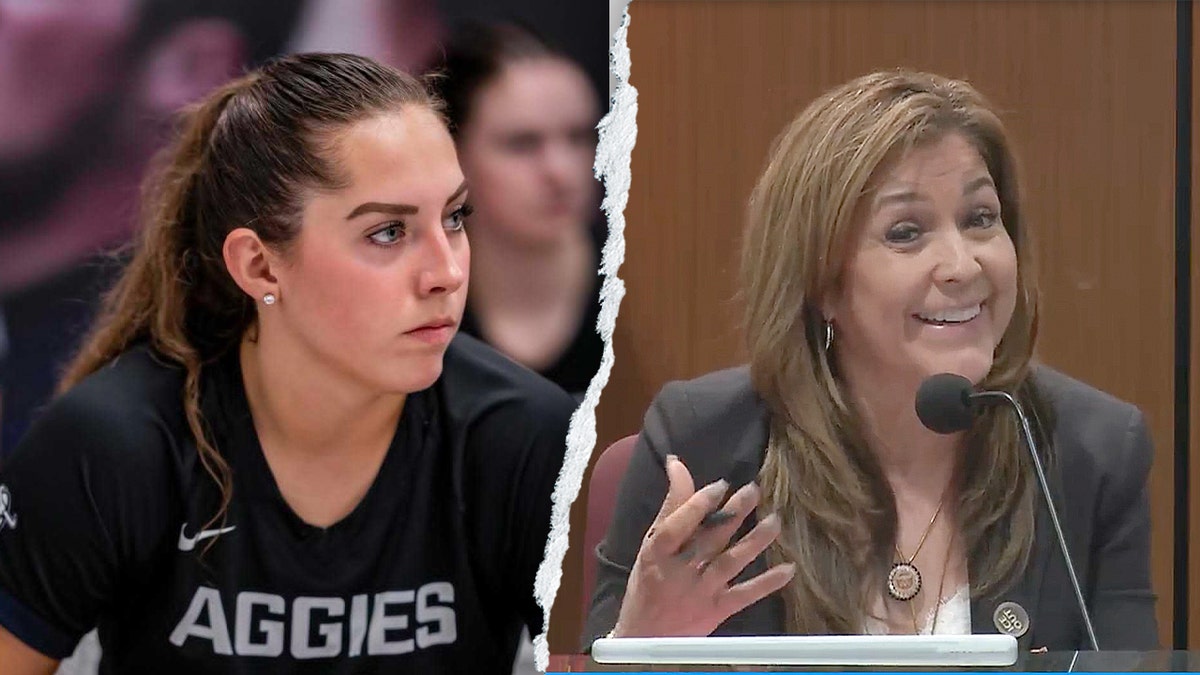
A heated exchange at an Arizona state education hearing has propelled former Utah State volleyball star Kaylie Ray into the national spotlight, solidifying her status as a prominent figure in the burgeoning "save women’s sports" movement. Ray, who previously garnered attention for her role in a San Jose State volleyball scandal that led to a team forfeit over concerns about a transgender athlete’s participation, found herself in a public debate with Arizona State Senator Catherine Miranda. The incident, which unfolded as Ray lobbied for a bill aimed at protecting women’s sports in Arizona, has ignited passionate discussions about fairness, competition, and the definition of womanhood in athletics.
The confrontation began when Senator Miranda, rather than directly addressing Ray’s arguments about the competitive landscape of women’s sports, pivoted to commenting on Ray’s physical appearance. "I mean, you look pretty healthy… You look very much in shape and strong," Miranda stated, before posing the provocative question, "so how competitive do you think you really are?" This seemingly dismissive remark, perceived by many as an attempt to undermine Ray’s credibility by focusing on her physicality rather than her athletic achievements and advocacy, was met with a swift and passionate response from Ray.
Ray, visibly taken aback but determined to stand her ground, articulated her indignation to Fox News Digital, stating, "How could you look me in the eyes and ask me if I’m competitive. Obviously I’m standing in front of you fighting for something right now. I don’t know what part of that is not competitive to you. But if you want to go toe-to-toe then we can go toe-to-toe." Her response, delivered with a measured yet firm tone within the legislative chamber, was a powerful assertion of her commitment and competitive spirit. She admitted to Fox News Digital that while she strived to maintain professionalism in the "professional environment," internally she was "fuming" and later had to vent her frustration to her parents.
The senator’s initial comments, as recalled by Ray, left her bewildered. "When she started saying those words, the only thing I was thinking is, ‘where could she possibly be going with this?’" Ray shared. She perceived Miranda’s line of questioning as suggesting that her physical attributes should somehow dictate her competitive capacity, a notion she found illogical and deeply unsettling. "It was clear to me as she continued speaking that, for whatever reason, my physical appearance or stature should have some type of effect on how competitive I am with men. So I was definitely thrown off guard."
Senator Miranda and her office have remained notably silent on the incident, offering no public statement or clarification regarding her remarks or the ensuing backlash. Multiple attempts by Fox News Digital to solicit a response from Miranda’s office have gone unanswered. Ray, in turn, expressed her lack of surprise at the senator’s silence, suggesting that such responses are typical when arguments falter. "They usually tuck their tales and run when they realize that they have lost the plot a little bit," Ray commented. "I’m just reminded that common sense is not so common here. And I’m not sure what statement she can put out that can paint her in a good light. It was not a logical argument in the slightest."
During the hearing, Senator Miranda attempted to contextualize her perspective by drawing upon her own athletic experiences, stating, "It’s a sports mentality when you’re growing up and how much competition that you’ll take on. So it’s not just a silver bullet for one community of sports players, it’s the individual person on how competitive you wanna be. So you grew up one way. I grew up a different way. I would have taken on a man in a heartbeat. I’ve played in, I was the only girl sometimes in sports. But to have a man on my team, I would have welcomed it." Notably, Miranda did not explicitly use the terms "transgender," "male," or "female" in her response, opting instead to refer to male opponents as "men."
A 2017 article from Hispanic Engineer & Technology provides further insight into Miranda’s background, detailing her own experiences with sports. The article quotes Miranda as saying, "Sports was my life. There were four girls and one boy in my family. My brother turned me into his ‘little brother’ so he could have someone to play sports with. I was a 100% tomboy," and claims she was the only girl to play in a local little league. This personal history, Ray suggests, may inform Miranda’s perspective, but Ray maintains that such experiences are not directly comparable to the complexities of modern elite-level athletics, particularly at the NCAA Division I level.
Ray countered Miranda’s anecdotal evidence by highlighting the significant physiological differences that emerge after puberty, which she believes fundamentally alter the competitive dynamics in sports. "I have brothers too. I know what it’s like to grow up competing with boys. But around the time that puberty hit, there was a drastic difference," Ray explained. She recounted a personal experience from her own youth, stating, "I played volleyball from the time I was eight, and in high school, my brother, my older brother… my mom made him try volleyball." Ray’s refusal to even practice with her brother and his male teammates at that level underscores her conviction about the safety and fairness concerns. "It was dangerous," she asserted, adding, "It’s silly that I had to explain that to her."
The San Jose State volleyball scandal, which precipitated Ray’s initial foray into public advocacy, involved allegations of a transgender player being allowed to compete on the women’s team, leading to a team-wide forfeit. Ray has previously spoken out about the impact of this experience, describing the challenges and emotional toll it took on her and her teammates. Reports indicate that the situation led to injured fingers and shattered dreams for some athletes. The controversy has drawn the attention of prominent figures in sports, including Olympic legend Kaillie Humphries, who has publicly supported athletes like Brooke Slusser and spoken out against the handling of the SJSU scandal.
Ray’s involvement in advocating for legislation that would provide protections for girls’ and women’s sports in Arizona positions her as a key voice in a broader national conversation. The "save women’s sports" movement, gaining momentum across the country, centers on the argument that the inclusion of transgender women in female sports categories undermines fair competition due to inherent biological advantages. Proponents of this movement often cite scientific studies and athletic performance data to support their claims, emphasizing the importance of preserving opportunities for biological females in sports.
Conversely, advocates for transgender inclusion in sports argue that bans or restrictions based on gender identity are discriminatory and violate principles of equality. They often point to instances where transgender athletes have not dominated and emphasize the importance of inclusivity and the mental and physical health benefits of sports participation for all individuals, regardless of gender identity. The debate is often framed as a clash between the principles of fairness in women’s sports and the rights of transgender individuals to participate fully in society.
The incident with Senator Miranda has amplified Ray’s platform and underscored the often contentious nature of these legislative debates. While Miranda’s focus on Ray’s physique was widely criticized as inappropriate and irrelevant to the policy discussion, it also highlighted a tactic sometimes employed in these debates to question the authenticity or "womanhood" of female athletes who advocate for sex-based sports categories.
Ray has indicated that she would be open to accepting an apology from Senator Miranda, provided it is genuine and accompanied by a demonstration of understanding. "I think if she were to give me a genuine apology I would accept it," Ray stated. "Obviously, she comes from a place of ignorance. I would definitely need to see some action on her end to show that she understands and that she recognizes truth, basic truth." This stance suggests a desire for education and acknowledgment of the core issues at stake, rather than solely personal retribution.
The broader implications of this exchange extend beyond the immediate legislative context. It reflects a growing polarization on issues of gender identity and its intersection with sports. As more athletes and advocates like Kaylie Ray step forward to share their experiences and lobby for policy changes, the national dialogue surrounding these critical issues is likely to intensify, demanding nuanced consideration of biological realities, ethical principles, and the evolving understanding of gender in the modern world. The ongoing efforts by Ray and others aim to shape the future of women’s sports, ensuring what they believe to be fair competition and opportunities for biological females.