
 By Lina Irawan
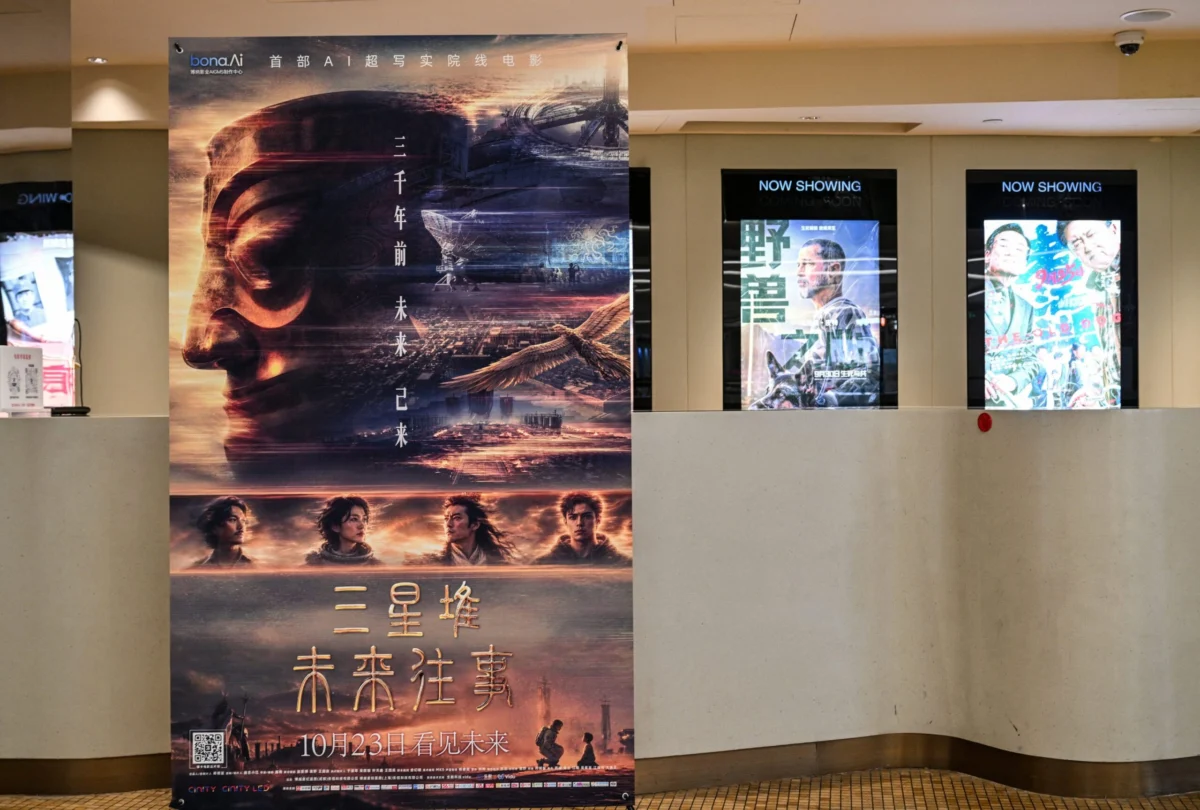
The sci-fi thriller, Sanxingdui: Future Past, produced by the prominent Bona Film Group, aimed to break new ground by becoming the first AI-generated feature film released in Chinese cinemas. Its narrative, as described by Chinese state media, centered on an archaeologist’s desperate mission to liberate a future world enslaved by AI. Despite its intriguing premise and the novelty of its production method, the film struggled to attract audiences, generating an estimated mere $180,000 by Monday, according to ticketing platform Maoyan. This figure stands in stark contrast to its reported budget of $1.5 million, a substantial investment that yielded less than a tenth of its cost in returns, as reported by AFP. The financial setback signals a significant caution for an industry increasingly exploring AI’s potential.
Jiang Defu, chief operating officer of Bona Film Group, acknowledged the film’s poor commercial showing in an interview with Chinese film outlet Yuli. However, he framed Sanxingdui as an invaluable "experiment" rather than a failure. "We are the first to try it, the first to get a theatrical release permit, and the first to be tested by the audience," Defu stated, emphasizing the pioneering spirit behind the venture. "I think that is not easy at all." His comments reflect an industry grappling with the disruptive potential of AI, where even commercially unsuccessful ventures are viewed through the lens of technological advancement and market exploration. Bona Film Group, a powerhouse in Chinese cinema known for blockbusters like The Battle at Lake Changjin, venturing into AI-generated features demonstrates the industry’s serious consideration of this technology, even if initial results are challenging. Fortune has reached out to Bona Film Group for further comment on their future AI strategy.
Social media platforms, often a barometer for public sentiment in China, reflected a mixed but generally skeptical response to Sanxingdui: Future Past. On Xiaohongshu, a popular Chinese social media platform akin to Instagram, one user candidly expressed, "China’s first AI movie totally traumatized me," suggesting a jarring or unappealing viewing experience. This sentiment points to a potential disconnect between AI’s current capabilities and audience expectations for emotional depth and visual fidelity in a feature film. Conversely, another user offered a more optimistic, albeit pragmatic, take: "My biggest takeaway? AI movies are super low-cost and let you tell stories with complete freedom." This comment highlights the perceived advantages of AI in terms of efficiency and creative liberation, echoing the very reasons producers like Bona Film Group are investing in the technology. However, the commercial flop suggests that "freedom" and "low-cost" do not automatically translate into audience engagement for feature-length productions.
The Microdrama Phenomenon: A Different AI Story
The contrasting fortunes of Sanxingdui: Future Past and the thriving microdrama sector offer a crucial insight into audience readiness for AI-generated content. AI has, indeed, already taken over microdramas, those bite-sized narratives designed for rapid consumption on social media platforms like TikTok (known as Douyin in China). These short, often serialized stories, typically lasting only a few minutes per episode, have become a dominant form of digital entertainment. According to Caixin, a staggering statistic reveals that over 95% of the more than 120,000 Chinese microdramas released in the first quarter of 2026 were AI-generated. This represents an astronomical leap from virtually zero just a year prior, underscoring the swift and comprehensive adoption of AI in this specific niche.
The reasons for AI’s success in microdramas are multifaceted. Firstly, the format itself lends well to algorithmic generation. Microdramas often follow predictable narrative arcs and tropes, focusing on quick emotional hooks, dramatic reveals, and cliffhangers. AI can efficiently generate scripts, character dialogues, and even basic visual elements that align with these established patterns. Secondly, the economic advantages are undeniable. The cost of producing these dramas has plummeted dramatically, with some now costing as little as $3,000. This drastic reduction in production expenses allows for an unprecedented volume of content, catering to diverse niche interests and rapid trends. For content creators and platforms, AI offers a highly scalable and cost-effective solution to churn out engaging, albeit often formulaic, entertainment that keeps users glued to their screens. Audiences, in turn, appear more forgiving of stylistic imperfections or formulaic plots in a format designed for casual, on-the-go viewing, where the primary objective is quick entertainment rather than a profound cinematic experience. The low barrier to entry for consumption and production has created a vibrant, if sometimes creatively shallow, ecosystem.
Do Audiences Want AI Feature Films? The Chasm Between Short and Long Form
Sanxingdui’s flop unequivocally suggests that consumers draw a distinct line when it comes to AI in full-length movies. The expectations for a feature film, particularly one released in cinemas, are fundamentally different from those for a social media microdrama. "The public is highly skeptical about AI use in major feature films, despite their general acceptance of short-form films," explains Stanley Rosen, a University of Southern California professor specializing in Chinese film and society. This skepticism stems from several factors inherent to the cinematic experience.
Feature films demand narrative complexity, character development, nuanced emotional performances, and sophisticated visual storytelling that current AI models struggle to deliver consistently. While AI can generate impressive individual scenes or assets, stitching together a cohesive, compelling, and emotionally resonant two-hour narrative remains a significant challenge. The "uncanny valley" effect, where AI-generated visuals or voices appear almost human but subtly unsettling, can be particularly detrimental in a feature film where immersion is key. Audiences pay for a theatrical experience that promises a level of artistry, originality, and human connection that they perceive as being undermined or absent in a fully AI-generated product. The communal aspect of cinema also plays a role; watching a film in a darkened theater with others elevates expectations for a shared, high-quality artistic experience.
The narrative of Sanxingdui: Future Past, involving an archaeologist saving humanity from AI, ironically mirrors the very anxieties surrounding AI’s role in creative industries. While the specific details of AI’s involvement in the film’s production—whether it was used for scriptwriting, visual effects, character animation, or a combination—are not fully disclosed, the implication of a heavily AI-driven process likely contributed to audience apprehension. For many, film is an art form rooted in human expression, vision, and collaboration. The notion of a machine generating a story, even with human oversight, can detract from its perceived artistic value and authenticity.
The Global AI Debate in Filmmaking
The controversy surrounding AI in filmmaking is not unique to China; it is a global phenomenon. In the U.S., the debate reached a fever pitch in 2023 when the Writers Guild of America (WGA) and the Screen Actors Guild – American Federation of Television and Radio Artists (SAG-AFTRA) went on strike. A core demand from both unions was robust protections against the unchecked use of artificial intelligence. Screenwriters feared AI’s ability to generate scripts, potentially devaluing their craft and leading to job displacement, while actors expressed concerns over their likenesses, voices, and performances being replicated or manipulated by AI without consent or fair compensation. These strikes highlighted the profound ethical and economic implications of AI for human creatives.
Despite these concerns, AI models are already being integrated into Hollywood productions in various capacities. Companies like ByteDance and Higgsfield AI are developing tools that assist filmmakers, from pre-visualization and script analysis to automated editing and special effects. However, these applications generally serve as aids to human creatives, not replacements. The distinction between AI as a tool and AI as the primary creator is crucial.
A notable recent example is Netflix’s crime thriller Animals, released on October 9, whose director Ben Affleck admitted to using AI in its production. "I used [AI] for lots of things in that movie," Affleck stated during a Bloomberg event. His subsequent hesitation to "point out what they are" because movies are meant to "foster the illusion of reality" is telling. It suggests that while AI can be a powerful tool for enhancing production efficiency or visual effects, its overt presence can break the immersive spell of cinema. Audiences want to believe in the world presented on screen, and the knowledge of AI’s generative hand might disrupt that suspension of disbelief. This aligns with the public’s current preference for AI to remain a backstage assistant rather than the lead creative force.
The Future: Streaming and Caution
Looking ahead, Stanley Rosen remains unconvinced that audiences will flock to AI-generated films in theatres unless their quality can match the breathtaking visuals and storytelling prowess of blockbusters like James Cameron’s Avatar or critically acclaimed animations such as Nezha 2. Achieving such a benchmark would require monumental advancements in AI technology, capable of producing narratives with intricate plots, emotionally resonant characters, and consistently high-fidelity visuals that rival the best human-led productions. This level of sophistication is still years, if not decades, away.
Consequently, Rosen suggests that such films may instead find a more suitable home on streaming platforms such as Netflix and Amazon Prime Video. Streaming services offer a lower barrier to entry for content, a broader diversity of programming, and often cater to audiences with different consumption habits and expectations compared to theatrical releases. Viewers scrolling through a vast library of options might be more willing to experiment with an AI-generated film from the comfort of their homes, where the financial and experiential commitment is minimal.
The financial loss incurred by Sanxingdui: Future Past will undoubtedly send ripples through the industry. "The financial loss of Sanxingdui: Future Past will compel others contemplating using AI for feature films to tread more carefully," Rosen predicts. This caution is not necessarily a rejection of AI itself, but rather a re-evaluation of its current capabilities and the appropriate contexts for its application. While AI promises unparalleled efficiency and cost savings, the Sanxingdui experience demonstrates that these benefits do not automatically translate into audience appeal or commercial success for feature films. The path forward for AI in cinema likely involves a more nuanced approach, focusing on human-AI collaboration, where AI augments human creativity rather than attempting to fully replace it, preserving the artistic integrity and emotional connection that audiences deeply value in their cinematic experiences. The ultimate success of AI in feature filmmaking will hinge not just on technological prowess, but on its ability to enhance, rather than diminish, the magic of storytelling.
