
 By admin
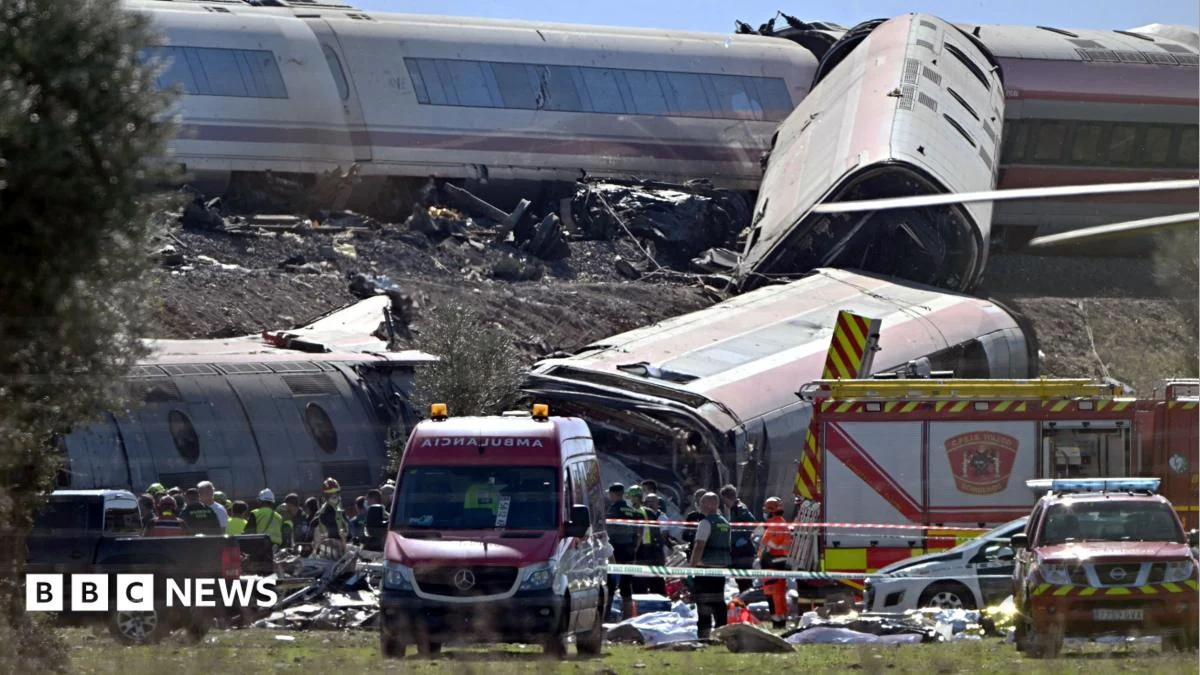
A catastrophic high-speed train crash in central Spain has plunged the nation into mourning, with official reports confirming at least 68 fatalities and dozens more injured. The devastating incident occurred on Wednesday morning when a train en route from Madrid to Seville violently collided with another train that had come to a standstill on the tracks. The sheer force of the impact was so immense that it sent several carriages tumbling down a steep embankment, transforming a routine journey into a scene of unimaginable horror. This tragedy marks one of the most severe rail disasters in Europe’s modern history and stands as Spain’s deadliest train accident in over thirteen years, shattering the lives of countless families and raising urgent questions about the safety of the nation’s rail infrastructure.
The collision took place shortly after 09:00 local time (08:00 GMT), approximately 140 kilometers (about 100 miles) south of the capital city, Madrid. The stationary train, operated by the private rail company Iryo, was carrying 147 passengers when it was struck from behind by a train operated by Spain’s state-owned railway company, Renfe, which had a significantly larger complement of 397 passengers on board. The catastrophic sequence of events, as detailed by Spain’s Transport Minister Óscar Puente, points to a confluence of technological failure and human error. According to Puente, the Iryo train had stopped on the tracks due to a critical computer failure. In such situations, operational control typically shifts to a 24-hour control center in Madrid. However, in an "inexplicable" decision, this control center allegedly authorized the movement of the trains without implementing any necessary speed restrictions, a critical oversight that directly contributed to the fatal collision.
Survivors of the horrific crash recounted harrowing scenes of chaos and terror. Passengers described being violently thrown from their seats, with some finding themselves trapped amidst the mangled wreckage. The desperate struggle for survival saw many resorting to smashing windows to escape the confines of the damaged carriages. One of the affected carriages was engulfed in flames, adding another layer of terror to the unfolding tragedy. Witness accounts painted a grim picture of trapped individuals crying out in pain and bleeding profusely, with some buried beneath debris. The sheer force of the impact was described as "brutal" by 62-year-old passenger Salvador Arriza, who was traveling on the Renfe-operated train. He vividly recalled the terrifying moment of impact and the subsequent pandemonium as passengers attempted to free themselves from the wreckage, with some unable to move due to being pinned by seats and twisted metal.
The physical damage inflicted on the trains was extensive and horrific. Photographs emerging from the scene starkly illustrate the brutal nature of the collision, with one disturbing image revealing a long section of railway track that had speared through the side of a carriage, a testament to the immense kinetic energy involved. Spanish journalist Antonio Jiménez Barca, who works for the prominent newspaper El País, was walking towards the Renfe train’s cafeteria when the disaster struck. He described feeling an overpowering shove from behind, as if he were being propelled to the ground. He sustained a severe head injury, resulting in profuse bleeding, and found himself pinned down by other passengers. He recounted witnessing individuals with injured arms and heads, underscoring the widespread trauma inflicted upon those on board. Another passenger, 46-year-old Sebastián Herrero, shared his terrifying experience with El Mundo newspaper, reporting seeing "many people with broken noses, broken arms." He described the impact as "terrible, terrible," and recalled being airborne for what felt like an agonizing eternity.
The psychological toll on survivors is profound. Many passengers were left in a state of shock, grappling with the unfathomable loss and the traumatic events they had just endured. One particularly poignant and heart-wrenching account emerged from a survivor who sobbed during an interview with a local television station as he recounted witnessing a woman die in his arms. His words, "She was very cold and she was all alone," deeply resonated, even prompting the show’s presenter to break down in tears, reflecting the collective grief and empathy sweeping across the nation.
Emergency services responded with swiftness and dedication. Dozens of ambulances converged on the scene, working tirelessly to provide medical assistance to the injured. Helicopters were deployed to evacuate those with the most critical injuries, underscoring the severity of the medical exigencies. The Spanish Civil Guard has indicated that DNA samples from relatives will be required to formally identify some of the victims, a somber indication of the extent of the casualties and the devastating injuries sustained.
Prime Minister Pedro Sánchez visited the crash site, offering words of solace and solidarity to the grieving nation. "The whole of Spain is grieving," he stated solemnly. "Lives have been shattered, families have been torn apart, the pain is immense." His visit underscored the gravity of the situation and the government’s commitment to addressing the aftermath of this national tragedy.
This latest disaster brings into sharp focus a disturbing trend of rail accidents in Spain. The nation was still reeling from a high-speed rail disaster near Córdoba in January of the same year, which claimed the lives of 46 people. Disturbingly, that accident also occurred on the same rail line, although much further south. Wednesday’s crash now stands as the worst the country has experienced since 2013, when a tragic derailment on the outskirts of Santiago de Compostela in northwest Spain resulted in 80 fatalities. The recurrence of such severe accidents has fueled public concern and prompted calls for accountability and a thorough investigation into the safety protocols governing Spain’s extensive rail network.
Alberto Núñez Feijóo, leader of the main opposition People’s Party, voiced the public’s demand for transparency, stating, "Spain has the right to know what is happening with its infrastructure." The gravity of the situation has also led to political repercussions. The Spanish trade union CSIF has called for the transport minister’s resignation, accusing him of attempting to scapegoat a traffic manager by attributing the blame to human error in the control room, rather than accepting broader responsibility.
In response to the unfolding tragedy, Prime Minister Sánchez and other Spanish politicians have cancelled all public engagements, including their campaigning efforts for the upcoming parliamentary elections scheduled for the following month. Sánchez has declared the situation "unacceptable" for Spain to experience two serious train crashes within a single year. He has vowed to "get to the bottom of this" and meticulously determine if any negligence was involved. His commitment to a thorough investigation includes a promise that "If there have been failures in the security system, they will be addressed with the utmost firmness." The nation now awaits the findings of these investigations, hoping for answers that will not only provide closure to the affected families but also ensure the safety and security of future rail travel across Spain. The memory of the 68 lives lost serves as a stark reminder of the critical importance of robust safety measures and vigilant oversight in the operation of high-speed rail systems.
