
 By Rifan Muazin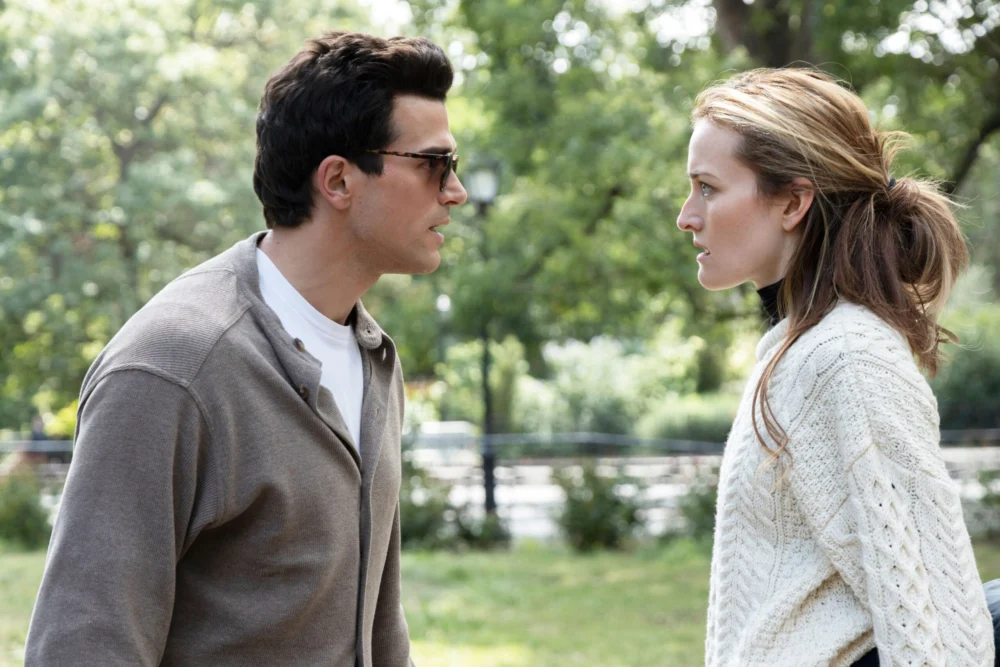
With the airing of its fifth episode, titled “Battery Park,” the FX anthology series American Love Story has finally reached the most pivotal and scrutinized chapter in the tumultuous relationship of its central figures. The episode, which premiered strategically just one day after the 30th anniversary of the actual event, offers a meticulous and haunting recreation of the public explosion between John F. Kennedy Jr. and his then-girlfriend, Carolyn Bessette. Brought to life by actors Paul Anthony Kelly and Sarah Pidgeon, the scene serves as the emotional epicenter of the season, capturing a moment that shifted the public perception of the “Prince of Camelot” and his fashion-icon partner from a fairy-tale romance to a gritty, high-stakes drama played out on the streets of Manhattan.
The historical incident took place on February 25, 1996. While popular urban legend and occasional erroneous reporting have often placed the confrontation in Washington Square Park, the series corrects the record by setting it in New York City’s Battery Park. At the time, the argument became a global sensation, largely due to the presence of a persistent paparazzo, Angie Coqueran. Her photographs and grainy video footage were quickly sold to the highest bidders, eventually appearing on the front pages of the National Enquirer and the New York Daily News. These images stripped away the veneer of the Kennedy mystique, revealing a raw, human, and deeply troubled dynamic that the public had never before witnessed in such a visceral way.
For the actors, recreating such a well-documented moment of domestic distress required a balance between technical precision and emotional authenticity. In a recent interview with GQ, Paul Anthony Kelly discussed the weight of the responsibility. He noted that because video evidence of the fight exists, the production team was able to treat the sequence almost like a choreographed dance. Kelly and Pidgeon reviewed the original footage repeatedly to ensure their body language, the cadence of their movements, and the physical distance between them mirrored the reality as closely as possible. Kelly remarked that the goal was to be as accurate as the record allowed without crossing into the realm of the “tacky” or exploitative, aiming instead for a psychological portrait of two people under immense pressure.
In the narrative world of American Love Story, the clash is framed as the culmination of mounting friction. The show depicts Bessette as increasingly suffocated by the relentless media glare and Kennedy’s perceived failure to protect her privacy. The immediate catalyst in the show is Bessette’s reluctance to accept Kennedy’s marriage proposal. When the tabloid press catches wind of her hesitation, Kennedy—ever the media-savvy scion—attempts to control the narrative. Hoping to shift the focus back to the impending launch of his political-lifestyle magazine, George, he makes a public statement denying that any proposal had taken place. This gaslighting of their private reality sets the stage for the explosion in the park.
As the couple walks their dog, Friday, through the wintry landscape of Battery Park, the contrast between their internal states is stark. Kennedy is seen boasting about the early reception and buzz surrounding George, seemingly oblivious to his partner’s burgeoning resentment. When Bessette attempts to create physical distance by speeding up, Kennedy catches her and grabs her arm, a move that triggers an immediate and defensive recoil. “I just need space,” she insists, a plea that falls on deaf ears. Kennedy’s retort is cutting and analytical: “I think you can’t handle a partner who is emotionally mature enough to talk to you, because what you really need is an excuse to escape. You need control. You need to be the one who abandons. It’s obvious, and, quite frankly, lame.”
The dialogue in the series highlights the fundamental disconnect between the two. Bessette accuses him of breaking his solemn promise to keep their private life out of the headlines, suggesting that his betrayal has eroded any foundation of trust. The argument escalates into a face-to-face shouting match, with Kennedy losing his composure and yelling that the media circus would subside if she had simply accepted his proposal “like a normal fucking person.” The physical tension peaks when Kennedy attempts to forcibly reclaim a ring—one that belonged to his mother, the late Jacqueline Kennedy Onassis—from Bessette’s finger. As she resists, telling him he is hurting her, the scene captures the desperate, unglamorous reality of their conflict. After he successfully retrieves the ring and walks away, the show recreates the famous moment where she jumps on his back, only to be pushed off, and continues to block his path, challenging him with the provocation, “Talk to me, fucking pussy.”
The intensity of the filming was so high that it reportedly caused alarm among the local New York City population. Director Crystle Roberson Dorsey staged the scene with such realism that a bystander, unaware that a television production was in progress, actually reported the incident as a real-life domestic dispute on the Citizen app. Kelly shared this anecdote with a sense of grim professional pride, noting that when the public believes “shit is going down,” it is a sign that the performance has achieved its intended impact.
However, while the visual recreation is remarkably faithful to the paparazzi footage, American Love Story takes significant creative liberties with the timeline and the underlying causes of the fight. In the series, the argument is the catalyst for Bessette finally agreeing to marry Kennedy. In reality, historical records suggest the timeline was quite different. Kennedy is widely reported to have proposed over the July 4th weekend in 1995, and Bessette accepted several weeks later. By February 1996, they were already well into their engagement, meaning the fight was likely not about the proposal itself. Furthermore, the show depicts Kennedy celebrating the launch of George during this February walk, yet the magazine’s famous inaugural issue—featuring Cindy Crawford as George Washington—had actually debuted months earlier, in September 1995.
Historians and biographers have offered alternative theories for what triggered the 1996 blow-up. Angie Coqueran, the photographer who captured the moment, recently told the Daily Mail that she had followed the couple that morning specifically because she anticipated Kennedy would be in a volatile mood. The New York Times had just published an auction listing for his mother’s personal possessions, an event that Kennedy found deeply distressing and invasive. Other perspectives, such as those found in Steven M. Gillon’s 2019 biography America’s Reluctant Prince, suggest the friction was more chronic. Gillon, a friend of Kennedy’s, noted that many of their arguments stemmed from Bessette’s frustration that Kennedy allowed people to “walk all over him,” and her belief that he was too accommodating to the very press that was making her life miserable.
There is even a more cynical theory that has circulated among Kennedy observers for decades: the idea that the fight was partially staged. Some conspiracy theorists believe the couple, desperate for a reprieve from the wedding-watch frenzy, orchestrated a public spat to signal that their relationship was on the rocks, hoping the media would lose interest in their upcoming nuptials. If that was the goal, it failed spectacularly. The fight only served to increase the value of their photographs and intensify the hunt for the next "crack" in the Camelot armor.
The episode concludes with a quieter, more somber reconciliation on a park bench. This transition from explosive violence to rational, almost defeated conversation reflects the mercurial nature of their bond. “What happens if I don’t fit into your life?” Bessette asks in the show, voicing a prophetic fear. “It will be a disaster for you, and everyone will blame me.” This line underscores the tragic foresight the writers have granted her character, acknowledging that in the court of public opinion, the "outsider" is often the first to be scapegoated. The scene ends with Kennedy sitting on the ground, crying, as Bessette consoles him—a reversal of power that highlights his vulnerability and her role as his emotional anchor, however turbulent that anchor might be.
As American Love Story moves toward its next episode, “The Wedding,” the series continues to explore the paradox of the Kennedy-Bessette legacy. They were a couple who sought a "normal" life while living in a fishbowl that made normalcy impossible. By enriching the narrative with these layers of historical context and psychological analysis, the show transforms a tabloid headline into a profound exploration of fame, legacy, and the high cost of being loved by the world. The Battery Park fight was not just a domestic dispute; it was a symptom of a larger, systemic pressure that would eventually follow them until their tragic deaths in 1999. In recreating it, the series reminds audiences that behind the glamorous black-and-white photos was a colorful, often painful reality that no camera could fully capture.
