
 By admin
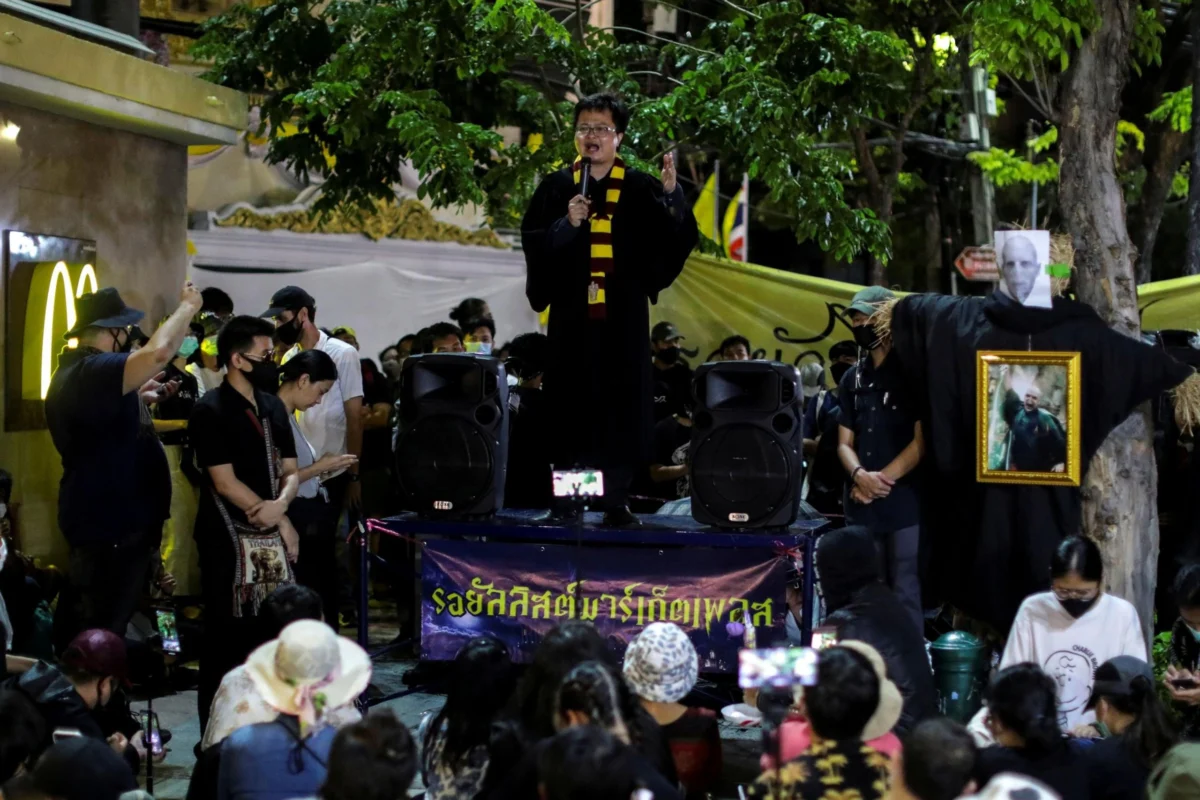
Even before they come through the door, the clinking of shackles around their ankles signals the prisoners’ approach to the courtroom. The five individuals who enter are all too familiar with this routine; they face multiple criminal prosecutions and have spent a significant portion of the past five years navigating the labyrinthine Thai legal system. Among them is Arnon Nampa, a 42-year-old human rights lawyer, a small, bespectacled man with greying hair. He opens his arms to embrace his three-year-old son, who, along with his partner, has accompanied him to court. Arnon’s “offence”? He dared to advocate for the scrutiny and accountability of Thailand’s powerful monarchy. His act of defiance, performed at a Harry Potter-themed demonstration in central Bangkok in 2020, saw him dressed as the iconic young wizard, a symbol of courage and a call to challenge the status quo.

On Friday, a court in Bangkok delivered its verdict, sentencing Arnon Nampa to two years and eight months imprisonment for violating Thailand’s stringent lèse-majesté law, also known as Article 112. This draconian piece of legislation has led to more people being jailed for perceived insults against the royal family in Thailand than in all other countries with similar laws combined. For Arnon, this is merely one chapter in a much larger legal battle. He is currently facing a total of fourteen cases brought against him under the same charge, accumulating a potential sentence exceeding 34 years, with verdicts in two cases still pending. "To me, this isn’t a surprise," Arnon later told reporters, his voice steady despite the circumstances. "If the country was more open, we would be able to talk about these issues freely."
The past six years have witnessed the most extensive application of the lèse-majesté law in Thai history. This surge in prosecutions is a direct response to unprecedented student-led protests that erupted in 2020, marking a watershed moment when calls for public discussion of the monarchy’s role were voiced for the first time. Since then, an alarming 294 individuals, including 20 minors, have been prosecuted, facing prison sentences of up to 50 years. Many of these cases remain ongoing. The common practice for those charged under this law is the denial of bail, resulting in prolonged pre-trial detention, often spanning several years. Thai officials consistently defend the law by stating it "reflects the culture and history of Thailand, where the monarchy is one of the main pillars of the nation, highly revered by the majority of Thai people."

However, the actual text of Article 112 of the Thai criminal code is starkly concise: "Whoever defames, insults or threatens the King, the Queen, the Heir-apparent or the Regent, shall be punished with imprisonment of three to 15 years." In practice, the interpretation and application of this law have expanded far beyond its literal wording. A broad spectrum of comments concerning the monarchy, its members, and even historical figures, has led to prosecutions. In one particularly egregious case, a taxi driver was imprisoned for remarks made to a passenger in his cab. The law’s ambiguity has become a significant concern for human rights advocates. "If you ask me what the text of the law says, I can tell you," explains Akarachai Chaimaneekarakate, assistant director of Thai Lawyers for Human Rights, an organization providing legal defense for those accused under Article 112. "If you ask me how the courts interpret the words ‘defame’ or ‘insult,’ I don’t think I can give you a definition, because it’s so ambiguous, it’s so vague. Even questioning the law itself, for example, can constitute lèse-majesté under Section 112."
From his cell in the Bangkok Remand Prison, where he has been held for the past three years, Arnon Nampa continues to communicate with his young children through heartfelt letters. "Dear Pran and Karl, my beloved children," one letter begins, "The winter wind has not only brought us cool weather, but also brings back stories from the past. I miss the time we travelled outside Bangkok that first winter after Karl came into this world. It was such a magical time for me. I shall miss it every winter I spend here until I regain my freedom." Court hearings, like the one Arnon attended just weeks before his recent sentencing, represent the only occasions he has seen his son, Karl, since he was an infant. While Karl, now three, is initially shy, he soon settles into his father’s arms, proudly displayed to the other inmates. His older sister, Pran, aged ten, occasionally visits her father in prison and often expresses her emotions through her drawings and paintings. Arnon and his partner, Lookwa, have decided that Karl is too young to visit, leading him to believe that the courtroom is simply his father’s place of work.

The courtroom itself, often filled with a group of Arnon’s supporters, offers an unexpectedly informal setting for individuals facing such grave charges. Laughter and gossip are exchanged among prisoners and their visitors before the judges enter, a stark contrast to the gravity of the proceedings. This atmosphere, however, belies the chilling effect of Article 112, which has effectively silenced public discourse on the monarchy for decades. Prior to 2017, discussions about the monarchy were largely confined to hushed whispers.
The landscape of dissent began to shift dramatically on August 3, 2020. That year, a growing wave of frustration among younger Thais with the conservative government, led by former coup leader Gen Prayuth Chan-ocha, reached a tipping point. Millions had cast their votes for the reformist Future Forward party, only to see it dissolved by the Constitutional Court on a technicality in February 2020. The ensuing COVID-19 pandemic temporarily suppressed public gatherings, but as infection rates declined, students began organizing rallies demanding an end to the military’s influence in politics. Arnon Nampa, however, felt this was not a radical enough demand.

His speech, delivered while clad in the costume of Harry Potter, was a bold challenge to a long-standing taboo. He called for a public dialogue concerning the monarchy’s opaque power and considerable wealth, specifically criticizing King Vajiralongkorn’s decision to assume personal control of the vast assets managed by the Crown Property Bureau and key army units. This single act shattered a silence that had permeated Thai society for much of its modern history. Throughout the remainder of 2020, the student-led protests escalated, with increasingly audacious demands for changes to the monarchy’s role.
At the time, the use of the lèse-majesté law had been temporarily suspended for three years. Insiders close to the palace had previously acknowledged that the negative international attention generated by lèse-majesté convictions could be counterproductive. However, the intensity of the protests prompted a swift reevaluation. From late 2020 onwards, prosecutions under Article 112 resumed and rapidly accelerated, leading to dozens of young activists fleeing into exile to evade imprisonment.

One such individual is Supitcha "Melinn" Chailom, a 24-year-old from Chiang Mai now residing in Montreal, Canada. She is a fugitive facing four lèse-majesté charges. Melinn was merely 18 years old when she delivered a speech at a protest at Chiang Mai University, just three weeks after Arnon Nampa’s initial call for reform. A photograph capturing her raising the three-finger salute – a symbol adopted from "The Hunger Games" – ignited widespread cheers from the crowd, becoming an iconic image of the protests and propelling Melinn to national prominence. She traveled extensively across the country, becoming a leading voice in the movement, advocating for reforms to Thailand’s outdated education system and even conducting informal polls on public opinion regarding the monarchy.
"I love playing games, and I dreamed of being a game designer," Melinn shared from Canada. However, her aspirations were met with familial disapproval. "I felt that, as a young person, I could not question, or have a discussion with people older than me. The monarchy gave me the same vibe." In November 2020, Melinn participated in a protest in Hat Yai, a southern city, where she delivered a speech comparing the preferential treatment afforded to the king’s dog with that of ordinary citizens. Nine months later, the police delivered a summons to her home, charging her with lèse-majesté. "It was a shock. I wasn’t expecting it because I only talked about the dog. It was during Covid when the police came to my home with the summons, so they knew my parents would be there with me. They tried to stay calm, but I nearly lost my mind."

Her family urged her to cooperate with the authorities and admit wrongdoing, but Melinn remained steadfast in her convictions. She joined a movement known as Thalu Wang, which translates to "breaking through the palace." Instead of direct speeches, the group employed unconventional tactics, such as street polls questioning the public about the disruption caused by royal motorcades or the extent of the monarchy’s power. "We knew the risks, but we thought it would be safer just conducting a poll. It turns out it was not." Melinn faced two additional lèse-majesté charges in 2022 and was detained, later released on bail. She was subjected to wearing an electronic monitor on her ankle and a strict curfew, confined to her home between 4 PM and 6 AM. Her parents were compelled to sign a document agreeing to report on her activities. Facing the prospect of decades in prison, Melinn, with the help of a friend, fled Thailand and eventually secured asylum in Canada.
Article 112, while ostensibly a law passed by the Thai parliament and theoretically subject to amendment, has become increasingly entrenched. The Constitutional Court has, in effect, declared the law itself, much like the institution it protects, to be beyond reproach. In 2024, the reformist Move Forward party, the successor to Future Forward, was dissolved, and its leader was banned from politics, simply for proposing less severe penalties for lèse-majesté offenses. The legal system, as experienced by those charged, actively hinders their ability to mount a defense. "In many cases, like the one against Arnon Nampa, prosecutors accuse the defendant of lying about the monarchy," states Chaimaneekarakate. "But when we ask the judge to subpoena documents or witnesses who could show the truth of what the defendant says, the judge refuses to do it. When one lawyer protested against the court deciding that the trial would be held in secret, she was warned by the judge to be quiet or face a contempt of court charge." He further notes instances where judges have openly criticized young activists for their alleged actions even before the commencement of trials.

Arnon Nampa, often seen as the catalyst for the public debate surrounding the monarchy, appears to be facing the harshest repercussions. Despite the formidable legal challenges, he meticulously prepares for each court appearance, actively participating in his own defense and assisting fellow inmates with theirs. This is no easy feat, as he is prohibited from bringing any written notes and must commit all his arguments to memory. The judges have objected to his role as a lawyer, particularly given his attire of regulation-brown prison shorts and his shackled feet. Nevertheless, these court appearances offer him the invaluable opportunity to connect with his family.
The letters he pens from prison are his primary means of maintaining contact. Arnon acknowledges the possibility of spending his entire life incarcerated. He is determined that his children will know him and, when they are older, understand the reasons behind his choice to challenge the system at the cost of his freedom. "Since the first day that we made up our mind to take up this mission, we knew of the dangers. Speaking the truth is not difficult. What is difficult is speaking a forbidden truth. I remember well that on the evening of 3 August 2020, after speaking at the Harry Potter event, I felt very good, content, and relieved to have finally begun speaking about the truth, in public," he wrote to his family last year. Earlier this year, he reflected, "Living here is a struggle. But it is just a dot in the bigger picture of our movement’s struggle. We must play a part in writing our own history. Become a drop of water that will one day become an ocean." His words encapsulate a profound sense of purpose and a commitment to a larger cause, even in the face of personal sacrifice.
