
 By Lina Irawan
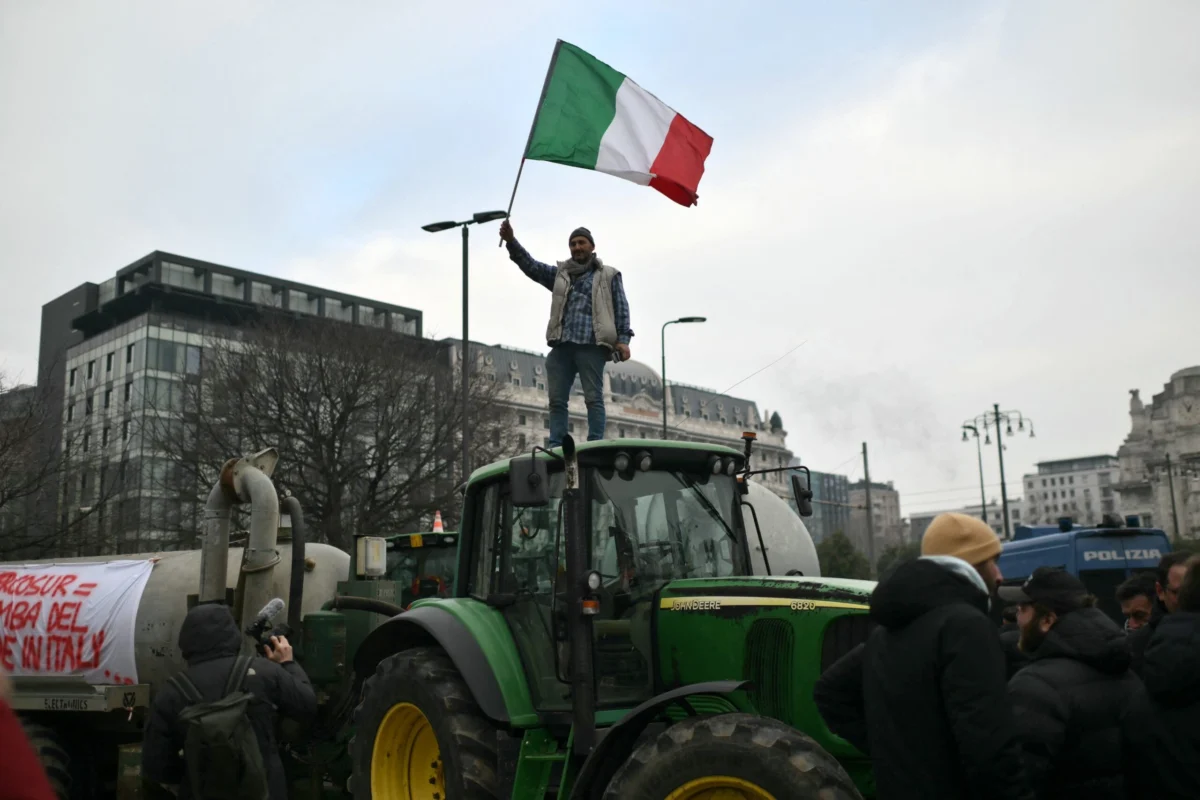
Farmers tipped two bins of manure in front of Turin’s city hall Friday morning, a visceral and pungent symbol of their deepening frustration, just before tens of thousands of people set off on a broader march against living costs and military spending. The provocative act, executed in the early hours of the day, served as a stark prelude to a day of nationwide dissent that underscored a growing chasm between ordinary Italians and their government. A speaker, addressing the burgeoning crowd over a microphone, articulated the farmers’ pointed message, declaring their action to be "against those who want to turn Turin into the city of arms companies," a grievance that resonated deeply within a city with a rich, albeit complex, industrial heritage tied to both automotive and defense sectors.
This dramatic demonstration in Turin was merely the spearhead of a much larger wave of discontent sweeping across the Italian peninsula. Turin was one of more than 50 Italian cities that held protests Friday, coinciding with a general strike called by the grassroots union USB. This coordinated national action saw a diverse coalition of disaffected groups — farmers, truck drivers, students, and taxi drivers — march side-by-side, united by shared economic anxieties and a simmering resentment against perceived government inaction. The timing could not have been more poignant; the same morning, Istat, Italy’s national statistics agency, reported that Italian inflation had surged to 5.4% in October, marking its highest level in more than three years. This figure painted a grim picture, significantly outpacing the 3.7% price increase seen in the U.S. through September, and dwarfing China’s modest 0.9% inflation rate. The primary driver of this inflationary spiral was the astronomical rise in energy prices, which were up a staggering 31.4% from a year earlier, squeezing household budgets and crippling businesses. The desperation was palpable, with reports emerging from Naples of people resorting to riding horses through the streets, a stark testament to the prohibitive cost of gas and diesel.
For Italian farmers and truckers, Friday’s widespread protests represented the culmination of a month-long, increasingly desperate fight over the soaring costs of operating their essential businesses. Since mid-October, these vital sectors had been engaged in disruptive blockades, strategically targeting roads, ports, and fuel depots across the south of Italy. The primary catalyst for their actions was the escalating price of diesel, which now cost roughly a third more than it did before the generalized global energy market volatility exacerbated by conflicts like the Iran war and the ongoing war in Ukraine. Further fueling their outrage was the expiration of a temporary diesel tax discount earlier this month, a lifeline that many had come to rely upon. Vincenzo Aleccia, president of a trucking group in the Sicilian port of Trapani, articulated the sentiment of many, asserting, “It’s a peaceful protest and it’s for the benefit of the people,” underscoring their belief that their fight was for the collective good of Italian citizens struggling with rising prices.
Empty Supermarket Shelves: A Nation’s Culinary Heritage at Risk
The blockades, though concentrated in the south, quickly sent ripple effects across the entire nation, severely disrupting the supply chains of two of Italy’s most iconic and beloved foods: buffalo mozzarella and pasta. The delicate production of buffalo mozzarella, a jewel of Italian gastronomy, is notoriously time-sensitive, requiring the milk to be processed within 60 hours of milking. With trucks immobilized and roads impassable, fresh buffalo milk couldn’t reach the dairies clustered near Naples, the heartland of its production. Pier Maria Saccani, director of the consortium that oversees Mozzarella di Bufala Campana DOP, lamented the catastrophic losses, reporting that approximately 1 million liters of milk went unused and spoiled in a single day. "Yesterday, no mozzarella was produced," he told the Associated Press, estimating the financial loss at a staggering €3 million within a mere 24 hours. Saccani further highlighted the pre-existing pressures on producers, whose costs had already surged by about 30% before the blockades, with most of that increase absorbed by the producers themselves, demonstrating their already precarious financial situation.
The pasta industry, another cornerstone of Italian cuisine and economy, suffered similar blows. Rummo, a renowned pasta maker based in Campania, was forced to suspend production, its operations grinding to a halt due to lack of ingredients. Likewise, La Molisana halted its plant in Campobasso, a significant blow to the region’s economy. Puglia, a southern region often referred to as Italy’s granary, cultivates about a quarter of Italy’s durum wheat and processes much of the country’s semolina, as reported by Il Sole 24 Ore. The blockades thus threatened the very foundation of Italy’s pasta supply chain, with potential long-term consequences for both domestic consumption and international exports. The immediate impact on consumers was stark and visible: supermarkets in Naples displayed apologetic notices on their barren shelves, while Sicily, an island heavily reliant on mainland supplies, experienced severe shortages of fresh pasta, cheese, and meat.
A North-South Divide Exposed: The Forgotten Protests
Ironically, the regions that are agricultural powerhouses, growing much of Italy’s food, were precisely the ones that ran out of it first. Retail group Federdistribuzione confirmed that vast quantities of fresh produce rotted in warehouses across Campania, Puglia, and Calabria, unable to reach markets or consumers. Giuseppe Richichi, president of a Sicilian truckers’ association, expressed the bittersweet realization of their impact, telling AFP, “We realized we were only hurting half of Italy, our half, the south.” This sentiment underscored a deeper historical and economic grievance: the persistent north-south divide that has long characterized Italy. While protests in affluent northern cities like Milan and Bologna often captured national headlines and political attention, the arduous and economically impactful southern blockades were largely ignored by mainstream media and, by extension, the government. "It’s become impossible to face the costs of fuel,” Luigi Di Benedetto, who manages an agricultural business in Caltagirone, Sicily, told EUobserver, echoing the frustration of many southern producers who felt their plight was overlooked.
In an attempt to quell the rising unrest and mitigate the severe economic disruptions, Prime Minister Giorgia Meloni’s government approved a €175.2 million aid package for truckers, farmers, and fishermen on October 22. This injection of funds brought the total aid for these sectors to €540 million in tax credits, a sum intended to alleviate the immediate financial pressures. The last southern pickets came down the very next day, a testament to the immediate impact of the financial relief. However, the truce was fragile. Richichi, among others, remained skeptical, arguing that the government was merely "paying money it already owed," suggesting the aid was not a new concession but rather a belated fulfillment of existing obligations, thereby failing to address the underlying structural issues.
Deep Roots of Discontent and a Government’s Hard Line
The pressure on food prices in Italy is not a recent phenomenon but a trend with deep historical roots, exacerbating the current crisis. Istat data reveals that while consumer prices generally rose by about 63% between 2000 and 2025, food prices surged disproportionately, climbing by approximately 90% over the same period. This long-term trend highlights a chronic vulnerability within the food supply chain and a persistent struggle for farmers and consumers alike.
Italian farmers have a history of mobilizing dramatically to voice their grievances. In February 2024, they famously drove tractor convoys into Rome, staging a powerful protest against perceived betrayals by EU green rules, the influx of cheap imports, and the ever-increasing operating costs. This year, however, Meloni’s right-wing government has adopted an even harder line in response to the protests, reflecting its broader "law and order" stance. Prior to Friday’s nationwide marches, the Interior Ministry made preventive arrests, a controversial tactic aimed at deterring potential agitators and maintaining public order. Transport workers, initially planning to join the general strike, ultimately dropped their plans after Transport Minister Matteo Salvini, known for his firm approach, publicly threatened them with severe sanctions, including potential fines and license suspensions, highlighting the government’s resolve to prevent major disruptions to essential services. In Turin, the confrontation escalated further when police briefly used a water cannon to push back protesters who approached the prefecture, a symbolic government building, underscoring the authorities’ determination to contain the demonstrations, even with force.
The convergence of economic hardship, exacerbated by global geopolitical events, and a perceived lack of adequate government response has created a volatile atmosphere in Italy. The protests, ranging from the symbolic dumping of manure to widespread blockades, are more than just about fuel prices or agricultural subsidies; they represent a deep-seated frustration with the rising cost of living, the erosion of purchasing power, and the feeling that essential sectors of the economy are being neglected. As Italy grapples with these multifaceted challenges, the specter of continued social unrest looms large, testing the resilience of its citizens and the resolve of its leadership. The events of Friday in Turin and across Italy serve as a potent reminder that beneath the surface of daily life, significant forces of discontent are at play, demanding attention and systemic solutions.
