
 By Lina Irawan
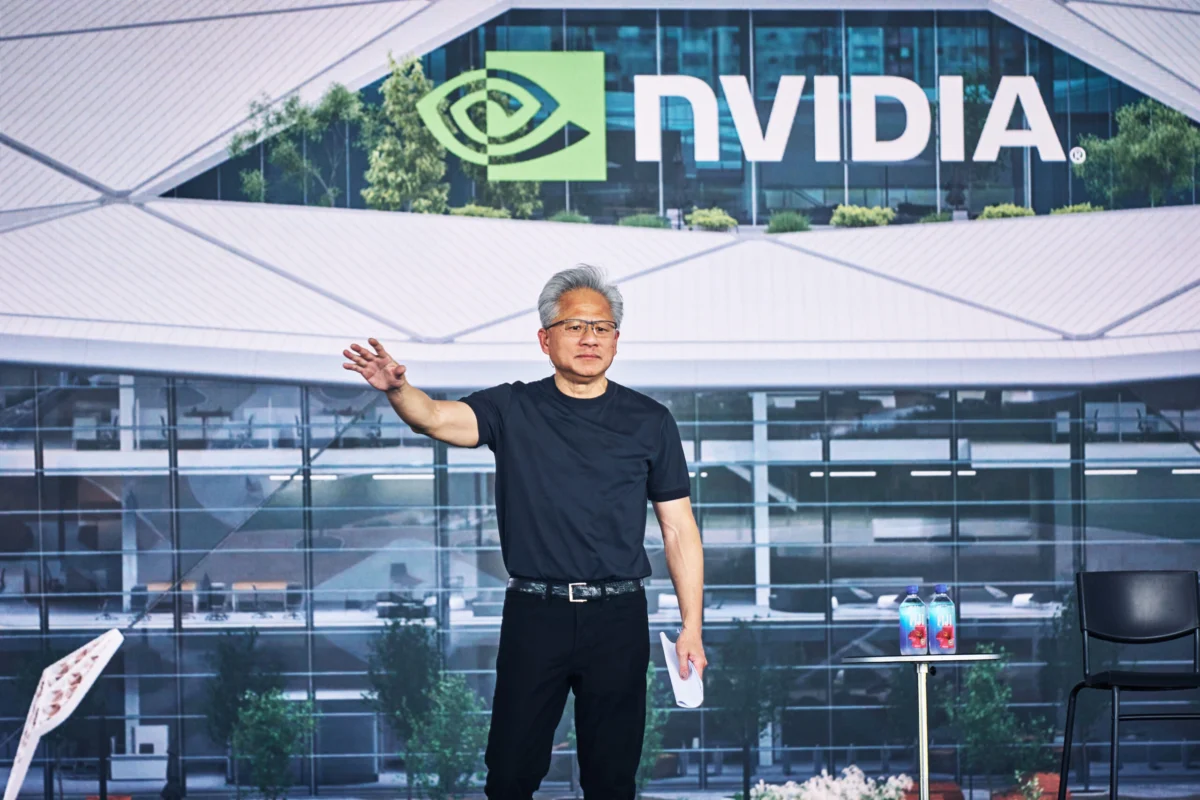
On Thursday, Colette Kress, Nvidia’s seasoned chief financial officer since 2013, was appointed interim CEO. Kress will navigate the company through this transitional period while simultaneously continuing in her crucial CFO role. Her dual appointment signals the board’s immediate priority: maintaining financial stability and operational continuity during a period of intense scrutiny and strategic recalibration. Kress’s decade-long tenure as CFO has coincided with Nvidia’s most explosive growth phase, transforming it from a leading chipmaker into a dominant force in data centers, professional visualization, and automotive AI, boasting a market capitalization that has, at times, rivaled tech giants like Apple and Microsoft. She has been instrumental in managing the company’s complex supply chains, navigating geopolitical trade tensions, and overseeing its impressive revenue growth, which soared from billions to hundreds of billions annually, driven largely by its H100 and A100 GPU accelerators.
"Colette is very much the right interim CEO," commented Scott W. Simmons, co-managing partner of the prominent executive search firm Crist Kolder Associates, lending credence to the board’s decision. Simmons, who brings nearly three decades of experience in executive recruiting, believes Kress’s appointment provides a steady hand. However, he also suggests that Nvidia’s board, likely chaired by Harvey Jones in this critical search, will ultimately seek a permanent successor with a deep technological background, potentially looking beyond internal candidates to cast a wider net. The challenge lies in finding someone who can not only sustain Nvidia’s technical leadership but also emulate Huang’s unique blend of engineering prowess, strategic foresight, and charismatic leadership that has defined the company’s culture and market dominance.
The search for Huang’s permanent successor has immediately sparked a fervent debate among industry analysts and investors, with a diverse slate of high-profile external candidates emerging as frontrunners. These individuals represent a spectrum of leadership styles and technical backgrounds, each bringing a unique set of strengths to a role that demands an almost superhuman combination of skills.
If Nvidia’s board opts for an external candidate, Shay Boloor, chief market strategist at The Futurum Group, is placing a significant bet on Rene Haas, the current CEO of Arm. Boloor highlighted Haas’s deep-rooted connection to Nvidia, noting, "He spent seven years at Nvidia and understands Jensen’s culture; and what makes him interesting is that Nvidia’s Grace and Vera CPUs run on Arm architecture." This architectural synergy is crucial, as Nvidia’s superchips, like Grace Hopper, integrate its GPUs with Arm-based CPUs, creating powerful computing platforms for AI. Haas’s familiarity with the CPU side of Nvidia’s platform is considered unparalleled among external candidates, despite his absence during the rise of NVLink, Mellanox acquisition, and the full-scale rack-level AI infrastructure development. Sam Sugarman, a venture capital and private equity investor at Concordia Capital, echoed this sentiment, including Haas on his own list of prime external contenders.
Haas’s career trajectory since leaving Nvidia in 2013 further bolsters his candidacy. He successfully steered Arm through its highly anticipated 2023 initial public offering (IPO), a landmark event that valued the British chip designer at over $54 billion. Under his leadership, Arm has expanded its business beyond traditional processor licensing into new growth areas like automotive and data centers, demonstrating a keen understanding of market diversification and strategic execution. His background encompasses engineering, product strategy, and global sales, providing a comprehensive skill set. However, a critical question for Nvidia’s board will be whether running Arm, despite its global reach and foundational IP, has adequately prepared him for the sheer scale, complexity, and aggressive innovation pace of Nvidia’s multi-faceted business, which spans everything from discrete GPUs to full-stack AI platforms and software ecosystems.
Another prominent name circulating among the investment community is Lisa Su, CEO of Advanced Micro Devices (AMD). Sugarman also championed Su as a potential successor, acknowledging the delicious irony that she is a distant cousin of Jensen Huang. Su’s appeal is undeniable: she boasts impeccable semiconductor engineering credentials and an indisputable track record of running a major chipmaker with unparalleled success. Since taking the helm of AMD in 2014, Su orchestrated one of the most remarkable corporate turnarounds in recent tech history. She revitalized the struggling company, transforming it into a formidable competitor against Intel in CPUs (with the Ryzen and EPYC lines) and a serious challenger to Nvidia in the burgeoning AI chip market (with products like the MI300X accelerators). Her strategic vision, relentless focus on innovation, and ability to execute complex product roadmaps have earned her widespread acclaim and respect. This experience, particularly in competing directly with Nvidia in high-performance computing and AI, could be highly appealing to a board seeking a leader who understands the competitive landscape intimately. The challenge, however, lies in the monumental task of persuading a sitting CEO, who has personally rebuilt and led her company to such heights, to leave for a rival, no matter how prestigious the offer.
Expanding the list of potential external candidates, Dan Ives, partner and senior managing director at Yorkville Ives & Co., presented a trio of tech heavyweights: Tim Cook, formerly CEO of Apple; Tom Kurian, CEO of Google Cloud; and Nikesh Arora, chairman and CEO of Palo Alto Networks. Ives positioned these three as "the top three external candidates for Nvidia’s CEO role," each bringing a unique set of experiences from different facets of the technology industry.
Tim Cook’s candidacy is particularly intriguing. He brings the invaluable experience of having successfully navigated one of the most challenging leadership transitions in corporate history: succeeding the iconic and irreplaceable Steve Jobs at Apple. Over 15 years as CEO, before becoming executive chairman in September, Cook grew Apple into the world’s most valuable company, masterfully expanding its product lines, services, and global footprint. His legendary mastery of supply chains and logistics, crucial for a hardware-heavy company like Nvidia, would be an undeniable asset. Furthermore, Apple’s decade-long commitment to developing its own powerful in-house processors (like the A-series and M-series chips) means Cook possesses direct, high-level experience in the semiconductor business. His ongoing work in fostering Apple’s international relationships would also be highly relevant to Nvidia, a company deeply entangled in complex geopolitical pressures, particularly concerning global chip supply and trade with China. However, his continuing responsibilities as Apple’s executive chairman could complicate recruitment efforts, raising questions about his full dedication to a new, demanding CEO role. Interestingly, his candidacy received an unexpected endorsement from former President Trump, who posted on Truth Social that Cook should replace Huang, adding a unique, albeit politically charged, dimension to the public discourse.
Tom Kurian, CEO of Google Cloud, offers a compelling connection to Nvidia’s critical AI infrastructure business. Before taking the reins at Google Cloud in 2019, Kurian spent 22 years at Oracle, culminating in his role as president of product development. At Google Cloud, he has significantly grown its market share and established robust partnerships, including a crucial AI infrastructure collaboration with Nvidia. This partnership means Kurian has worked closely with Nvidia’s technology and teams, giving him an intimate understanding of their product capabilities and market strategies from a major customer’s perspective. The central question for the board would be how readily his experience in leading a cloud services giant and product development at an enterprise software behemoth would translate to directly leading a chip design and manufacturing powerhouse. While he understands the deployment and consumption of AI infrastructure, leading the creation of the underlying silicon presents a different challenge.
Finally, Nikesh Arora, the current chairman and CEO of Palo Alto Networks, rounds out Ives’s list. Arora brings a wealth of experience as a sitting public-company chief executive with a diverse career spanning enterprise technology, global sales, and significant investment roles. Prior to joining the cybersecurity leader in 2018, Arora served as president and COO of SoftBank, a global investment powerhouse, and held several senior commercial roles at Google, including chief business officer, where he oversaw advertising and global sales operations. His appeal as a candidate could hinge on Nvidia’s strategic direction: if the board seeks a leader who excels at market expansion, strategic partnerships, and building robust business models around Nvidia’s unparalleled technical leadership, Arora’s profile fits well. He is a strategist and a dealmaker, which could be invaluable for navigating Nvidia’s evolving ecosystem of software, services, and diverse hardware applications.
The challenge facing Nvidia’s board is monumental. Jensen Huang’s legacy is not just about groundbreaking technology but also about cultivating a unique, aggressive, and visionary corporate culture. His successor must possess a rare blend of technical acumen, strategic vision, operational excellence, and the gravitas to lead a company that is at the very nexus of several transformative technologies—AI, accelerated computing, robotics, and the metaverse. The chosen leader will need to steer Nvidia through intensifying competition from rivals like AMD and Intel, navigate complex geopolitical landscapes, and continue to innovate at a blistering pace to maintain its competitive edge.
"There’s such a small pool to fish in when you think about people capable of stepping into this," Simmons aptly concluded. The board’s decision will ultimately determine Nvidia’s fate, influencing not only its financial performance and market position but also its continued role as a driving force in the global technological revolution. The guessing game may have just begun, but its outcome will shape the future of computing for decades to come.
