
 By admin
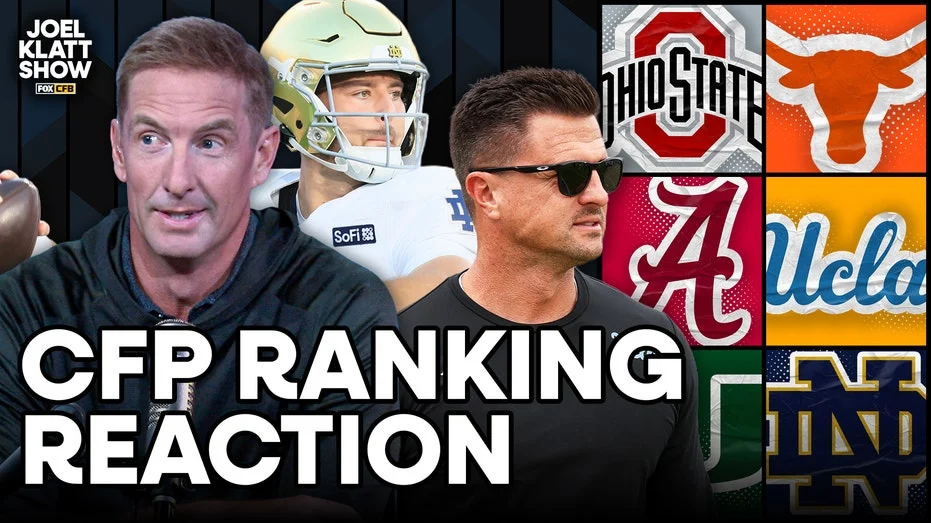
The inaugural College Football Playoff (CFP) rankings for the 2026 season have ignited a firestorm of debate, with prominent college football analyst Joel Klatt expressing significant displeasure with the committee’s methodology and the resulting top 25. Unveiled on a Tuesday night that saw Miami unexpectedly placed at No. 1, followed by Georgia, Utah, and Indiana, with Ohio State conspicuously positioned at No. 12 and the first team outside the expanded 12-team field, Klatt argues that the issues transcend any single team’s placement. On the latest episode of "The Joel Klatt Show," Klatt meticulously dissected the committee’s approach, asserting that the very foundation of their ranking system is flawed, and vehemently pushing back against the notion that the initial top 25 has minimal consequence.

Klatt’s critique centers on several key areas, each highlighting a perceived deficiency in the CFP selection process. His primary concern, labeled "No Consistent Criteria," underscores a fundamental lack of a unified and transparent framework guiding the committee’s decisions. "They’re left to their own accord to rank teams based on any criteria they want," Klatt stated, drawing a parallel to the inception of the playoff era in 2014. He observed a recurring pattern where the committee seemingly oscillates between different evaluation metrics, giving undue weight to some factors at one moment and others at a different juncture. "Record has an influence, obviously. Who you beat has an influence. Sometimes who you lost to, your strength of schedule – that’s been more of a common theme this year – your personnel, who’s injured, who’s not injured," he elaborated. However, Klatt’s core argument lies in the absence of a hierarchical structure for these criteria. "There’s all these different criteria, and none of them are valued over any other criteria. Well, that’s impossible," he declared. While acknowledging the integrity of the individuals on the committee, Klatt concluded that their collective efforts are undermined by a "broken process." This ambiguity, he suggests, leaves teams and fans alike guessing about the true determinants of their standing, fostering an environment of uncertainty rather than clarity. The lack of clearly defined and consistently applied metrics can lead to perceived injustices and erode confidence in the fairness of the rankings.
Further compounding Klatt’s dissatisfaction is the perceived inadequacy of the committee’s composition, encapsulated in his point, "13 Inputs Aren’t Enough." He finds it "wild" that a decision of such monumental importance to the sport rests on the opinions of a mere 13 individuals. In a sport as complex and data-rich as college football, where countless metrics and variables contribute to team performance, relying on such a small group to encapsulate the entirety of the landscape is, in Klatt’s view, insufficient. "We have to increase the number of inputs into this data set," he urged. Klatt emphasizes that this isn’t a criticism of the committee members themselves, who he believes are doing their best with the resources provided, but rather a systemic flaw. He uses the analogy of "building a house with no blueprints," suggesting that without a more robust and diverse set of perspectives and data points informing their decisions, the committee is essentially operating without a clear architectural plan for selecting the nation’s best teams. This limited input can lead to biases, blind spots, and an incomplete understanding of the nuanced realities of each team’s season. The current structure, he implies, does not adequately capture the breadth and depth of information necessary for truly comprehensive and equitable rankings.

Perhaps the most stinging indictment from Klatt is his assertion that the initial top 25 is "an outlier." He draws a parallel to personal budgeting, explaining that a single month with extraordinary expenses, like a vacation, is recognized as an anomaly and not used to dictate the entire year’s financial plan. Klatt argues that the CFP committee’s first ranking is precisely this kind of outlier, so far removed from what a more statistically sound aggregation of opinions would produce that it distorts the perception of the college football hierarchy. "I would argue that what they gave us on Tuesday night is about as big of an outlier as you can possibly get in a top 25," he stated. He posits that if 50 different committees were to convene and render their rankings, the published list would be an extreme deviation from the norm. In statistical analysis, Klatt points out, outliers are often discarded to better understand the central tendency of the data. However, the CFP committee, by presenting this extreme ranking, is using it as the primary representation of college football’s pecking order, which Klatt finds fundamentally flawed. This "outlier" ranking, he fears, will disproportionately influence the narrative and perception of teams, setting a distorted trajectory for the remainder of the season. The danger lies in the committee potentially overvaluing or undervaluing teams based on this initial, statistically improbable assessment, creating a ripple effect that could impact the entire playoff picture.
Beyond the inherent flaws in the ranking criteria and committee structure, Klatt argues that the current system is actively detrimental to the sport itself, specifically in its impact on non-conference scheduling. He believes the committee’s ranking process is "killing non-conference games." Klatt laments the decline of marquee matchups like Texas vs. Ohio State and Michigan vs. Oklahoma, which he deems "great for the sport." His central thesis is that the committee’s historical tendency to not adequately reward teams for playing and winning difficult non-conference games has incentivized a move towards easier schedules. "There is zero, and I mean zero reason to schedule a tough non-conference game," Klatt declared, highlighting the perceived lack of tangible benefit in the rankings for undertaking such risks. He argues that these high-profile games are becoming "extinct" precisely because the committee "is actively hunting them and shooting them out in the wild." This suggests that teams are strategically avoiding challenging non-conference opponents for fear that a loss, or even a narrow victory, could significantly damage their playoff prospects, while a win against a lesser opponent might not provide a substantial enough boost to offset the risk. The consequence is a homogenization of schedules, a reduction in exciting early-season matchups, and a less compelling product for fans. The very entities tasked with promoting the sport are, in Klatt’s view, inadvertently contributing to its erosion by failing to recognize and reward competitive scheduling.

Finally, Klatt refutes the common refrain that the first ranking "doesn’t matter." He unequivocally states, "The first ranking matters," and contends that only the final ranking holds more significance. He likens the initial CFP top 25 to the starting grid in a NASCAR or IndyCar race. In motorsports, qualifying positions provide a crucial advantage, with the best cars starting at the front and facing fewer hurdles. Klatt asserts that the initial CFP rankings establish a similar starting advantage for teams. Those ranked higher begin the "race to those 12 spots" with a distinct benefit, not carrying the same "burden of proof" as the teams ranked lower. He poses a rhetorical question to any race car driver: would they prefer to start 12th or first? The answer, he implies, is self-evident. This initial positioning, therefore, imbues every subsequent game with a specific value, directly tied to the committee’s Week 1 assessment. Teams ranked higher can afford a stumble or two more than those fighting from the bottom of the rankings. This creates a dynamic where teams are not just playing to win, but playing to improve their ranking position, a concept heavily influenced by that initial, and in Klatt’s view, flawed, top 25. The implications are profound, as early-season performance and perception are amplified, potentially overshadowing later-season heroics or stumbles. The committee’s initial pronouncements, therefore, set a significant tone and establish an uneven playing field that Klatt believes needs a radical overhaul to ensure fairness and the continued health of college football.
