
 By Lina Irawan
For more than a year, Nvidia CEO Jensen Huang has repeated the party line about covert smuggling of his highly coveted premium chips: There’s no evidence Nvidia AI chips are being diverted to China, Huang has asserted. This unwavering stance, delivered with Huang’s characteristic charisma and confidence, has long been a cornerstone of Nvidia’s public image amidst escalating U.S.-China tech tensions. However, this narrative has now been irrevocably shattered by a confluence of explosive allegations and investigations, exposing deep vulnerabilities within the company’s compliance framework and raising profound questions about its leadership and national security implications.
Two bombshell scandals, both allegedly running through the critical geopolitical nexus of Southeast Asia, have blasted a data-center sized hole through Huang’s carefully constructed credibility. The first case, involving approximately $2.5 billion in computer servers equipped with Nvidia chips under intense scrutiny, directly implicates Super Micro Computer (Supermicro), a company led by Charles Liang, a longtime friend and one of Nvidia’s closest and most strategically important partners. More recently, a separate string of reports has revealed that Nvidia’s largest Southeast Asian customer, Megaspeed, is itself under U.S. investigation for widespread chip diversion. As these corporate sagas unfold, they have become inextricably linked to a third, deeply personal crisis for Huang: his confession of an extramarital affair with a former executive of Megaspeed, whom intelligence officials now suspect was a Chinese state intelligence asset.
While there is no definitive evidence so far that the two corporate cases—Supermicro and Megaspeed—are directly connected in a grand, overarching conspiracy, some industry observers and investigative bodies have pointed to potential areas of overlap and shared methodologies in their alleged schemes. Whether the two cases are ultimately determined to be part of a larger, coordinated scheme, or completely separate incidents, the dual corporate scandals, now compounded by a sensational espionage allegation, have left Nvidia, its shareholders, and its famously visionary CEO reeling. The fallout promises to reshape the landscape of AI hardware supply chains, U.S. export controls, and corporate governance for years to come.
On Sunday, Huang delivered a stunning admission, telling employees in an email that he had betrayed his wife and family in an extramarital affair. His confession followed highly damaging reports claiming that intelligence officials in Washington believe Huang’s affair partner, Alice Huang (no relation), was recruited by China’s Ministry of State Security (MSS) to purportedly report on his doings to Beijing. The gravity of this allegation cannot be overstated; it transforms a corporate compliance issue into a potential national security breach at the highest echelons of one of America’s most critical technology companies. Alice Huang is identified as a former executive of Megaspeed International, a Singapore-based company that reportedly ascended to become Nvidia’s largest chip buyer in Southeast Asia, creating a direct and alarming link between Huang’s personal life and the alleged corporate malfeasance.
In the wake of Huang’s admission, Nvidia’s board of directors swiftly announced it has opened an independent investigation into whether the company’s co-founder and CEO was indeed the target of a foreign intelligence operation. Despite the seriousness of the claims, the board notably expressed that its members maintain "confidence" in Huang’s leadership. Furthermore, the board stated it currently has "no reason to believe that either national security or Nvidia secrets were compromised," a declaration that has been met with skepticism by some analysts given the ongoing nature of the investigations. To underscore the seriousness of their inquiry, Nvidia board members have retained the formidable legal expertise of Joon H. Kim, acting U.S. Attorney of the Southern District of New York, and his prestigious firm Wachtell, Lipton, Rosen & Katz, to lead the independent investigation, signaling an acknowledgment of the profound legal and reputational risks at play.
The significance of Nvidia’s GPU chips in the global technological landscape cannot be overstated. These advanced processors are the critical, indispensable components for training and running cutting-edge artificial intelligence models, powering the innovations championed by companies like OpenAI, Anthropic, and countless others. Recognizing their strategic importance and potential for dual-use, the U.S. government considers these chips to be dual-use technology with significant military applications. Consequently, stringent export licenses are required to sell them to nations deemed strategic competitors or adversaries, such as China. Crucially, the most high-powered and advanced of Nvidia’s chips—precisely those coveted for AI development—have not been granted such licenses for export to China, forming the bedrock of the U.S. strategy to curb Beijing’s technological and military advancement.
The evolving situation for Nvidia is unfolding in real time, with political scrutiny intensifying rapidly. A terse letter sent to Nvidia in June by Senator Elizabeth Warren (D-Mass.) regarding its compliance program, previously a concern, is now widely expected to escalate into a formal subpoena. This increased leverage for congressional oversight is largely due to the recent midterm election results that saw Democrats regain control of the Senate, positioning Senator Warren to chair the powerful Senate Banking Committee starting in January. Warren, alongside Senator Jim Banks (R-Ind.), issued a joint statement calling for Nvidia to provide comprehensive answers regarding the alleged diversions. Separately, three House committee chairs have formally requested Huang to accede to a closed-door grilling before lawmakers on November 18, a mere day after Nvidia is scheduled to report its third-quarter financial results, ensuring that the company’s performance will be overshadowed by the looming scandal.
The June letter, addressed to Nvidia general counsel Tim Teter and audit committee chair Brooke Seawell, specifically sought detailed answers from Nvidia regarding the efficacy and robustness of its compliance program. It pointedly noted that Nvidia continued to include Super Micro Computer (Supermicro) as a key partner in its extensive network, despite mounting concerns. The letter also referenced a report published by Culper Research, a short seller that had placed a significant bet against Nvidia. Culper’s report alleged possible smuggling links between Supermicro, Nvidia, and Megaspeed, the very company where Alice Huang, the CEO’s alleged affair partner, was a top executive. U.S. authorities have since been investigating whether the billions in Nvidia hardware Megaspeed purchased through Nvidia’s server partners were ultimately diverted to Chinese firms explicitly barred from acquiring such advanced chips. Megaspeed has, for its part, publicly denied any wrongdoing, maintaining its innocence amidst the swirling allegations.
Alice Huang has now emerged as the critical, human link connecting Jensen Huang’s personal infidelity and the burgeoning cover-up scandal to the persistent question that has dogged Nvidia for years: where do its chips actually end up after they’re purchased? The alleged "honey trap" espionage case, involving a high-profile CEO and a potential foreign intelligence operation, carries immense public-interest tailwind. This dramatic narrative far surpasses the at times byzantine regulations involved in obtaining and complying with export restrictions and licensing, making it unlikely that this latest revelation will simply blow over as a singular rogue actor or an administrative export record issue. The public and political appetite for answers is now insatiable.
An export-control veteran, who requested anonymity due to client confidentiality, articulated the profound shift in corporate risk assessment. "If I were an independent director or general counsel," he stated, "I’d be looking at whether the company they oversee has a Huang honeytrap problem—and not just at the CEO level." He elaborated on the historical prevalence of such seduction schemes, noting that executives responsible for inspecting data centers or conducting crucial due diligence have been targets of foreign intelligence operations for decades. He also drew a chilling parallel to a March Supermicro indictment, which highlighted that a compliance auditor was "off-site enjoying entertainment paid for by" another company—a "fairly common tactic," he confirmed, designed to compromise oversight.
Scandal One: Supermicro—A Friendship Under Fire
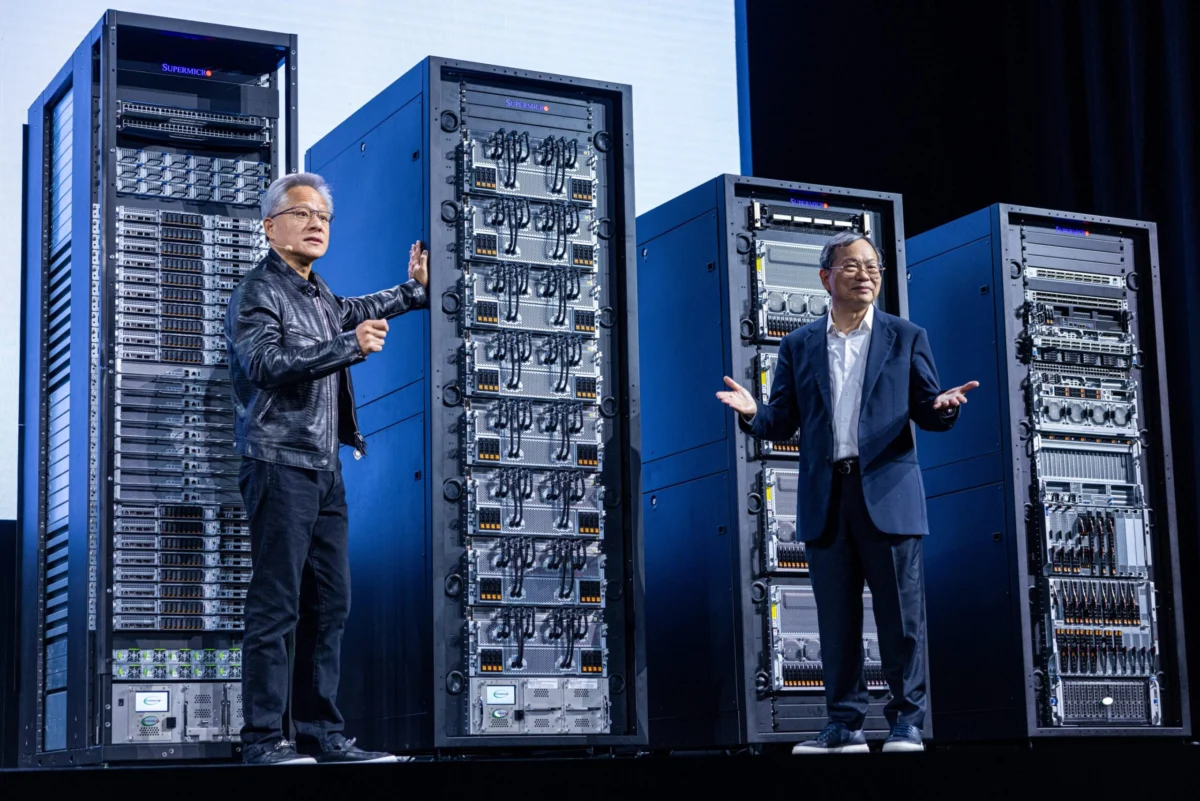
Until recently, the most high-profile case involving contraband Nvidia chips centered on one of Nvidia’s closest partners: Supermicro, a company co-founded and led by Charles Liang, Jensen Huang’s longtime friend. The bond between Huang and Liang, both having founded their respective companies in 1993, has been a public spectacle, often sharing the stage at events like Computex in Taiwan, where they would joke in a blend of Taiwanese, Mandarin, and English. "When we’re together, sometimes we speak Taiwanese, sometimes we speak Mandarin, and then when we disagree, we speak English," Huang famously quipped before an adoring Computex crowd in 2024—the same year he was photographed with Alice Huang at a Taipei cocktail bar.
In March, federal prosecutors took decisive action, charging Supermicro co-founder Yih-Shyan "Wally" Liaw and two others with orchestrating a sophisticated scheme to route approximately $2.5 billion in servers, heavily laden with Nvidia H200 and B200 GPUs, to China. The alleged pathway involved a Southeast Asian front company, later identified by Bloomberg and corroborated by Culper Research as OBON, a Bangkok-based AI infrastructure firm (which has not been charged). Supermicro itself was not charged in the indictment and has consistently maintained it was a victim of the elaborate scheme, asserting its cooperation with authorities. Liaw has pleaded not guilty, though one of his co-defendants has already pleaded guilty. Liaw co-founded Supermicro with Liang and Liang’s wife, Sara Liu, the same year Huang co-founded Nvidia, establishing a parallel founding narrative and deep industry ties. Neither Liang nor Liu were named in the indictment.
According to Liaw’s indictment, the elaborate scheme involved a meticulously planned deception: staging thousands of nonworking dummy servers in three warehouses to trick auditors. Contractors allegedly resorted to using rudimentary tools like hair dryers to soften the adhesive on serial-number labels, enabling their removal and replacement, further obscuring the true destination of the advanced hardware. This alleged scheme bears a striking resemblance to a playbook that had ensnared Supermicro years earlier, in 2006, when the company pleaded guilty to illegally exporting computer equipment to Iran through a distributor in Dubai. Both routes involved selling to a neighboring country or through an intermediary to keep the real, embargoed buyer hidden, suggesting a pattern of exploitation of indirect supply chains.
Crucially, the Liaw indictment does not accuse Nvidia of direct wrongdoing, but it intricately details how the front company’s orders for Supermicro hardware directly influenced Nvidia’s highly coveted chip allocation process. In December 2024, Liaw allegedly pressed the front company for monthly forecasts, explicitly stating that these forecasts were "the only way" to secure Nvidia’s promise of B200 chip allocations, according to the indictment. This detail highlights the intense demand for Nvidia’s chips and the potential for bad actors to manipulate allocation processes.
Supermicro has since disclosed that it received a grand jury subpoena from the U.S. Attorney’s Office for the Southern District of New York, alongside subpoenas and inquiries from various foreign authorities, the Securities and Exchange Commission (SEC), and the Bureau of Industry and Security (BIS)—the primary agency responsible for enforcing export controls. In Liaw’s case, his lawyer informed the judge that the extensive documents Supermicro would provide to the government could be material to his defense, leading to his trial being pushed back from November 2026 to March 2027, indicating the complexity and volume of evidence involved.
Scandal Two: Megaspeed—The Customer at the Heart of the Storm
As details of the Megaspeed scandal continue to emerge, Nvidia’s chips are now at the center of a second major smuggling investigation—this time involving one of its own direct, major customers. Megaspeed reportedly procured more than $4.8 billion worth of Nvidia’s chips over the past two years, with nearly $2 billion of these advanced processors allegedly installed in data centers located in Malaysia and Indonesia. These offshore data centers are then said to serve Chinese customers remotely, effectively bypassing direct export controls to mainland China, according to investigative reporting by the New York Times.
Nvidia, in what could become a grave strategic misstep, repeatedly provided public assurances regarding Megaspeed’s credibility. As recently as October 2025, a company spokesperson stated that Nvidia had conducted on-site visits to Megaspeed’s operations and found no evidence of chip diversion. Last month, as initial reports about suspected Chinese spying began to surface, Nvidia doubled down, stating that the diversion allegations against Megaspeed had been "thoroughly investigated and debunked." Jensen Huang himself, in a statement that has depreciated faster than an older-generation GPU, told Bloomberg that his interactions with Alice Huang were "completely normal and not unusual," a claim now severely undermined by his subsequent confession and the ongoing intelligence investigation.
In May, Culper Research, known for its short position on Nvidia, forcefully argued for direct connections between the Supermicro indictment, alleged Nvidia chip smuggling, and Megaspeed. Culper’s report pointed out that Megaspeed’s website once explicitly listed Supermicro as a partner alongside other tech giants like Nvidia, Intel, and Gigabyte. Although this web entry was subsequently removed, Culper’s forensic analysis revealed that the information still resided within the site’s underlying code, suggesting an attempt to conceal past affiliations. Furthermore, the report contended that the reported Supermicro-OBON smuggling route was merely one of many illicit pathways Nvidia chips travel before ultimately reaching China, painting a picture of a systemic problem rather than isolated incidents.
Huang now faces a gauntlet of challenges. He is scheduled to meet with analysts on November 17, when Nvidia reports its third-quarter earnings, where he will undoubtedly face intense questioning beyond the usual financial metrics. The very next day, House lawmakers have requested a closed-door briefing, a forum where Huang will be pressed to provide answers under the weight of congressional authority. And come January, with Senator Warren poised to chair the powerful Senate Banking Committee, it is highly anticipated that she will wield the committee’s subpoena power, finally securing the comprehensive answers she originally sought back in June, potentially marking a new, more aggressive phase in the government’s scrutiny of Nvidia. The coming months will be pivotal in determining the fate of Nvidia’s leadership, its corporate integrity, and its standing as a cornerstone of the global AI revolution.
