
 By admin
Spain ground to a halt today as tens of thousands of people participated in the nation’s first general strike in 14 years, a powerful demonstration against a deepening housing affordability crisis and the relentless surge in the cost of living. The industrial action, spearheaded by the country’s major trade unions, UGT and CC.OO, saw significant disruptions across public transport and essential services, underscoring a palpable sense of public discontent just weeks before the upcoming parliamentary elections on November 29th.
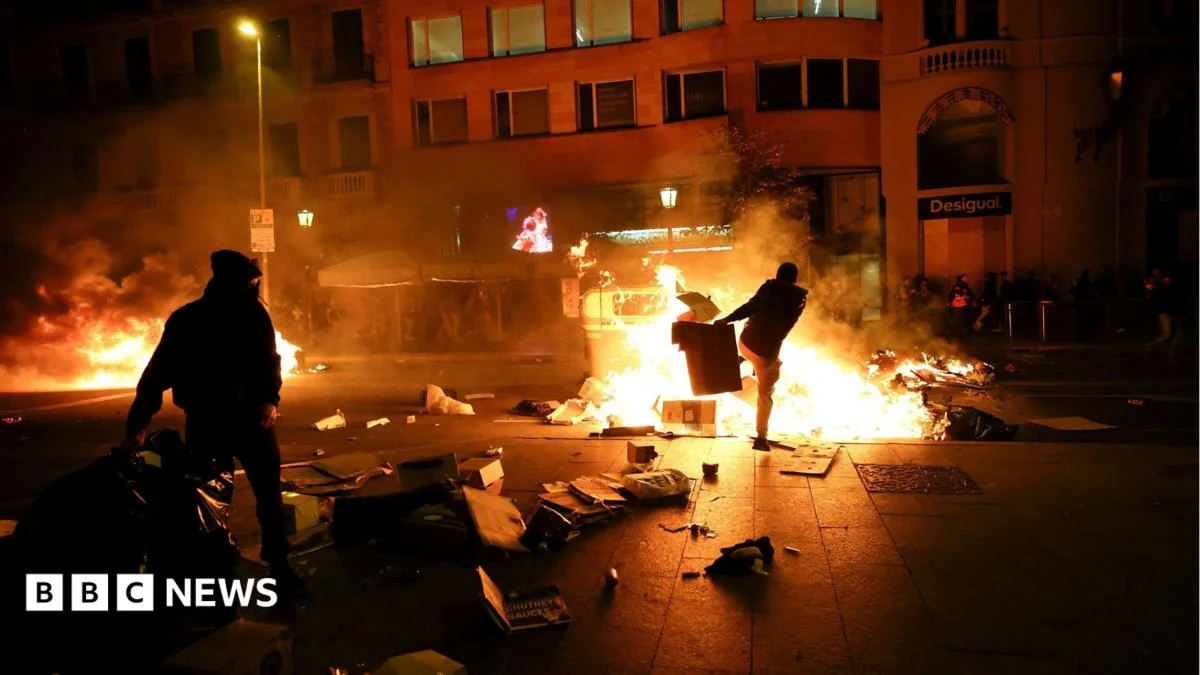
In the heart of Barcelona, the strike’s message of protest took a volatile turn as clashes erupted between groups of masked men and law enforcement. Footage emerged of individuals setting fire to rubbish bins and smashing shop windows, prompting police to respond with tear gas. The city, usually a vibrant hub of activity, bore witness to scenes of unrest, with iconic areas like the Passeig de Gràcia, near the Plaça de Catalunya, becoming hotspots for disturbances. Small fires flickered in the streets as bins were torched, and local media reported instances of fireworks being directed at police, as well as looting of businesses, including the Lego store. Protesters were also observed attempting to gain entry to the Apple Store, highlighting the widespread anger directed at both corporate entities and the perceived inaction of authorities. The interior ministry confirmed dozens of arrests across the country for various incidents, with reports also indicating attacks on estate agency offices, a clear target for those frustrated by the housing market.
Madrid also saw substantial participation, with an estimated 120,000 people joining a demonstration in the capital. A protester in Madrid, speaking to Reuters news agency, declared the city "completely brought to a standstill," emphasizing the widespread support for the strike despite inclement weather. "Everyone’s out there, despite the rainy weather; everyone’s out on the streets," they stated, capturing the collective spirit of the day.
The grievances fueling this widespread industrial action are deeply rooted in the escalating cost of housing and the general economic squeeze faced by ordinary Spaniards. Olga Domingo, a 37-year-old teacher participating in the strike, articulated the frustration: "The government ‘keep making cuts’ and ‘the housing situation is outrageous. The current cost of living compared to wages is completely unsustainable’." This sentiment resonates with a growing segment of the population struggling to make ends meet.
The catalyst for the strike, according to many participants, was the recent eviction of 87-year-old Maricarmen Abascal from her Madrid flat, a home she had occupied for seven decades. Her subsequent death in hospital weeks later served as a poignant symbol of the human cost of the housing crisis. The stark reality of Spain’s rental market is underscored by recent data. In October, the average monthly rent for a modest 50 square meter apartment in Madrid stood at €1,170 ($1,300; £1,000). This figure, when contrasted with Spain’s average gross monthly salary of approximately €2,460, reveals a grim picture. Rent alone consumes nearly half of the average gross salary, far exceeding the 30% affordability threshold recommended by housing experts and public institutions. This unsustainable financial burden leaves little room for other essential expenses such as food, utilities, and transportation.
The strike has also become a focal point in the political landscape, with Spain on the cusp of parliamentary elections. The government, led by Prime Minister Pedro Sánchez, has framed the strike as a legitimate expression of workers’ rights and a response to genuine economic hardship. UGT leader Pepe Álvarez hailed the strike as a success with "massive" participation, while Unai Sordo of CC.OO described the turnout as "very significant." Sánchez himself defended the right to strike, stating, "What is nonsense is to question the rights of workers to strike."
Conversely, the conservative People’s Party (PP), currently leading in opinion polls, has accused the government of exploiting the strike for electoral advantage. PP leader Alberto Núñez Feijóo derided the strike as "nonsense," labelling the unions "mafia" and "trash." Party spokesman Miguel Tellado echoed this sentiment, accusing the government of using the strike to warn voters against a potential right-wing administration. This political maneuvering highlights the high stakes of the upcoming election, with the strike serving as a barometer of public sentiment.
Gonzalo Álvarez, a 27-year-old sales professional volunteering for a housing union, shared his personal struggles, which mirror those of many young Spaniards. He and his girlfriend, a dental hygienist, rent a one-bedroom flat in Madrid’s southern Arganzuela district for €1,000 per month, meaning each spends approximately half their salary on housing before other bills. "It’s absolutely crazy… with the food, with the electricity, with the water, with gas," he lamented. The prospect of homeownership remains an unattainable dream for him and his generation. "You have to collect an insane amount of money to be able to buy a house. So with these salaries, it’s impossible," he stated, adding that with current rent and purchase prices, buying a property is "completely impossible."
The business community has also weighed in on the strike, with mixed reactions. Miguel Garrido, vice-president of the CEOE, Spain’s largest business association, criticized the strike, arguing that businesses have minimal influence over housing prices. He characterized the strike as "not for labour-related reasons, but rather for political ones, and it is closely linked to the early calling of elections." This perspective suggests a belief that the strike’s timing and objectives are strategically aligned with the impending electoral contest.
The scale of public support for the strike is being closely watched as an indicator of discontent ahead of the elections. Another reliable measure of strike participation is the demand for electricity in Spain’s industrial sector. Data from operator Red Eléctrica revealed a 7.5% decrease in power usage during the early hours of Wednesday, a significant drop, though less pronounced than the over 15% decline observed during the general strike 14 years ago. This indicates a substantial, though perhaps not total, shutdown of industrial activity.
The strike, while disruptive, has undeniably brought the critical issues of housing affordability and the cost of living to the forefront of national discourse. The scenes of unrest in Barcelona serve as a stark reminder of the deep-seated frustrations that have been simmering beneath the surface. As Spain heads towards the polls, the echoes of this general strike and the grievances it represents will undoubtedly resonate with voters, shaping the political landscape for years to come. The stark contrast between the government’s defense of workers’ rights and the opposition’s accusations of political opportunism paints a complex picture of a nation grappling with economic anxieties and political polarization. The future direction of Spain’s social and economic policies will hinge on the outcome of the upcoming elections, with the demands articulated by the striking workers and protesters likely to remain a central theme.
