
 By admin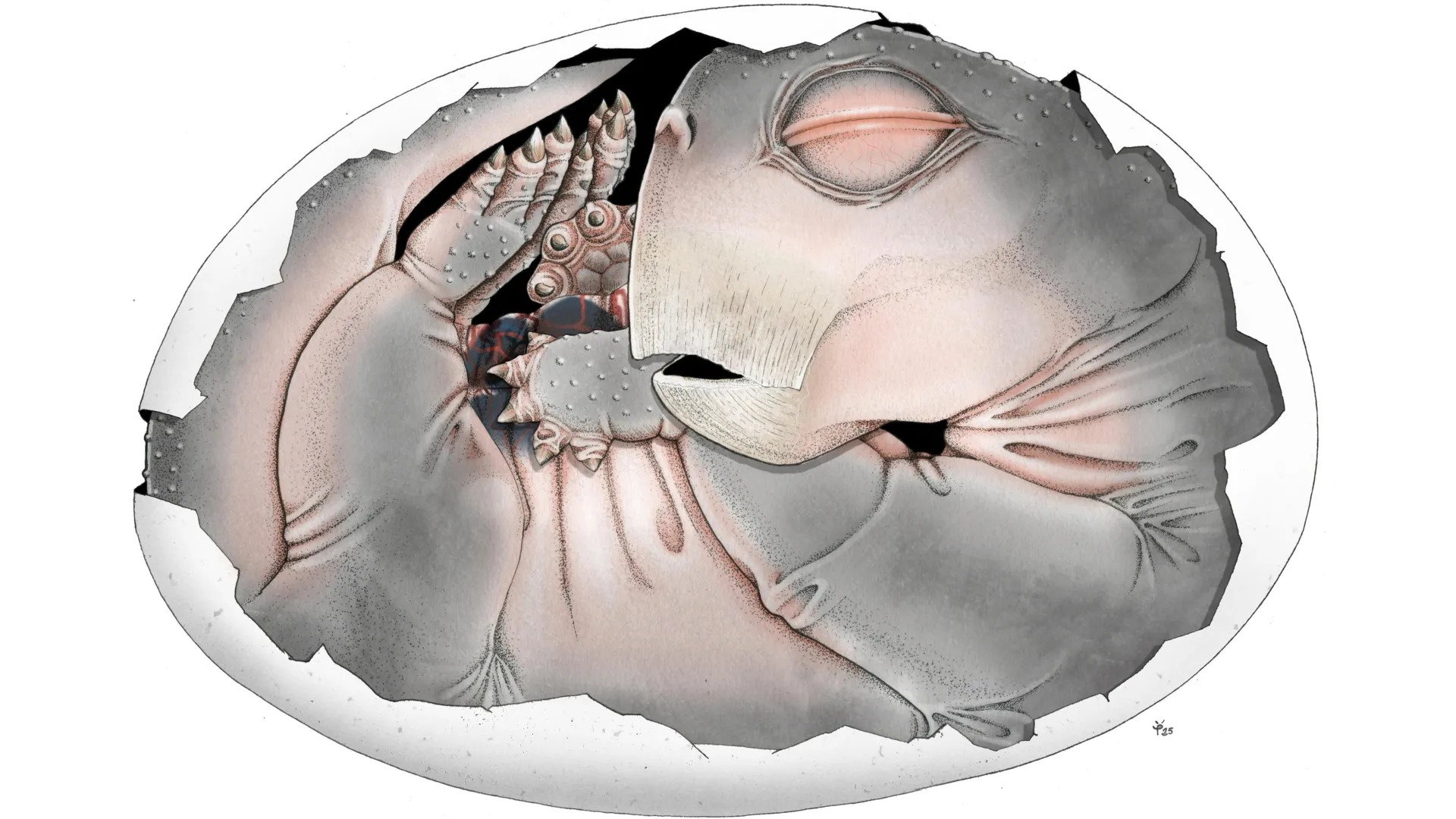
New research, meticulously detailed in the prestigious scientific journal PLOS ONE, unveils a groundbreaking discovery that fundamentally reshapes our understanding of this ancient animal and the evolutionary trajectory of early mammals. An international consortium of scientists, spearheaded by Professor Julien Benoit and Professor Jennifer Botha from the Evolutionary Studies Institute at the University of the Witwatersrand, South Africa, and Dr. Vincent Fernandez from ESRF—The European Synchrotron in France, has identified an incredibly preserved egg containing a Lystrosaurus embryo, dating back roughly 250 million years. This extraordinary fossil represents the first definitively confirmed egg ever found from a synapsid, the lineage that includes mammals and their direct ancestors, thereby providing a definitive answer to a long-standing and hotly debated question in paleontological and evolutionary biology: Did the ancestors of mammals lay eggs? The resounding answer, now unequivocally supported by direct fossil evidence, is yes.
The Elusive Nature of Ancient Eggs: Why This Find is Unprecedented
The scarcity of fossilized eggs from early mammal ancestors has long been a perplexing anomaly, especially when contrasted with the abundant fossil record of dinosaur eggs. The research team posits a compelling explanation for this rarity: Lystrosaurus eggs were likely soft-shelled. Unlike the hard, mineralized, and often robust eggs of dinosaurs, which possess calcified shells that readily resist decay and fossilize with relative ease, soft-shelled eggs are highly susceptible to rapid decomposition. Their flexible, leathery casings, similar to those of many modern reptiles and the monotreme mammals (echidnas and platypuses), lack the rigid mineral structure necessary for routine preservation. This inherent fragility means that, under most geological conditions, these delicate eggs would have decayed before any opportunity for fossilization could arise, rendering this particular discovery exceptionally rare and scientifically invaluable. The exceptional circumstances that led to the preservation of this Lystrosaurus embryo within its egg highlight the extraordinary confluence of specific environmental conditions required for such a delicate fossil to endure for hundreds of millions of years.
The significance of this discovery extends far beyond merely confirming the oviparous (egg-laying) nature of these ancient creatures. It offers profound insights into their developmental biology, reproductive strategies, and ultimately, their capacity for survival in a world teetering on the brink of ecological collapse.
Professor Botha recounts the genesis of this pivotal discovery: "This fossil was unearthed during a field excursion I led in 2008, nearly 17 years ago. My preparator and truly exceptional fossil finder, John Nyaphuli, with his keen eye, first identified a small nodule that initially revealed only tiny flecks of bone. As he meticulously prepared the specimen, it became increasingly clear that it was a perfectly curled-up Lystrosaurus hatchling. I suspected even then that it had died within the egg, but at that time, we simply didn’t possess the advanced technological capabilities to definitively confirm such a delicate hypothesis." This initial hunch, born from years of field experience and intuition, would patiently await the advent of cutting-edge imaging techniques to be fully validated.
Unlocking Secrets with Advanced Imaging: A Synchrotron Revelation
The crucial breakthrough came with the application of modern synchrotron X-ray computed tomography (CT) scanning. The European Synchrotron Radiation Facility (ESRF) in Grenoble, France, is one of the world’s most powerful synchrotron light sources, capable of generating incredibly intense, coherent X-rays. These powerful X-rays allowed researchers to non-destructively examine the fossil’s internal structure with unparalleled resolution and detail. Unlike conventional medical CT scans, synchrotron X-ray CT can differentiate between extremely subtle density variations within a specimen, making it ideal for visualizing delicate bone structures, soft tissues, and even remnants of eggshell that would be invisible using other methods.
Dr. Fernandez, a specialist in advanced imaging techniques, described the moment of revelation as particularly exciting: "Understanding the reproductive biology of mammal ancestors has been a long-lasting enigma, and this fossil provides a key, foundational piece to this complex puzzle. It was absolutely essential that we scanned the fossil just right to capture the level of detail needed to resolve such tiny, delicate bones without causing any damage to this irreplaceable specimen." The precision afforded by synchrotron technology allowed the team to peer inside the ancient nodule, revealing a hidden world of biological detail that had been locked away for a quarter of a billion years.
The high-resolution scans unveiled a critical morphological clue within the embryo’s anatomy. "When I observed the incomplete mandibular symphysis, I was genuinely excited," Professor Benoit explains. The mandible, or lower jaw, of many vertebrates is initially formed from two separate halves that must fuse together at the symphysis before the animal can effectively feed. "The fact that this fusion had not yet occurred in the Lystrosaurus embryo unequivocally demonstrates that the individual would have been entirely incapable of feeding itself," Benoit elaborates. This crucial detail provided irrefutable evidence that the embryo was indeed at a pre-hatching stage of development when it perished, confirming Professor Botha’s original suspicion and definitively establishing the presence of an egg.
Large Eggs and Precocial Young: A Blueprint for Survival
The comprehensive study further illuminates the reproductive strategy of Lystrosaurus. The findings indicate that these ancient synapsids produced relatively large eggs compared to their overall body size. In the biological realm, larger eggs typically contain a greater volume of yolk, which serves as a rich nutrient reserve. This increased yolk supply enables embryos to undergo a more extensive period of internal development, reaching a more advanced stage before hatching, thereby reducing or even eliminating the immediate need for intensive parental care post-hatching. This suggests that, unlike modern mammals, Lystrosaurus did not provision its young with milk, further underscoring its ancestral, non-mammalian reproductive traits, even as it stood on the direct lineage leading to mammals.
The relatively large size of the eggs also conferred another significant ecological advantage: enhanced resistance to desiccation. In the arid and climatically unstable world that characterized the Early Triassic period following the mass extinction, maintaining sufficient moisture for embryonic development would have been absolutely critical. Larger eggs, with their greater volume-to-surface-area ratio, are inherently better at retaining water, offering a crucial buffer against the prolonged droughts and fluctuating environmental conditions of the post-extinction landscape.
The combined evidence from the embryo’s developmental stage and the characteristics of the egg points strongly towards Lystrosaurus hatchlings being precocial. Precocial young are born at an advanced stage of development, meaning they are relatively mature and mobile from birth, capable of self-feeding, evading predators, and generally navigating their environment with a degree of independence shortly after hatching. This contrasts sharply with altricial young, which are born helpless, blind, and naked, requiring extensive parental care for an extended period. For Lystrosaurus, a species striving to repopulate a devastated world, this rapid development and early independence would have been a profoundly advantageous evolutionary strategy. It implies quick growth, rapid maturation, and the capacity for early reproduction—a highly effective mechanism for accelerating population recovery and adaptation in a volatile and resource-scarce environment. In essence, Lystrosaurus thrived by employing a strategy of fast growth and early reproduction, a biological blueprint for success in the wake of planetary catastrophe.
A Winning Strategy in a Harsh, Unforgiving World
The ecological backdrop against which Lystrosaurus flourished was one of unparalleled harshness. The End-Permian extinction event had not only wiped out most life but had also fundamentally destabilized Earth’s ecosystems. The Early Triassic was characterized by extreme global warming, ocean anoxia (lack of oxygen), ocean acidification, acid rain, and vast "coal gaps" indicating the widespread collapse of forest ecosystems. Food webs were drastically simplified, and competition for resources would have been fierce. In these challenging and unpredictable conditions, the reproductive strategy of Lystrosaurus proved to be exceptionally effective. Its ability to lay large, yolk-rich, desiccation-resistant eggs, coupled with the production of precocial young that could quickly become self-sufficient, allowed it to rapidly colonize and dominate the newly available ecological niches. This discovery provides the first direct evidence of how mammal ancestors reproduced and, critically, helps to explain the remarkable ecological success and widespread distribution of Lystrosaurus in the immediate aftermath of Earth’s most devastating mass extinction.
As scientists continue to unravel the mysteries of ancient life and past extinction events, a compelling and recurring pattern is emerging. Survival during periods of extreme global crises is not merely a matter of brute strength or size, but critically hinges on adaptability, inherent resilience, and crucially, an effective reproductive strategy. Lystrosaurus appears to have masterfully combined all three of these attributes, making it a powerful case study for understanding how life perseveres and evolves in the face of existential threats.
Perspectives from the Researchers: A Milestone in Paleontology
Professor Julien Benoit eloquently encapsulates the profound impact of this research: "This research is immensely important because it provides the first direct evidence that mammal ancestors, such as Lystrosaurus, definitively laid eggs, finally resolving a long-standing question about the origins of mammalian reproduction. Beyond this fundamental insight, it reveals how specific reproductive strategies can critically shape survival in extreme environments. By producing large, yolk-rich eggs and precocial young, Lystrosaurus was uniquely able to thrive in the harsh, unpredictable conditions that followed the End-Permian mass extinction. In a modern context, this work is highly impactful because it offers a deep-time perspective on resilience and adaptability in the face of rapid climate change and ongoing ecological crises. Understanding how past organisms survived global upheaval helps scientists better predict how species today might respond to current environmental stress, making this discovery not just a breakthrough in paleontology, but also highly relevant to current biodiversity and climate challenges." He further shared his personal experience: "The opportunity to work at the European Synchrotron Radiation Facility alongside dedicated beamline scientists was an unforgettable part of this scientific journey. The cutting-edge data we generated there allowed us to ‘see’ inside the fossil in extraordinary detail, ultimately revealing that the embryo was still at a pre-hatching stage. That moment, when all the pieces of the puzzle finally came together, was incredibly rewarding and a testament to collaborative science."
Professor Jennifer Botha adds her perspective, emphasizing the collaborative and historical context of the find: "What makes this work especially exciting is that we were able to quite literally follow in John Nyaphuli’s footsteps, returning to a specimen he discovered nearly two decades ago and finally solving the puzzle he so astutely uncovered. At the time of the initial discovery, all we had was a beautifully curled embryo, but no preserved eggshell to definitively prove it had died within an egg. Using modern imaging techniques, we were able to answer that question with absolute certainty." She concludes, "It is also thrilling because this discovery breaks entirely new ground in South African paleontology. For over 150 years of intensive paleontological exploration in this region, no fossil had ever been conclusively identified as a therapsid egg. This is the first time we can say, with absolute confidence, that mammal ancestors like Lystrosaurus laid eggs, making it a true milestone in the field and a testament to the ongoing power of scientific inquiry and technological advancement."
