
 By admin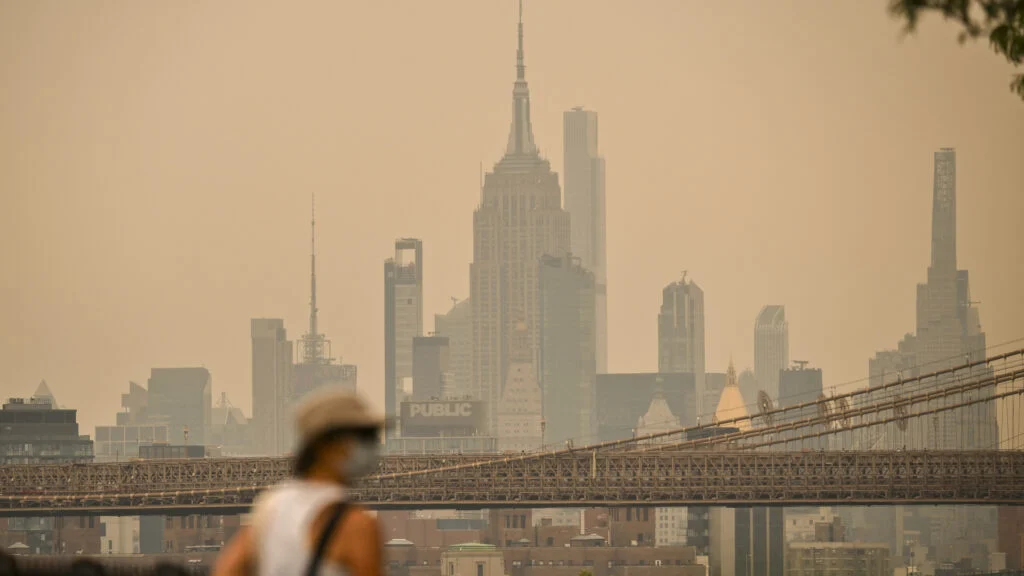
As wildfires incinerate millions of acres across the Canadian wilderness, a thick, acrid haze has migrated southward, enveloping major metropolitan hubs across the United States in a ghostly, orange-tinted shroud. This environmental catastrophe, which has become a recurring nightmare in the mid-2020s, recently sent air quality indices into the "hazardous" range, forcing millions of Americans to retreat indoors. In New York City, the impact was immediate and measurable: emergency room visits for asthma exacerbations surged by a staggering 31% by the end of the first day of heavy smoke inhalation. This surge in respiratory distress arrived at a moment of extreme vulnerability, as the city was already grappling with its second major heat wave of the season, creating a "compounding crisis" where heat and smoke acted as a dual assault on the human body.
The current state of the atmosphere represents more than just a bad season for forest fires; it is a visceral manifestation of the cyclical and compounding relationship between fossil fuel combustion, a rapidly warming global climate, and the resulting natural disasters that loop back to harm human health. For many observers, the sight of a darkened midday sun and the smell of burning timber in urban canyons feel like an admission of defeat—proof that the climate crisis has shifted from a future threat to an insurmountable present reality. However, a deeper look at environmental history suggests that these moments of acute public health crisis are often the catalysts for the most profound legislative and societal shifts. As public health experts Rebecca Florsheim, Neil Vora, Peter J. Winch, and Connie Hoe argue, we must never let a health-related environmental crisis go to waste, for history teaches us that the most significant protections are often born from the ashes of tragedy.
To understand the potential for change today, one must look back to the post-World War II era, a time when industrialized cities faced a different but equally suffocating environmental challenge: rampant air pollution. Long before "global warming" was a household term, the air in cities like Pittsburgh, London, and Los Angeles was thick with the detritus of progress. In the 1940s and 50s, regulations for air quality were virtually nonexistent. Urban life was characterized by the constant hum of coal-fired power plants, the proliferation of automobiles with zero emission controls, and the common practice of incinerating municipal garbage within city limits rather than transporting it to distant landfills. The result was a constant layer of soot and sediment that blackened buildings and coated windowsills, a phenomenon so ubiquitous it was largely accepted as the necessary price of economic growth.
Medical science at the time was beginning to identify the specific culprits in this toxic cocktail—substances we now categorize as "criteria air pollutants" or "classical air pollutants." These include carbon monoxide, particulate matter (PM), ground-level ozone, sulfur dioxide, and nitrogen dioxide. Each of these pollutants carries a unique chemical signature and a specific set of health risks. Particulate matter, especially the fine particles known as PM2.5, can bypass the body’s natural defenses in the nose and throat, lodging deep in the lungs and even entering the bloodstream to cause systemic inflammation. Sulfur dioxide, a byproduct of coal combustion, is a potent respiratory irritant that can trigger severe asthma attacks and permanent lung damage. Despite the mounting evidence of these dangers, effective federal regulation remained elusive for decades, stymied by industrial lobbying and a lack of public urgency—until the smog became lethal.
The global tipping point for air quality regulation arrived when "stagnant atmospheric conditions" turned routine pollution into localized death traps. The most infamous of these was the Great Smog of London in December 1952. A period of cold weather, combined with an anticyclone and windless conditions, collected airborne pollutants—mostly from use of coal—to form a thick layer of smog over the city. It lasted for five days, reduced visibility to a few yards, and stopped all public transport except the London Underground. More importantly, it killed. While initial reports suggested 4,000 deaths, modern epidemiological reviews estimate that the event caused upwards of 12,000 premature deaths and tens of thousands of chronic illnesses. The sheer scale of the horror in London directly led to the passage of the Clean Air Act of 1956, a landmark piece of legislation that curtailed industrial emissions and introduced "smoke-control areas" where only smokeless fuels could be burnt.
A similar, though less widely remembered, tragedy occurred in New York City in November 1966. During the Thanksgiving holiday weekend, a massive high-pressure system trapped a layer of warm air over the city, preventing the escape of pollutants from the city’s thousands of apartment house incinerators and power plants. As levels of sulfur dioxide and carbon monoxide reached record highs, the city took the unprecedented step of using television, radio, and print media to issue emergency messages. Citizens were urged to stop using their cars and to keep their thermostats at 60 degrees to reduce energy consumption. Those with preexisting heart or lung conditions were told to remain indoors. As municipal incinerators were shut down to mitigate the smog, garbage began to pile up in the streets, creating a dual image of urban decay and environmental collapse. By the time the weather pattern broke, approximately 200 people had died from the smog’s inflammatory effects on their cardiovascular and respiratory systems.
The 1966 NYC smog event served as a catalyst for the American environmental movement. Within a month, the New York City administrative code was overhauled to expand air pollution surveillance and aggressively stifle emissions. The national media coverage of New Yorkers gasping for breath resonated with urbanites across the country who were experiencing their own versions of the crisis. Just two months later, in January 1967, President Lyndon B. Johnson delivered his "Protecting Our National Heritage" message to Congress. He explicitly cited the New York smog as a warning, advocating for the 1967 Air Quality Act. This was followed by the even more robust Clean Air Act of 1970, which established National Ambient Air Quality Standards (NAAQS). The impact of these laws was transformative. By 2020, collective levels of the six most common criteria pollutants had dropped by 78% compared to 1970 levels. In some cases, individual pollutants like lead and sulfur dioxide dropped by more than 90%. Today, local industrial emissions in the U.S. no longer cause the kind of deadly smog events that were common fifty years ago.
However, as we solve the problem of local "criteria" pollutants, we are faced with the broader, more complex challenge of greenhouse gases. While criteria pollutants and greenhouse gases like carbon dioxide and methane often originate from the same source—fossil fuel combustion—they impact human health through different pathways. Criteria pollutants are directly toxic; they cause immediate sinus inflammation, heart disease, and cancer because of their physical and chemical interactions with human tissue. Greenhouse gases, by contrast, act as a "blanket" that warms the planet. Their health impacts are often indirect but no less deadly. A warming climate increases the frequency of extreme weather events, lengthens the season for allergen-inducing pollen, expands the range of infectious disease vectors like ticks and mosquitoes, and, as we are seeing now, creates the perfect conditions for mega-wildfires that send smoke across entire continents.
More than half a century after the first Clean Air Acts, the climate crisis has moved from an abstract scientific projection to a tangible, physical experience for hundreds of millions of people. Much like the smog events of the 1950s and 60s, the current era of "smoke seasons" and "heat domes" is making the invisible visible. The haze from Canada descending on New York, Chicago, and D.C. is a physical manifestation of a changing climate that can no longer be ignored or debated away. This "palpability" of the crisis is reflected in shifting public opinion. Data from the Pew Research Center indicates that 67% of individuals across 25 surveyed countries now view climate change as a major threat to their nations. Furthermore, over 80% of those who personally experience extreme weather recognize climate change as a contributing factor. Research consistently shows that those who have endured the trauma of a natural disaster or a health-related environmental crisis are more than twice as likely to view climate change as an urgent crisis compared to those who have not.
The path forward requires a strategic shift in how we communicate the climate emergency. While data regarding atmospheric carbon parts per million or global mean temperature shifts are vital for scientists, they often fail to move the needle for the general public. To build a mandate for the massive structural changes required to reach net-zero emissions, we must center the conversation on human health. Highlighting the immediate health risks and the massive economic costs of medical care related to extreme weather provides a bridge to engage those who may be skeptical of broader climate science. When people realize that climate policy is not just about "saving the planet" in an abstract sense, but about preventing their children from developing asthma or protecting their elderly parents from heatstroke, the political calculus changes.
We stand at a crossroads similar to that of 1952 or 1966. We can view the current spate of wildfires and heat waves as a sign of inevitable decline, or we can use them as the "tipping point" for a new era of environmental stewardship. Every extreme weather event must be linked clearly and unapologetically to its root cause in public discourse. By emphasizing the direct connection between fossil fuel use, a warming climate, and the resulting health crises, we can galvinize the public demand necessary for legislative action. If we follow the blueprint provided by the public health pioneers of the mid-20th century, this moment in history will be remembered not just for its disasters, but for how we used those disasters to secure a breathable, sustainable future for the generations to come. The science is clear, the history is written, and the health of the global population hangs in the balance.
