
 By Titik Puspa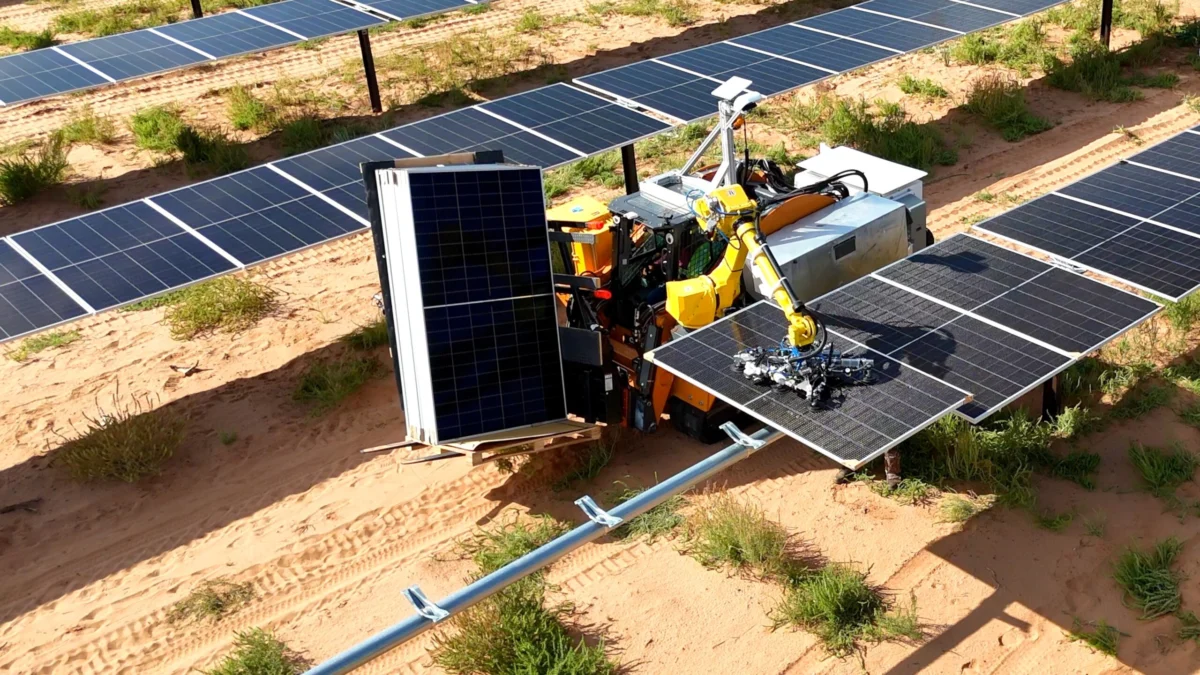
The global imperative to combat climate change and achieve energy independence has ignited an unprecedented surge in solar energy deployment. From sprawling solar farms to distributed rooftop installations, nations and corporations are aggressively investing in photovoltaic technology and associated battery storage solutions. This ambitious build-out, however, is encountering a critical bottleneck: a significant shortage of skilled labor required for the installation of these complex systems. While the prospect of robotic assistance has long been considered, traditional industrial robots have historically faltered in the dynamic and unpredictable environments characteristic of construction sites. Yet, the advent of sophisticated artificial intelligence models is poised to fundamentally alter this landscape, ushering in an era where robots can finally navigate and operate effectively in these challenging terrains.
This transformative potential is precisely what drives Gritt, a pioneering startup founded by Carnegie Mellon-trained roboticists Puneet Puri (CEO) and Vishal Dugar (CTO). Emerging from stealth mode, Gritt announced a substantial $26 million Series A funding round, spearheaded by Obvious Ventures, with significant contributions from Union Square Ventures and Active Impact Investment. This latest injection of capital propels Gritt’s total funding to $34 million, building upon a robust seed round previously supported by prominent investors including First Round Capital, Climactic, Congruent Ventures, and VSC Ventures. The company’s overarching mission is to "help civilization build infrastructure faster," a bold declaration that underscores its ambition to accelerate the pace of construction projects through intelligent automation.
"Our core belief is that to truly expedite construction," Puri articulated in an interview with TechCrunch, "we require an intelligence capable of operating within the unpredictable outdoor environments of construction sites. Crucially, this intelligence must be generalizable enough to adapt and perform across a wide spectrum of these varied settings." This philosophy directly addresses the inherent limitations of rigid automation systems that struggle with the inherent messiness and variability of real-world construction.
Gritt’s innovative approach eschews the resource-intensive endeavor of developing proprietary robots from the ground up. Instead, the company strategically leverages readily available, off-the-shelf hardware. This includes rented skidders and sophisticated robotic arms manufactured by industry leaders such as Kawasaki. Gritt’s genius lies in integrating these components into intelligent platforms orchestrated by its advanced AI models. The initial application of Gritt’s systems is focused on the critical task of unloading large, fragile solar panels. These panels are then transported to their designated metal frames, where they are precisely positioned with sub-millimeter accuracy, facilitating seamless and efficient fastening by human workers. This targeted application not only addresses a labor-intensive aspect of solar installation but also highlights the potential for AI to enhance precision and reduce errors in a process where accuracy is paramount.
Andrew Beebe, a partner at Obvious Ventures and the lead investor in Gritt’s Series A round, drew a compelling parallel to emphasize the unique value proposition of Gritt’s founders. "There are individuals who once built rockets for space exploration, with virtually unlimited budgets for even the smallest components," Beebe observed. "And then there are those who understand the profound importance of scaling dirty, dull, and dangerous jobs. These founders are firmly in the latter category. They possess a rare blend of technical acumen, advanced AI capabilities, and machine vision expertise necessary to make this vision a reality." This perspective highlights the pragmatic and impactful nature of Gritt’s mission, focusing on solving real-world industrial challenges.
Currently, Gritt has two of its intelligent systems deployed in active field operations. The data meticulously collected by these systems is instrumental in continuously refining and improving their operational behaviors. Puri shared a striking statistic: while a typical eight-person crew can install approximately 800 solar panels per day, the same crew working in conjunction with Gritt’s robotic systems can achieve an output of 3,000 to 4,000 panels daily. This exponential increase in productivity demonstrates the significant impact of Gritt’s technology on project timelines and efficiency.
The company’s rapid progress is further evidenced by its impressive project pipeline. Gritt is currently contracted to facilitate the installation of 2.8 gigawatts of solar panels within the next 18 months. Its clientele includes three of the top ten solar power construction companies in the United States, a testament to the trust and confidence placed in Gritt’s capabilities by industry leaders. Looking ahead, Gritt aims to have 48 of its systems operational within the next six months, signaling an aggressive scaling strategy to meet burgeoning demand.
A Gritt customer, who requested anonymity due to competitive sensitivities, expressed strong enthusiasm for the system’s potential to revolutionize their operations. The customer anticipates significant advantages in attracting and retaining workers for remote site installations, where labor recruitment is often challenging. Furthermore, the system is expected to contribute to a substantial reduction in workplace injuries, as it alleviates the need for workers to repeatedly lift heavy, 100-pound solar panels overhead. This focus on worker safety and well-being adds another critical dimension to Gritt’s value proposition, aligning technological advancement with human welfare.
Gritt operates within a competitive landscape that includes other companies developing automated solar panel installation solutions. Notable competitors include Luminous Robotics and Cosmic, as well as China’s Trinabot. A key differentiator for Gritt lies in its strategic choice to focus on integrating off-the-shelf hardware rather than developing bespoke robotic platforms. This lean approach to hardware acquisition is anticipated to foster faster growth and a more cost-effective operational structure, particularly as demand for solar infrastructure continues to escalate globally. The ability to adapt and integrate with existing robotic arms and vehicles offers Gritt a significant advantage in terms of agility and capital efficiency.
Gritt’s long-term vision extends far beyond the initial task of panel unloading and positioning. The company is actively working to expand its system’s manipulation capabilities to include fastening the solar panels, drilling mounting posts, and even constructing the very racks upon which the panels are installed. Looking even further ahead, Gritt intends to venture into other labor-intensive construction tasks that are ripe for automation, such as the intricate process of tying rebar before concrete is poured. This ambitious roadmap highlights Gritt’s aspiration to become a comprehensive solution provider for a wide array of construction challenges.
The rapid advancement and widespread availability of new AI models have been the primary enablers of Gritt’s ambitious vision. Puri explained that while developing specialized systems for single tasks might have been feasible to some extent five years ago, the current generation of AI is democratizing generalization. The same underlying software pipeline can now be reused and iteratively improved across a diverse range of tasks. As a striking illustration of this progress, Puri noted that training the system to stack cinder blocks previously took weeks, whereas a comparable demonstration involving rebar tying required only a single day using the identical software. This exponential reduction in training time signifies a paradigm shift in the speed and efficiency of robotic system development.
However, Gritt’s aspirations do not end with task-specific training. The founders firmly believe that the sophisticated suite of sensors and the advanced intelligence integrated into their systems can offer benefits far exceeding simple panel installation. They envision their systems becoming invaluable tools for enhancing site management and decision-making processes. For instance, a Gritt system could detect an open trench during an approaching storm and promptly alert workers to cover it, thereby preventing potential damage to components. Similarly, it could flag missing inventory on-site, streamlining logistics and preventing costly delays.
"Gritt is evolving into a layer of physical AI," Puri explained, "capable of performing dexterous, labor-intensive tasks while simultaneously empowering better on-site decision-making. This dual functionality positions Gritt not just as an automation tool, but as an intelligent partner on the construction site, enhancing safety, efficiency, and productivity." This holistic view of the technology’s potential underscores Gritt’s commitment to creating a truly transformative impact on the construction industry and, by extension, on the acceleration of critical infrastructure development.
