
 By Rifan Muazin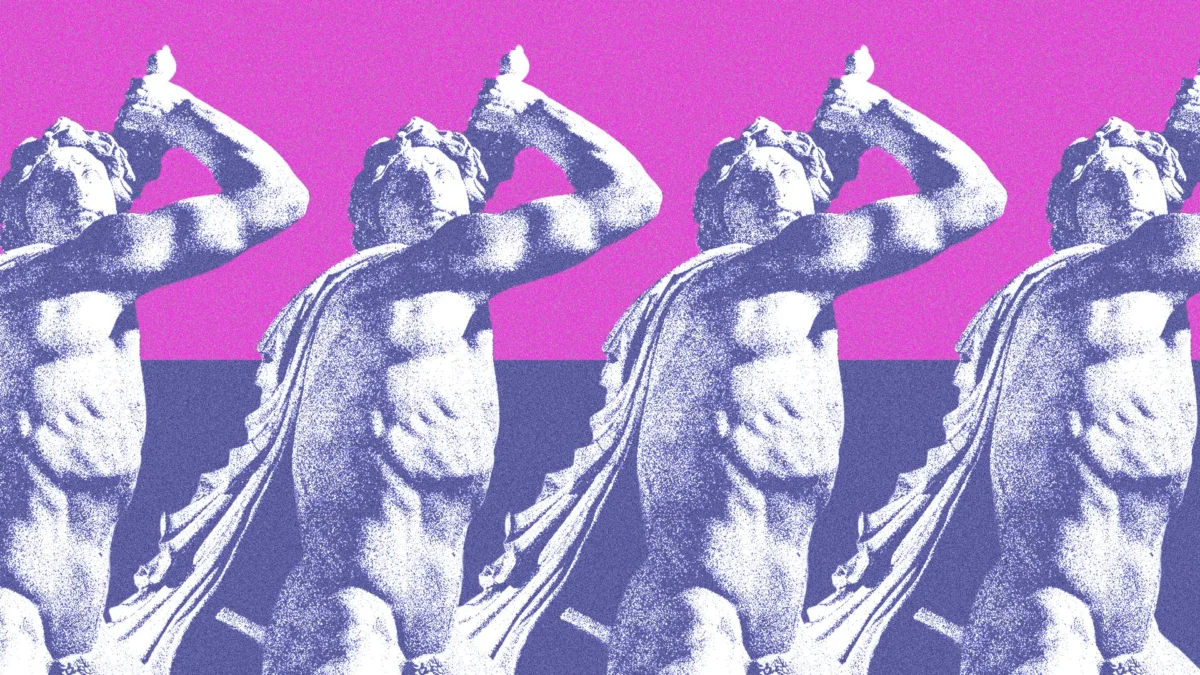
It turns out that ancient Greek men were just as into looking good as we are, and were confronted with nearly as many depictions of unattainable male bodies as the average Instagram feed. The "heroic" body was not merely a matter of vanity; it was a civic and spiritual requirement. To understand the world Nolan has attempted to recreate, one must understand the Greek concept of Kalokagathia—the idea that a beautiful body was the outward sign of a beautiful soul. In this classical world, fitness was heavy on cardio, grooming was a deeply social act, and the presence of a beard was more than a style choice—it was a legal and social status symbol.
The Masculine Ideal: Physicality as Morality
In the ancient Greek mind, the concept of masculinity was inextricably bound up with control. This was not merely the control of a king over his subjects or a general over his troops, but more importantly, the control over oneself. There was much less of a separation than we have today between mental capacity, physical capacity, and moral character. If you were a man of high status, your ability to train and develop your body was seen as a direct expression of your inner strength and discipline. To be "out of shape" was not just a health concern; it was a moral failing, suggesting a lack of the "thumos" (spiritedness) and "sophrosyne" (self-control) required of a leader.
Physical beauty was also viewed as a bridge between the human and the divine. When we look at the kouroi—those stiff, archaic stone sculptures of young men—we see musculature that is often picked out with unnatural precision. These statues were not meant to be realistic portraits but idealized representations. By honing the human body toward perfection, the Greeks believed they were paying respect to the gods, creating a vessel that was worthy of divine favor. In The Odyssey, when the goddess Athena enhances Odysseus’s appearance, she isn’t just giving him a makeover; she is restoring his divine-right status as a hero.
The Physique: Functional Strength vs. Hollywood "Yoked"
In Nolan’s film, Matt Damon’s Odysseus is properly yoked, possessing the hyper-defined, low-body-fat physique of a standard Hollywood action hero. While the Greeks certainly valued muscle, their version of "fit" was grounded in functionality. The athletics of the time—the pentathlon, consisting of running, long jump, discus, javelin, and wrestling—produced a body that was versatile rather than specialized for aesthetics.
There was a heavy emphasis on running, particularly sprints, which would have produced powerful legs and lean torsos. However, the Greeks also understood and depicted different body types for different stages of life. Younger men were expected to be slimmer and more lithe, while men in their prime, like Odysseus, were depicted with broader shoulders and more developed, rugged musculature. While a modern bodybuilder might look "unnatural" to an ancient Greek, the sheer level of muscularity seen in Damon’s performance isn’t entirely historically inaccurate for a man whose life was defined by war and survival.
Even in the ancient world, people were confronted with unattainable bodies. Poor young Greek boys, walking through the agora, would have looked at the statues of Polykleitos or Lysippos and felt the same pangs of inadequacy that a teenager feels today looking at a filtered Instagram feed. For the nobleman, exercise was worked into the very fabric of daily life. The palaestra, or public exercise ground, was the social hub of the city. Unlike the modern "monastic" gym culture, where one might wear noise-canceling headphones to avoid interaction, the Greek workout was an essentially social act. It was where politics were discussed, philosophy was debated, and social bonds were forged—all while covered in dust and sweat.
The Social Ritual of Grooming
One of the most striking aspects of The Odyssey is the constant cycle of bathing and anointing. In the poem, whenever a guest arrives at a house, the first thing mentioned is that they are bathed, rubbed with oil, and dressed. To a modern audience, this level of intimate service might seem odd or even emasculating, but in the Homeric world, it was the ultimate symbol of xenia (hospitality). It was a social act that integrated the stranger into the household.
The Greeks were obsessed with cleanliness and scent, far more than popular "gritty" historical dramas often suggest. High-status men were not dirty; they were exfoliated. After exercise, they used a strigil—a curved copper instrument—to scrape off the mixture of sweat, dust, and oil from their skin. This was followed by the application of expensive, perfumed oils. Far from being seen as "unmanly," this level of grooming was a necessary component of masculinity. In the text of The Odyssey, there are actually more scenes of men grooming themselves than of women doing so. A man who did not care for his body was a man who had given up on his social standing.
The Symbolism of the Beard
In the film, the beard is a constant. In reality, the ancient Greek relationship with facial hair was deeply symbolic. Within the Odyssey, the beard is the primary marker of adult masculinity. Odysseus famously tells his wife, Penelope, that she is free to remarry once their son, Telemachus, grows his first beard. The hair on a man’s chin was the physical manifestation of his assumption of authority.
When Odysseus is disguised as a beggar, his hair is removed or thinned by Athena to hide his identity. His restoration to his true form is marked specifically by the regrowth of a lush, thick beard. While historical fashions varied—the later Hellenistic period under Alexander the Great saw a shift toward clean-shaven faces to look more "youthful" and god-like—in the heroic age Nolan depicts, a man without a beard was either a child or a slave.
However, Damon’s short, military-style haircut in the film might be a bit of a creative liberty. Archaic statues often show men with long, flowing hair, sometimes braided or styled in ringlets. Athena describes Odysseus as having a "lush head of chestnut hair," which most scholars interpret as being thick and somewhat long, a sign of vitality and health.
Textiles, Layering, and the "Fleeced Shirt"
The costumes in Nolan’s The Odyssey feature a lot of bare skin, even in environments that would be biting cold. While this serves the "sword and sandals" aesthetic of Hollywood, it ignores the reality of ancient Greek clothing. The Greeks were masters of layering. Tunics and cloaks were the primary garments, and they were designed to be versatile.
One of the most charming details in the original poem is the mention of "fleeced cloaks and fleeced shirts" given to Odysseus’s men at Circe’s palace. The idea of a fleeced shirt—essentially a soft, wool-lined garment—suggests a level of comfort and textile sophistication that is often missing from the "rough leather" look of cinema. Ancient Greeks didn’t want to be cold; they used the weight and quality of their wool to signal their wealth and status.
The Question of Sexuality
Finally, there is the issue of the film’s "suspicious lack of sex." Many viewers expected a more carnal interpretation of Odysseus’s years spent with the goddesses Calypso and Circe. However, Cargill-Martin notes that The Odyssey is a remarkably heterosexual poem for its time. While the Iliad is defined by the intense, arguably romantic bond between Achilles and Patroclus, the Odyssey is fundamentally a story about the restoration of the oikos—the household.
In broader Greek society, homosexuality was integrated into the military and educational structures, often through the formalized erastes/eromenos relationship. However, because the Odyssey is focused on a man trying to get back to his wife and reclaim his domestic throne, these elements are sidelined. Odysseus’s "infidelities" with Calypso and Circe are not presented as romantic conquests but as obstacles to his homecoming. His reticence is not necessarily a lack of desire, but a fear of being trapped in a "foreign" domesticity. Nolan’s decision to keep the film relatively chaste actually mirrors the source material’s focus on the singular goal of Penelope and Ithaca.
Ultimately, Christopher Nolan’s The Odyssey serves as a modern mirror to an ancient obsession. While it takes liberties with hair length and the occasional "yoked" physique, it captures the essential truth that for the ancient Greeks, the body was a battlefield, a temple, and a social calling card all at once. Through the eyes of classicists like Honor Cargill-Martin, we see that the distance between the palaestra and the modern gym is shorter than we think. We are still, in many ways, chasing the same "lush head of hair" and "heroic frame" that Odysseus sought three thousand years ago.
