
 By admin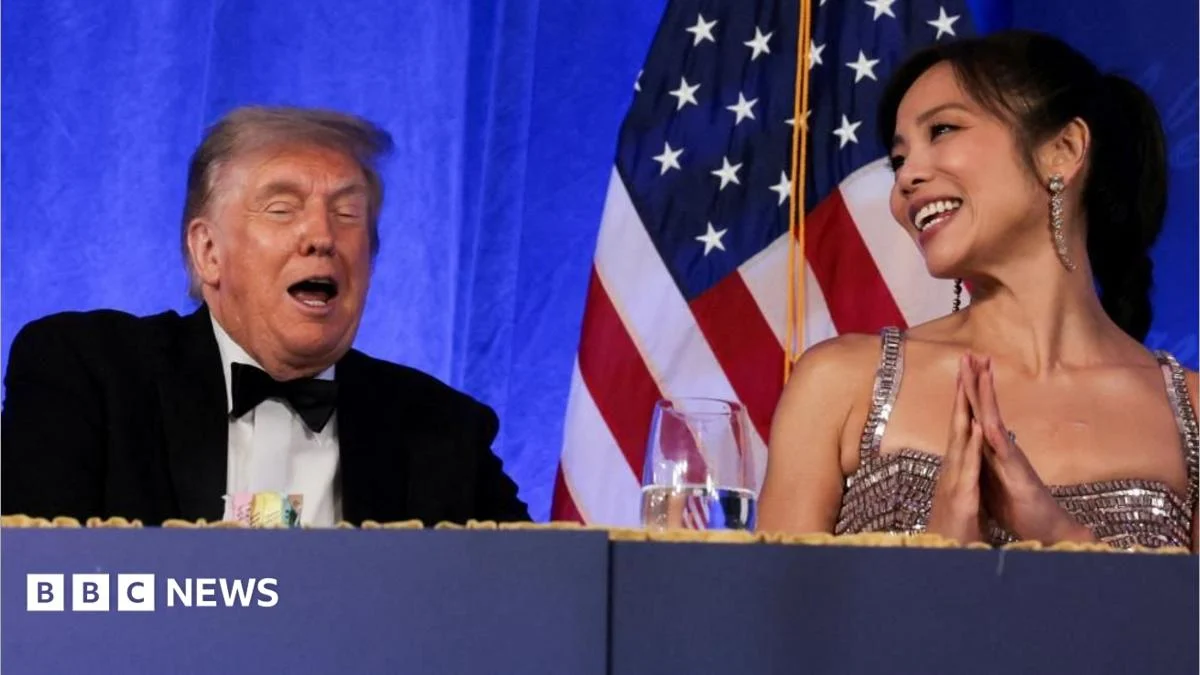
In a night that sought to reaffirm the bedrock principles of a free press, United States President Donald Trump found himself at the White House Correspondents’ Association (WHCA) dinner, a significant gathering that, three months prior, had been abruptly halted by a violent act. The atmosphere was a complex blend of solemn commemoration and sharp political theater, as reporters from outlets with whom the President has frequently engaged in public disputes and even legal battles, including the New York Times, CNN, and the Wall Street Journal, ascended to receive accolades for their journalistic endeavors. The resilience of the press corps was a palpable undercurrent, underscored by the outgoing WHCA head’s powerful declaration: "I would refuse to let an act of violence have the final word," a direct reference to the gunman who had been apprehended at the initial April event.
However, the somber remembrance of that traumatic incident quickly gave way to a more familiar dynamic. President Trump, known for his combative relationship with much of the media, unleashed a series of pointed remarks, leveling accusations of "fake news" and diagnosing many of the assembled journalists with what he termed "Trump Derangement Syndrome." This rhetorical volley set a distinct tone for his address, contrasting sharply with the expected somber reflection on the importance of a free press. Yet, even amidst these barbs, there were moments of unexpected conciliation.
WHCA President Weijia Jiang of CBS News, in her own remarks, projected a forward-looking message, announcing that the association would indeed return to the site of the April shooting, the Washington Hilton, for its next annual dinner, signaling a commitment to overcoming the fear instilled by the attack. A particularly poignant moment arrived when President Trump recognized and honored Officer Victor Gonzalez of the U.S. Secret Service. Officer Gonzalez had been shot during the April incident and was presented with an award by the President for his courageous actions on that harrowing night. This gesture, a direct acknowledgment of bravery in the face of danger, offered a counterpoint to the President’s more critical commentary.
The President also took the stage to acknowledge and shake hands with other award recipients. Among them was a team from The Wall Street Journal, recognized for their in-depth coverage of President Trump’s past associations with the disgraced financier Jeffrey Epstein. This particular award highlighted the press’s role in holding powerful figures accountable, a function that often puts them at odds with those in power.
Leading up to the dinner, a significant segment of the White House press corps had anticipated a particularly harsh critique from President Trump. Given his history of publicly denouncing many of the reporters present, and his frequent use of social media to label unfavorable coverage as "fake news" or biased, the expectation was a stern rebuke. The unusual circumstances of the rescheduled event, coupled with the lingering trauma of the shooting, had created an environment ripe for such speculation.
However, President Trump’s remarks at the dinner proved to be more nuanced than many predicted. While his characteristic criticisms were present, they were interspersed with moments of apparent cordiality and even conciliation. He began by acknowledging the significance of the rescheduled event, stating, "As I said three months ago, the show must go on." He then offered a somewhat softer stance on the media, observing, "the second time is always better," and adding a touch of humor by suggesting that he respects "most of them." This unexpected blend of geniality and sharp wit defined his address.
The President further underscored the importance of open discourse, calling on Americans to uphold the principle of freedom of speech. "We settle our differences not with bullets, but with open and vigorous debate," Trump declared, a sentiment that resonated deeply given the context of the evening. He continued, "And no deranged loser with a gun will ever change that. We can’t let that ever happen." This statement served as a direct repudiation of the violence that had disrupted the previous event, framing the press dinner as a symbol of democratic resilience.
Throughout the event, President Trump appeared to be in an amiable mood. He engaged in lighthearted banter, humorously telling the assembled journalists, "sometimes I really do think that some of you don’t like me." This self-aware quip was followed by his more pointed observation: "This place [the dinner] is really the largest group of ‘Trump derangement syndrome’ people ever put together at one time." He then added a playful, yet potentially barbed, remark: "I suspect some of you are lucky that our last dinner was cut short…I was going to go after you." This moment encapsulated the dual nature of his presence at the dinner – acknowledging the gravity of the occasion while simultaneously indulging in his well-established adversarial relationship with the press.
The rescheduled dinner was a considerably more subdued affair than its April predecessor. Approximately 700 people were in attendance, a stark contrast to the more than 2,000 guests who were present for the initial event. Security measures were also significantly heightened, reflecting the lingering concerns following the shooting. Several blocks surrounding the hotel were cordoned off, with a substantial presence of police and National Guard personnel. Attendees underwent a rigorous screening process, involving two separate checks, requiring the presentation of QR codes and identification, and culminating in the issuance of wristbands. At one point, guests were directed to walk in a single file line past two Secret Service officers armed with rifles, a visual reminder of the security protocols in place.
The suspect in the April shooting, identified as 31-year-old Cole Tomas Allen, faces serious charges, including attempting to assassinate the President of the United States. He was apprehended by agents just moments before reaching a staircase that led down to the ballroom where the dinner was scheduled to commence. The swift action of the Secret Service agents undoubtedly prevented a potentially catastrophic event.
The distinguished guest list at the Saturday night dinner included several high-ranking administration officials, underscoring the event’s significance within the political landscape. Among those present were Defense Secretary Pete Hegseth, acting Attorney General Todd Blanche, FBI Director Kash Patel, Treasury Secretary Scott Bessent, and Commerce Secretary Howard Lutnick. Their attendance signaled a unified front from the administration in supporting the press corps and condemning the violence that had threatened it.
The WHCA dinner, historically, serves as a platform for the President to engage with the White House press corps in a less formal setting, often characterized by a mix of humor and policy discussion. However, the events of April cast a long shadow over this year’s gathering. The shooting at the initial dinner, which left several people injured, sent shockwaves through Washington D.C. and raised profound questions about the safety of journalists and the broader implications for free speech and open discourse. The fact that the dinner was rescheduled and proceeded, despite the heightened security and the palpable memory of the violence, was a testament to the determination of both the White House Correspondents’ Association and the administration to not let such an act of terror dictate the future of journalistic engagement.
President Trump’s decision to attend and speak at the rescheduled dinner was itself a significant political statement. His frequent criticisms of the media have often been interpreted as an attempt to undermine public trust in journalistic institutions. However, his presence and his acknowledgment of the importance of free speech, even while engaging in his characteristic "fake news" rhetoric, presented a complex picture. It suggested a recognition, however reluctant, of the vital role the press plays in a democratic society, even when that role involves scrutinizing and challenging those in power.
The juxtaposition of President Trump’s playful jabs and his more serious pronouncements on the importance of open debate highlighted the ongoing tension between the President and the press. While he may have used the occasion to further his own narrative and critique his perceived adversaries, he also, in his own way, participated in a ritual that affirms the fundamental principles of American democracy. The fact that the event proceeded, with journalists from various outlets being honored, and the President himself acknowledging their work, albeit with his characteristic flair, represented a victory for resilience and a commitment to the ideals of a free and unfettered press. The rescheduled dinner, therefore, was not just a social event; it was a powerful symbol of the enduring spirit of journalism in the face of adversity, a spirit that President Trump, despite his criticisms, ultimately did not seek to extinguish, but rather to engage with on his own terms. The increased security, the subdued attendance, and the lingering memories of the violence all served as stark reminders of the challenges faced by journalists today, but the successful continuation of the WHCA dinner offered a hopeful message: that the pursuit of truth and the freedom to report it will persevere.
